Get Full Government Meeting Transcripts, Videos, & Alerts Forever!
Get email alerts on the Energy Renewables topic
No spam. Unsubscribe anytime.
Commission adds solar-farm rules to land use code; limits ground arrays to agricultural zones
Summary
The commission approved a land use code amendment establishing definitions, design standards and decommissioning rules for solar farms (ground-mounted arrays larger than 10 acres), allowing them with conditions in agricultural zones while preserving industrial land for other uses.
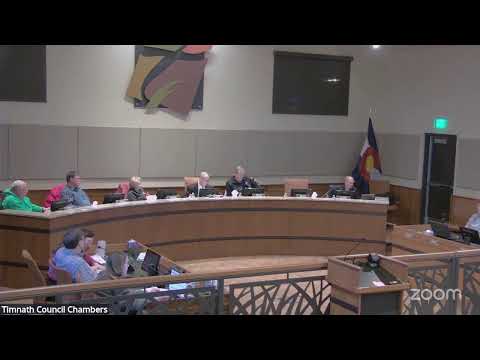
The Timnath Planning Commission voted 5-0 to adopt a land use code amendment creating regulations for utility-scale solar farms and ground-mounted arrays 10 acres or larger.
Staff said the town previously had no code provisions for solar power generation infrastructure; the amendment adds definitions, siting and setback requirements, height limits, safety and monitoring requirements, landscaping/buffering standards and decommissioning/site-restoration rules. Staff said the proposed approach draws from other Colorado counties and is tailored to Timnath, where agricultural zoning was identified as the most appropriate place for larger ground-mounted solar farms given limited industrial land.
Logan (staff) told the commission the amendment would regulate solar arrays 10 acres and larger and would permit those installations in the Agriculture zone with conditions. Staff said the town considered industrial zones but avoided tying up limited industrial acreage with long-term land banking by solar projects. The proposed code also preserves the ability to place rooftop solar on industrial buildings and elsewhere; staff clarified rooftop or building-mounted solar would still be allowed under separate rules.
Commissioner Tom Wood, who led much of the discussion, urged careful attention to decommissioning, hazardous-material handling and the electrical interconnection point for any proposed farm to avoid later demands for high-voltage transmission corridors. Wood also suggested restricting use of irrigated, highly productive farmland — a preference several commissioners noted by pointing to Weld County rules that limit solar conversion on irrigated agriculture.
Commissioner Michael Lowry asked about inspections and hazardous-material reporting. Staff and other commissioners noted that state agencies such as the Colorado Department of Public Health and Environment (CDPHE) and the Public Utilities Commission have regulatory authority over certain safety and hazardous-material issues and that the town would incorporate monitoring/reporting requirements and annual reporting obligations in the site-plan process.
A motion to approve the proposed solar energy facilities amendment carried on a 5-0 vote. Commissioners asked staff to continue clarifying buffering/landscape language so plantings do not shade panels, and to consider protections for irrigated farmland in future comprehensive-plan work.