Get Full Government Meeting Transcripts, Videos, & Alerts Forever!
Get email alerts on the Construction Hours topic
No spam. Unsubscribe anytime.
Boynton Beach directs staff to draft ordinance limiting overnight construction near homes after residents' complaints
Summary
After months of complaints from Monterey residents about late-night concrete pours and other construction noise, the City Commission directed staff to draft an ordinance narrowing allowable construction hours for work close to residential buildings and to remove administrative exemptions except for emergencies.
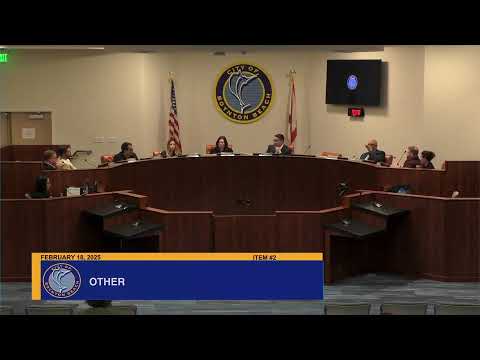
Boynton Beach City Commissioners on Feb. 18 directed staff and legal counsel to draft a new ordinance restricting overnight construction near residential buildings and to return with a proposed code amendment for future consideration.
The move followed sustained public comment from residents of Lake Monterey and other neighborhoods who said heavy construction at a nearby industrial site produced loud concrete pours, grinding and vibration in the middle of the night — in some instances between midnight and 4 a.m. "I had headaches and a hard time breathing for more than six weeks," resident Beth Sanzone told the commission. "Trucks beeping all day long … cement pours from midnight to 4AM when residents are sleeping just 25 to 40 feet from where those pours are happening." Another resident, Amelia, said the last eight months had been intolerable: "We're living through hell. We need relief now."
Staff presented a comparison of nearby cities' construction/noise rules and summarized the city’s current practice: a noise-based ordinance that allows construction Monday through Saturday, 7 a.m.–11 p.m., with Sundays and major holidays prohibited. Building-permit holders can apply for a noise-mitigation waiver that includes a contractor-submitted plan (site access, truck staging, lighting oriented inward, notice to police and building departments prior to early concrete pours, use of white-noise backup alarms, and flaggers when alarms are disabled). Building inspection staff said that on the current project the contractor has used vibration sensors and provided police details for some pours; the sensors, however, are owned and operated by a subcontractor, not the city.
Commissioners expressed support for changing the permitted hours for construction that is adjacent to residences and asked staff to return with draft ordinance language. Commissioner Cruz sought an absolute prohibition on after-hours work for any construction within a set distance "from building-to-building" and asked staff to recommend that buffer. "I do not think it’s fair for any resident to have to be awake from the hours of midnight to 4 in the morning," Commissioner Cruz said during the discussion. Several colleagues backed limiting start times and earlier evening quiet hours; one proposal discussed was 8 a.m.–8 p.m. Monday through Friday and 9 a.m.–8 p.m. on Saturday, with Sundays still prohibited.
Staff and the city attorney were asked to prepare a draft that: (1) models hours and residential/commercial distinctions on ordinances like Doral’s; (2) defines the distance threshold (building-to-building) that will trigger the stricter hours; (3) preserves narrowly defined emergency exceptions (utility outages, public safety), and (4) eliminates routine administrative waivers authorizing overnight work within that buffer. Commissioners also asked staff to analyze enforcement implications (how noise and vibration measurements will be collected, and whether the city should own monitoring equipment rather than rely on contractor‑paid subcontractors).
The commission did not adopt an ordinance at the meeting; instead it gave clear direction to staff and legal to prepare draft regulatory language and bring it back for formal consideration. Commissioners signaled support for accelerating the process and for convening future hearings so residents can comment on the draft before final action.