Get Full Government Meeting Transcripts, Videos, & Alerts Forever!
Get email alerts on the Housing Pilot James Place topic
No spam. Unsubscribe anytime.
Board approves PILOT for James Place Apartments to preserve 16 deeply affordable units
Summary
The Board of Estimates approved a 40-year payment-in-lieu-of-taxes agreement for James Place Apartments in the Bromo Arts & Entertainment District; city staff said the PILOT — the only city subsidy in the project — makes 16 units affordable at 50% AMI possible and yields an estimated annual payment of about $34,000.
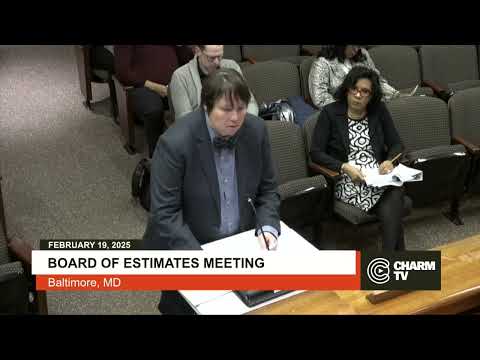
The Board of Estimates on Feb. 19 approved a payment‑in‑lieu‑of‑taxes (PILOT) agreement between AMCP Franklin LLC and the mayor and city council of Baltimore to support James Place Apartments, a 68‑unit residential project in the Bromo Arts & Entertainment District.
The payment was presented by Alice Kennedy, Housing Commissioner, Baltimore City Department of Housing and Community Development, who said the property includes 42 newly constructed units and 26 existing units, for 68 total. “The estimated pilot payment is just over $34,000 for the year,” Kennedy said, and she told the board the PILOT is the only city subsidy for the project.
Kennedy said 16 of the 68 units will be reserved for households at 50% of area median income (AMI) or below, 37 units at 80% AMI, and 15 units at market rate. Finance staff reviewed the developer’s financials and concluded the PILOT was necessary to make the numbers work, Kennedy said.
Council members asked about the PILOT term and location. Councilman Zach Blanchard confirmed the deal runs 40 years. President Zeke Cohen and board members discussed the PILOT’s role in encouraging projects in downtown neighborhoods close to transit and jobs; Kennedy and other panelists said tax incentives and other subsidies often are needed to create mixed‑income projects in high‑cost areas.
A motion to approve the PILOT was moved and seconded; the board approved the item by voice vote.
The PILOT covers property addresses including 418 North Howard Street and parcels on West Franklin; the city’s Finance Department reviewed and supported the proposed annual payment. The board did not approve additional city subsidies for the project beyond the PILOT.
Looking ahead, leasing of the newly renovated units will follow standard permitting and leasing processes managed by the developer and monitored by DHCD.