Get Full Government Meeting Transcripts, Videos, & Alerts Forever!
Get email alerts on the Public Art topic
No spam. Unsubscribe anytime.
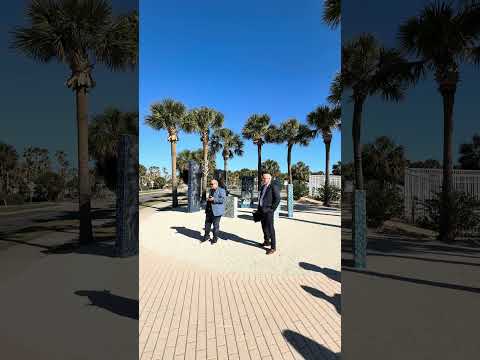
Jacksonville Beach proclaims Xavier Cortada Day as city unveils Water Columns sculpture
Summary
Jacksonville Beach officials formally unveiled the Water Columns sculpture by artist Xavier Cortada, proclaimed February 18 as Xavier Cortada Day and said a bronze plaque and QR code with educational material will be added soon as part of the city—s public art master plan.
Mayor Christine H. Hoffman of the City of Jacksonville Beach formally proclaimed February 18 as Xavier Cortada Day during a dedication ceremony for the Water Columns sculpture and highlighted plans for a bronze plaque and an informational QR code to accompany the installation.
The proclamation capped remarks at the downtown unveiling, which city officials said is the first sculpture installed under the Jacksonville Beach Public Art Master Plan launched by the Community Redevelopment Agency in 2017. The sculpture, created by artist Xavier Cortada, is intended to represent ocean zones from shoreline to the Blake Plateau and to provide an educational entry point about nearby marine ecosystems.
Mayor Christine H. Hoffman read the proclamation and said the city "do[es] hereby proclaim February 18 as Xavier Cortada Day." The mayor also noted the project came to the city through the recommendation of the Public Art Advisory Committee and the Community Redevelopment Agency and that a bronze plaque will be placed at the sculpture in the coming days.
Xavier Cortada, the artist, described the piece as an invitation to engage with the ocean and local ecology and to serve as an educational tool. "Jacksonville Beach is the entry point to this whole world, this underwater world, full of excitement and science and discovery," Cortada said, urging local stewardship of habitats from seagrass beds to deep coral communities on the Blake Plateau.
Adam Roberti, executive director of the Cortada Foundation, said the foundation worked with the Natural Resources Defense Council to develop content that will be accessible through the plaque and QR code. "When I learned about Xavier's work, I was incredibly inspired because I felt like he was innovating and doing something that most people were not doing," Roberti said, describing the goal of using interactive public art to spark curiosity and environmental learning.
City officials said the installation is part of a broader public-art effort that so far has produced two mural projects downtown and that the Water Columns is the first freestanding sculpture under the master plan. Cortada and staff recognized Michael Gray, a collaborator who helped install the piece, and noted parts of the installation process involved local contractors and volunteers; Cortada said some work occurred "during a hurricane," reflecting the project's long timeline.
Organizers plan to add a bronze plaque and a QR code linking to educational materials about the sculpture's organisms and marine zones; city staff and the Cortada Foundation were identified as contacts for teachers or groups wanting to connect with related programming. The ceremony included brief remarks from council members Greg Sutton and John Wagner and acknowledgment of former council member Fernando Meza, who the mayor said "was here when this whole project started as a council member."
The dedication was presented as a ceremonial recognition and educational initiative; no legislative vote or funding action was recorded in the transcript. The Community Redevelopment Agency and the Public Art Advisory Committee were credited for the project's development and selection process.
A reception with light refreshments followed the formal remarks, and organizers invited attendees to view the piece up close and use the QR code once the plaque is installed.