Get Full Government Meeting Transcripts, Videos, & Alerts Forever!
Get email alerts on the Zoning Rv Mini Barn Regulation topic
No spam. Unsubscribe anytime.
Bedford County commission approves zoning changes to regulate RVs and "mini‑barn" dwellings
Summary
Bedford County commissioners on an unanimous voice vote approved amendments to the county zoning resolution that add temporary‑use regulations and definitions aimed at regulating recreational vehicles (RVs), ready‑removables and small storage buildings often called "mini‑barns" when used as dwellings.
Bedford County commissioners on an unanimous voice vote approved amendments to the county zoning resolution that add temporary‑use regulations and definitions aimed at regulating recreational vehicles (RVs), ready‑removables and small storage buildings often called "mini‑barns" when used as dwellings.
The changes, which amend Article 2 (temporary use regulations) and Article 7 (definitions) of the Bedford County Zoning Resolution, give the zoning office explicit authority to issue temporary zoning permits, set renewal limits and define categories of nonstandard dwellings so staff can work with occupants to bring units into compliance rather than rely solely on building‑code enforcement.
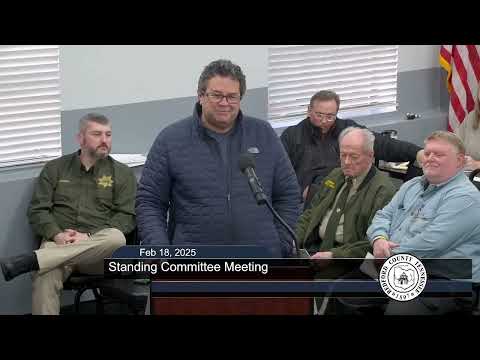
Director Chris Watts, who explained the proposal to the commission, said the amendments are intended to address structures that fall outside residential building codes — for example, backyard storage buildings converted to living space or RVs used as permanent homes. "These are new regulations that deal with people buying, like, mini barns at Lowe's and converting them to residences," Watts said. He added the rules would give zoning staff flexibility to issue temporary permits for persons living in an RV while a house is under construction and to allow limited renewals when construction is delayed.
The measure was prompted in part by public and staff concerns about public‑health risks from uninspected dwellings: commissioners cited cases where septic systems were failing and where occupants could be medically vulnerable. "The building codes department's only remedy was to call Duck River and have the power shut off," Watts said, arguing zoning has more tools for staged transitions.
Commissioners tested the boundaries of the policy. One commissioner asked whether the rules would prohibit a homeowner from living in their own camper for extended periods and noted common scenarios such as students living near a family home or homeowners occupying an RV while constructing a house. Watts said the draft includes exceptions and temporary permits for construction and limited medical circumstances, but that living in an RV as a permanent, unchecked dwelling is already a violation of adopted building codes and that the zoning change aims to regulate such cases "in a more humane manner."
The commission also heard an extended explanation of the county's distinction between campgrounds (A1) and RV parks (C1). Watts said RV parks are regulated more intensively — with requirements for roads, wastewater and other infrastructure — and that a recent long‑running RV park proposal highlighted ambiguous language in the existing resolution about where RV parks are allowed. He said the planning staff intended to send one matter back to the Board of Zoning Appeals for reconsideration because the application route taken initially (as a campground in A1) differed from how the commission's regulations address commercial RV parks.
The commission approved the zoning amendment after discussion. Commissioners and staff said additional, more detailed regulations may follow as the county learns from implementation and from specific permit applications.
The amendments as approved will be enforceable through the county zoning process; commissioners said they expect to refine the rules further and to add language addressing RV park extensions and enforcement timing in coming months.