Get Full Government Meeting Transcripts, Videos, & Alerts Forever!
Get email alerts on the Economic Development topic
No spam. Unsubscribe anytime.
Growing Victoria report: new businesses and workforce training, but housing and population gaps limit retail growth
Summary
Economic development staff recapped retail recruits, workforce training wins and downtown reinvestment while emphasizing a shortfall in housing and population growth that limits retail expansion; staff proposed more resources for business retention and mixed‑income housing initiatives.
Danielle, economic development staff, and Kate, downtown/Main Street coordinator, presented the Growing Victoria FY2024 annual report to the council on Tuesday, listing recent business openings, workforce‑training outcomes, downtown reinvestment and persistent housing shortfalls.
Danielle described Growing Victoria’s five focus areas — retail recruitment, small-business development, quality of life, workforce development and housing — and listed primary retail openings during the year, including Longhorn Steakhouse, Crumble Cookie, Stir Soda (an expansion from downtown), Franklin’s Backyard Bayou, Speedy Stop Liquors and several convenience-store entries. She credited local incentive coordination with the Victoria Sales Tax Development Corporation for some placements.
On workforce development, Danielle said the city supported a high‑demand job training grant through the Texas Workforce Commission that helped fund Midcoast Construction Academy; the academy recruited 76 students in the period. She called the academy and related apprenticeship programs in HVAC, electrical and plumbing “a huge success” and urged continued support of education partners (Victoria College, UHV, BISD) and training programs.
Kate reviewed downtown metrics under the city’s Main Street program and the downtown master plan. She said roughly 62% of master‑plan projects have been completed or are ongoing and that downtown reinvestment mixes private, public and partnered funds. Kate reported about 2,200 jobs within Main Street boundaries, a net gain of two full‑time positions and about 16 part‑time positions, 7 new downtown openings and 14 closures during the year; plaza bookings totaled 839 events in the April–Sept period after plaza expansion.
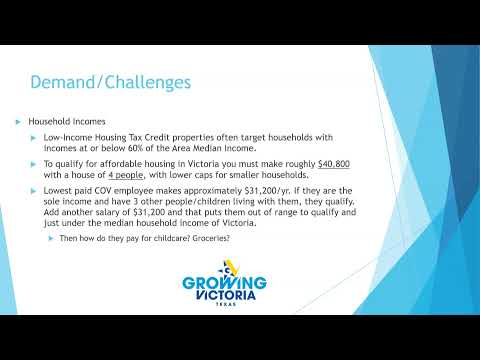
Housing was the most urgent constraint noted. Danielle said the city facilitated the Enchanted Gardens affordable complex (168 units) and expects two senior housing projects — Fish Pond at Victoria (75 units) and the Victorian on John Stockbier (68 units) — to increase options. The Victorian project is a nine‑percent tax‑credit senior development with an estimated $14 million development cost; the Housing Finance Corporation provided a $500,000 loan and staff projected $130,394 in annual tax revenue once completed.
Danielle said market indicators show constrained supply and affordability: a median single‑family sale price of about $226,000 (down 8.5% year‑over‑year), 37 homes sold in the year, 69 median days on market, 308 homes listed for sale and only 32 new homes built in the fiscal year. She said about 40% of housing units are renter‑occupied, and that some income tiers fall between eligibility for tax‑credit affordable units and market‑rate housing, creating a “missing middle.”
Danielle emphasized the staff capacity problem for a city-level business‑retention and expansion (BRE) program: city records show about 3,543 small businesses (50 employees or fewer) across roughly 30,000 jobs; a meaningful BRE outreach program would require several thousand staff hours to visit and assess local businesses. “What it all boils down to is time, money, and people,” Danielle said.
Council members praised workforce training outcomes and asked staff to continue aligning education and training with employer needs. Staff recommended continued incentives for targeted recruitment, expanded support for the BRE program if resources allow, and incentives or programs to encourage residential development and infill housing to support downtown and retail vitality.