Get Full Government Meeting Transcripts, Videos, & Alerts Forever!
Get email alerts on the Traffic And Traffic Safety topic
No spam. Unsubscribe anytime.
Winfield Ridge residents press council for fire gate as city staff outline traffic-monitoring plan for Thule/Toole development
Summary
Residents of Winfield Ridge urged the Newcastle City Council to require a fire gate to block cut-through traffic from a new subdivision. City staff described a hearing-examiner condition requiring the developer to fund a traffic monitoring plan and said a final decision on a gate will wait for that study and further cost and design details.
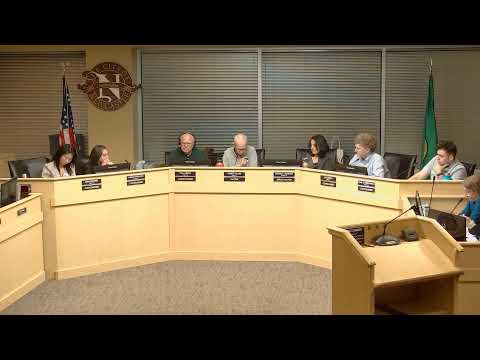
Dozens of Winfield Ridge residents asked the Newcastle City Council on Feb. 18 to install a fire gate on Southeast 80th Street to prevent new subdivision traffic from turning their cul-de-sac into a through route.
The request followed a staff presentation about a condition the hearing examiner attached to preliminary plat approval for the project (referred to in agenda materials as the Thule/Toole or “A Hundred and Thirteenth Newcastle” development): the applicant must prepare a traffic-monitoring plan, subject to City Public Works approval, “to gauge whether the connectivity creates any appreciable amount of pass-through traffic from travelers who don't live in the vicinity,” and fund its proportionate share of any required calming measures.
Why it matters: Residents said neighborhood safety and the ability of children to play in cul‑de‑sac streets are at stake once mapping apps route drivers through the area. Councilmembers and staff said the city must follow the examiner's condition and ensure the monitoring and any mitigation are properly scoped and funded before final plat approval.
Residents' pleas and examples Several residents — including Lisa Johnson of Winfield Ridge and Jeff Johnson, who both spoke during public comment — told council that the new connection will bring app-directed cut-through traffic, speeding and safety risks. Lisa Johnson, Winfield Ridge resident: “With a gate, everyone gets what they want. Fire trucks and ambulances will have access as well as pedestrians and bicyclists. And our neighborhood can keep its current scale and feel.” Jeff Johnson, Winfield Ridge resident: “To me, that [waiting 1 in 3 to 4 years to reevaluate] is ridiculous. Why do we want to wait for a problem when we can resolve it ahead of time?” Several parents and children described the steep grade and limited sight lines on the street and pleaded that a gate or other calming be considered immediately.
Staff presentation and the hearing-examiner condition City staff (Director Bruns and a colleague) summarized the examiner's written condition and the project layout. They said the condition requires the developer to submit a traffic‑monitoring plan before final plat approval and that Public Works will determine whether the developer must post security (a bond) for payment of the developer’s “proportionate share” of mitigation costs. Director Bruns (presenting): read from the condition: “The applicant shall prepare a traffic monitoring plan … The results and the conclusions of the monitoring plan shall be tabulated in a report … The applicant shall fund its proportionate share … Public Works may require security.”
Staff also reviewed trip-generation estimates from Institute of Transportation Engineers (ITE) rates: the project would add about 29 new homes (net) and an estimated 273 daily trips distributed across nearby links, though staff said an origin-destination/trip-distribution analysis is needed to model where peak-direction trips would actually go.
Gate feasibility, timing and cost Staff said a gate is a possible mitigation, but premature to require now for two reasons: (1) the monitoring plan and an origin-destination analysis are needed to quantify “appreciable” cut-through traffic, and (2) the hearing-examiner condition makes the developer responsible for its proportionate mitigation costs; any action taken before the monitoring could obligate the city to pay.
Staff identified practical constraints for gate placement tied to required emergency vehicle turnaround geometry. Staff estimated a gate installation cost informally at about $50,000 but described that as an initial, nonbinding figure. Public works presenter: “At this point it’s premature — we don't know what the traffic study is going to show. Any action taken before the study is concluded would be at the city's cost.”
Council reaction and procedural outcome Councilmembers expressed sympathy for residents and repeated a desire to avoid having taxpayers shoulder the cost. Councilmember Quigg moved to direct staff to install a fire gate at a location west of 100th and 114th Ave SE and to place “Not a through street” signs immediately; the motion was seconded. City Manager: “I'm gonna suggest to the council this is not an appropriate motion. This was not contemplated for action tonight.” The city manager and mayor said the item had been placed on the agenda for discussion (not action) and the council did not take the motion as a formal, noticed action. The mayor said staff will return with additional analysis, gate location/cost estimates and the developer’s response to alternatives.
Next steps Staff said the developer must submit the traffic monitoring plan (staff will require an origin‑destination component). The plat cannot receive final approval until the monitoring plan is approved as required by the hearing examiner’s condition. Staff will also ask the developer to evaluate the council’s suggested alternative (keeping the two existing streets separate) and will return to council with gate cost estimates and a more-detailed schedule for monitoring and review.
Votes at a glance - Motion by Councilmember Quigg to direct staff to install a fire gate at an identified location and post two “Not a through street” signs. Seconded by Councilmember Burford. Outcome: Motion deferred/no action — city manager declared the motion was not appropriate for action at the noticed meeting; council directed staff to return with additional information for a future, properly noticed action.
Ending note Council members and staff told residents they had been heard, repeated that the examiner's monitoring condition remains in force, and committed to returning quickly with additional cost, design and developer-response information before any city-funded work or a final decision on permanent measures.