Get Full Government Meeting Transcripts, Videos, & Alerts Forever!
Get email alerts on the City Management Goals topic
No spam. Unsubscribe anytime.
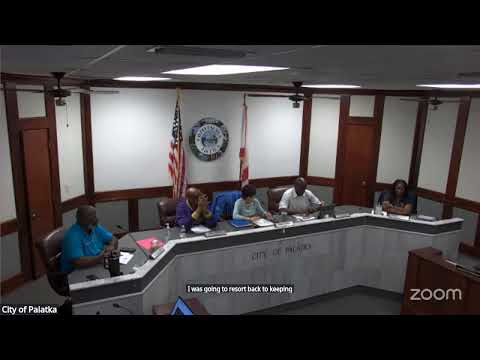
Palatka commissioners refine city manager goals, push for standardized reports and community feedback
Summary
At the Feb. 19 Palatka City Commission meeting, commissioners discussed and revised draft performance goals for the incoming city manager and directed staff to provide standardized, regularly scheduled status reports and an approach for community engagement and evaluation tools.
Palatka City Commissioners on Feb. 19 discussed a draft set of SMART goals for the incoming city manager and instructed staff to return with standardized reporting formats and evaluation tools to hold the manager accountable.
The discussion centered on tying city manager goals to the city’s strategic, comprehensive and Community Redevelopment Area (CRA) plans; creating a regular status report repository; and setting measurable touchpoints for performance evaluation during the probationary period.
Commissioners said they want the city manager to play an active role in producing and implementing a strategic plan. “I was looking for something to drive the goals or where we’re pulling the goals from,” Commissioner Justin Campbell said, noting that a formal strategic or comprehensive plan would give the commission objective targets to assess. Commissioner Boren added that the manager should “play an active role into helping us identify what the strategic plan needs to be.”
Commissioners asked staff to produce a standardized written report that would be delivered on a regular cadence (several commissioners suggested biweekly) and stored in a central data repository so commissioners could access real-time project updates. “A standardized report … could be in a location, especially if we have technology and resources that we’re not using, that we can have a data repository where those reports are expected,” an unidentified commissioner said during the exchange.
The commission also debated performance metrics and timing. Several commissioners recommended using established city-manager evaluation tools, including the International City/County Management Association (ICMA) evaluation templates, and conducting formal performance checkpoints at roughly 180 days and 12 months. Interim City Manager Cardi told the commission staff would collect sample evaluation tools immediately: “I will start I have Avery start looking for the evaluations, this week.”
Community engagement, and how to measure it, was another main topic. Commissioners asked for at least four community forums per year and for a formal mechanism to collect, summarize and act on feedback from forums and any community survey. Commissioner Patricia Davis said she wanted “a performance based approach to address concerns from a community survey and/or community forums” that would include timeframes for follow up.
Police outreach methods were discussed as an example of direct engagement. Assistant Chief Newcomb described informal “talking Tuesdays,” where officers walk neighborhoods and make direct contact with residents, and confirmed those activities are not publicized as a formal survey: “We do not publicize or advertise the talking Tuesdays. We did it first, and it really didn’t seem to make a difference in the number of people that we are able to reach.”
Commissioners raised concerns about relying solely on surveys because low response rates can produce unusable data; they recommended surveys be only one component of a broader community feedback and performance system. The commission asked that staff return with examples of valid, performance‑oriented survey methods and a proposal for a community feedback-to-action workflow that can produce measurable follow-up within set timeframes.
They also discussed training and workplace culture language. A previously drafted goal calling for “quarterly diversity and inclusion training” drew concern that the term “diversity” has, in some grant contexts, affected funding. Commissioners proposed keeping the training requirement but allowing flexible wording for training content so the requirement would be less vulnerable to external funding risk.
By consensus, commissioners asked staff to: (1) gather several city-manager evaluation tools (including the most recent ICMA form) and circulate them to the commission electronically before the next meeting; (2) draft a standardized reporting template that will include project categories, grant/project status and budget-line tracking; (3) propose a schedule for regular reports (several commissioners suggested biweekly updates with written and oral components), and (4) outline an approach for community forums and follow-up communications to residents.
The commission directed the clerk to schedule a follow-up meeting to finalize the evaluation tool and the reporting requirements once the sample tools are distributed.
The exchange produced a list of next steps rather than a final, adopted set of goals; commissioners said the drafts would be refined into a performance appraisal instrument to be signed by the new manager and used for probationary-period and annual reviews.