Get Full Government Meeting Transcripts, Videos, & Alerts Forever!
Get email alerts on the Municipal Finance Payments topic
No spam. Unsubscribe anytime.
Lake City council gets outside legal opinion saying ex‑manager payments were 'ultra vires'; council orders follow‑up review
Summary
Outside counsel told the Lake City City Council the post‑employment separation agreement and three lump‑sum payments to former city manager Paul Bridal were paid without required council approval and exceed handbook caps; council authorized a follow‑up legal opinion and discussion about next steps toward recovery.
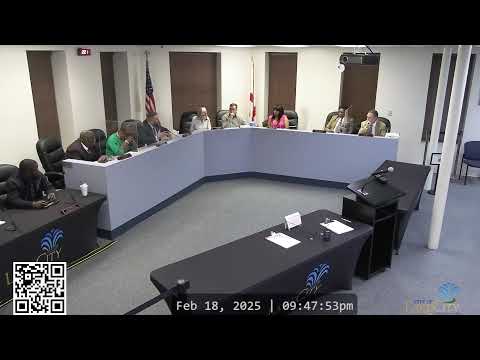
The Lake City City Council on Feb. 18 heard an outside legal opinion concluding that post‑employment payments made to former city manager Paul Bridal were paid without the approvals the city code requires and that portions of the payouts exceeded caps set in the city's personnel manual.
The opinion, delivered in person by Michael Cavendish of Cavendish Partners, said the signed separation agreement and the three lump‑sum payments—16 weeks of salary; a cashout of accrued vacation; and a cashout of accrued sick leave—were processed and paid “without either of those actions being brought before the city council,” and therefore were “ultra vires,” a Latin legal term Cavendish defined in the meeting as “without authority.”
Cavendish told the council the 16‑week salary payment (based on a $150,000 annual salary) amounted to about $46,000 before deductions; that sick‑leave cashout exceeded the city manual's payout cap by roughly $91,000; and that the vacation payout exceeded the manual's limit by about $5,700. He summarized the overpayments as “between $96,000 and $97,000” in total for the two leave payouts above policy caps.
Why it matters: The council’s code and personnel manual prescribe how payouts and post‑employment agreements must be approved, and payments that bypass those procedures may be voidable. Several residents at the meeting urged the council to pursue recovery of the money and examine whether other policy or personnel changes are needed.
Cavendish said the council does have the power to ratify or cure the prior action—meaning the council could later approve a post‑employment payment after the fact—but that in the present matter the separation agreement and the amounts “should have been presented to this council for approval.” He also cautioned that his written opinion was limited to the civil law view he was engaged to give and that he had not found evidence in his review to conclude a crime had been committed.
Council action and next steps The council voted to authorize Cavendish to prepare a supplemental legal opinion that takes into account a November 2024 budget resolution (identified in meeting materials as resolution 2024‑131) and other late documents. Councilwoman Pamela Harris moved the measure; the motion passed on a roll call vote recorded as: Harris — yes; Councilman Carter — yes; Vice Mayor Young — yes; City Attorney Clay Jernigan — no; Mayor Walker — yes. Cavendish said his invoice for the initial written opinion was about $4,000 and that the supplemental review should require fewer hours (he estimated the supplemental work would cost less than the initial opinion).
Public comment, prosecutorial review and government practice Multiple speakers urged the council to pursue the funds and to consider referring the matter to the state attorney for a review of possible criminal conduct; several said the payments had been hidden from the council and should be investigated. Cavendish confirmed he had, “out of courtesy,” provided his written opinion to the local state attorney's office but said he had not been told the state attorney would undertake a criminal probe. Cavendish recommended the council obtain the firmest legal footing before pursuing civil recovery and said the supplemental opinion would examine whether the November 2024 action changes the legal analysis.
The council discussed next steps including forming a small working group to evaluate options and asking staff to gather documents. Several council members said they wanted to weigh the likely legal costs and benefits before deciding whether to file a civil claim, issue demand letters, or pursue other remedies.
Context and closing Cavendish summarized his legal view in four points: the agreement should have been presented to council; the council had the power to approve a 16‑week post‑employment payment but did not do so in this matter; the personnel manual caps limited sick‑leave cashouts and that cap appears to have been exceeded; and the vacation cashout exceeded the manual's limit. The council authorized the limited follow‑up review by Cavendish to examine the November 2024 paperwork and return with guidance on legal options.
The council did not vote tonight to file suit or demand repayment; members said they wanted a clearer factual record and an accounting of costs and legal prospects before deciding how to proceed.