Get Full Government Meeting Transcripts, Videos, & Alerts Forever!
Get email alerts on the Child Welfare topic
No spam. Unsubscribe anytime.
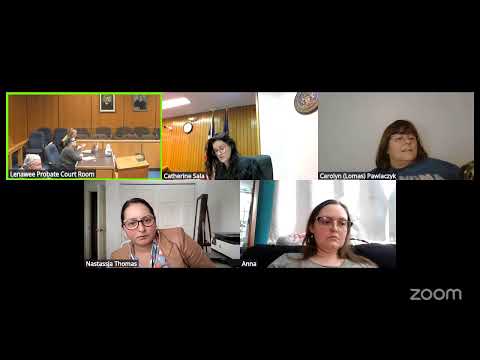
Judge sets dual goal of adoption and reunification, denies increased parenting time in Lenawee County review
Summary
At a permanency review in Lenawee County Probate & Juvenile Court, the judge found the child is safest in foster care, declined to expand the mother's supervised visits, set a dual goal of adoption and reunification, and scheduled the next review for May 12 at 10:30 a.m.
A judge in Lenawee County Probate & Juvenile Court changed the child's permanency plan to a dual goal of adoption and reunification and refused to expand parenting time after a review hearing in which caseworkers and attorneys reported limited progress by both parents.
The ruling follows testimony from the department's caseworker and parenting-instruction providers that the child is meeting developmental milestones in foster care but that the parents have not yet demonstrated the consistent skills or stability the child needs. The court scheduled the next dispositional review and permanency-planning hearing for May 12 at 10:30 a.m.
The decision matters because the court found that, given the child's young age, continuing placement in foster care provides necessary stability while services continue. The judge said the department had met its obligation to make reasonable efforts toward reunification but concluded there was insufficient progress to increase parenting time or return the child now.
Caseworker Ava Copas, who prepared the court report, told the court she observed the child twice during the reporting period and said the foster placement reported the child was "meeting all of his milestones" and that the placement was the "least restrictive and most appropriate" at this time. Copas testified that the department has implemented hands-on parenting education programs for the mother through Orchard Children Services, L and L Parenting (a parenting-aide program), and CBC, and that the mother has also sought mental-health services through CPC/ACPC. Copas said those programs are "very hands on," with instructors working one-on-one and using quizzes and in-person demonstration to try to build skills.
Copas reported ongoing concerns about the mother's ability to complete basic infant-care tasks consistently. She described repeated difficulties with diapering transitions, timely bottle feeding, and with the mother remembering and applying lessons from prior sessions. Copas said the mother's progress had not kept pace with the child's development and that expanding supervised parenting time "would not be in his best interest at this time." Copas also reported a psychological evaluation in the record noting significant cognitive impairment and listed the mother's IQ score, and she described the mother's recent seizure diagnosis.
The child's father, Dakota Harmon Duckworth, testified that he has a new psychiatrist and new medications and said his mood had begun to stabilize. He declined virtual parenting time, citing emotional difficulty when seeing the child remotely, and acknowledged past reluctance to take medication as previously recommended. Copas testified that the father had not shown the three months of documented mental-health stability that the providers recommended and that he has not consistently provided verification from treatment providers.
Guardian ad litem Nicole Underwood and department counsel Sasha Thomas argued the child is safest in foster care and recommended continued supervised services and another review period. Thomas told the court the department had explored a concurrent adoption plan with the caregiver and relatives but remained committed to reunification if sufficient progress is made through the programs. Underwood moved to admit the court report into evidence without objection.
In announcing the decision, the judge said the court found the department had provided reasonable efforts toward reunification and that the child remains in the "safest and least restrictive placement at this time." The judge added: "I will not allow any increase in parenting time, until and unless we see some gains," and then ordered the permanency goal changed to a dual goal of adoption and reunification. The court set the next review and permanency-planning hearing for Monday, May 12 at 10:30 a.m.
The record includes continuing services: Orchard Children Services' 16-week parenting program (ending at the end of the month), six-month interventions from L and L Parenting and CBC, and mental-health services through CPC/ACPC and Lenawee County Community Mental Health (CMH). The judge said the court would revisit whether to pursue adoption-only at the next review if progress remains limited.
The court's orders preserve ongoing hands-on parenting instruction while maintaining the child's placement pending further demonstration of consistent parenting skills and mental-health stability by the parents.