Get Full Government Meeting Transcripts, Videos, & Alerts Forever!
Get email alerts on the Cannabis Policy Out Of State Ownership topic
No spam. Unsubscribe anytime.
Out-of-state ownership of cannabis licenses draws sharp division at committee hearing
Summary
House Bill 19-40 would remove a six-month Washington residency requirement for cannabis business ownership and add a temporary B&O tax exemption for social-equity licensees. Supporters said the change would unlock capital; opponents warned it would enable consolidation and harm small and social-equity businesses.
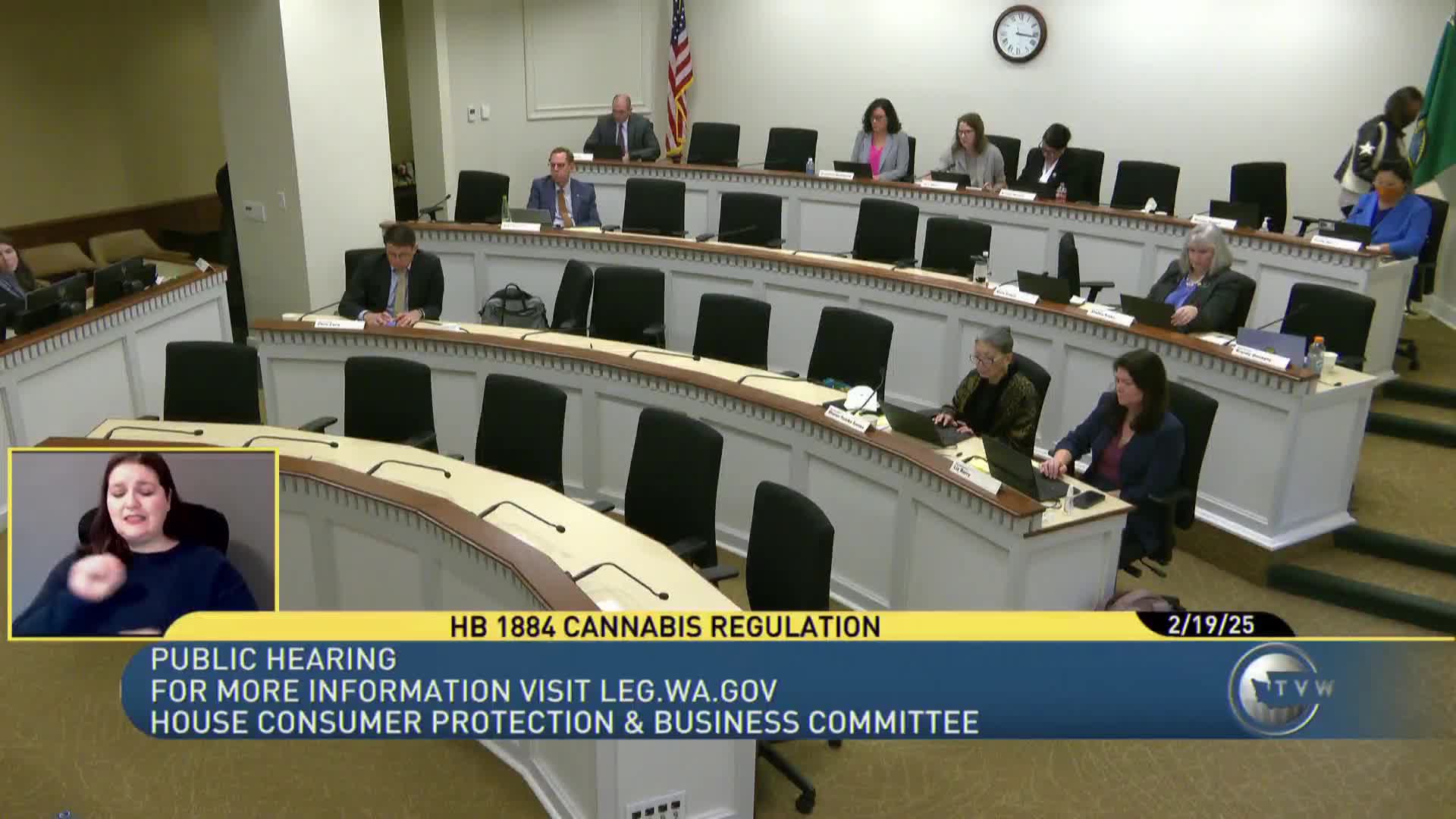
House Bill 19-40, presented Feb. 19 to the Consumer Protection & Business Committee, would authorize nonresident ownership of licensed cannabis businesses by removing a current six-month residency requirement. The bill also permits the Liquor and Cannabis Board (LCB) to impose additional licensing fees to recover investigation costs for nonresidents and would exempt social-equity cannabis producers, processors and retailers from the Business & Occupation (B&O) tax for five years after a licensee first exceeds $5,000 in sales revenue; that tax exemption language would expire on July 1, 2038 under the bill as presented.
Representative Melanie Morgan, the bill’s sponsor, framed the change as a tool to expand capital access for social-equity applicants and small operators who often cannot raise the private equity or loans necessary to open and operate licensed businesses. "One of the most significant challenges is the restriction of out-of-state investment, which has made it nearly impossible for social equity applicants to access capital," Morgan said.
Public testimony split sharply. Supporters argued that the residency restriction has blocked investment needed to make social-equity licenses viable. Paula Sardinas of FMS Global Strategies said international and out-of-state investors are ready to commit capital and pointed to interest from large-scale investors who cannot legally put money into Washington cannabis because of the residency restriction. Persuasive proponents asked for amendments that would allow orderly entry while protecting existing licensees.
Opponents — including multiple long-time Washington licensees and trade groups — warned that permitting out-of-state ownership historically correlates with industry consolidation, price-suppression and closures of smaller businesses. Trent Madsen of the Washington Cannabis Licensee Association said out-of-state capital has driven aggressive consolidation in other states, citing examples where large investors acquired market share rapidly and drove local businesses out of the market. Bethany Rondeau and Justin Rondeau, a Port Angeles producer and processor team, told the committee they had seen production and wholesale pricing collapse in an out-of-state market they know, and urged the Legislature to retain the residency rule.
Other witnesses urged compromise language. Producers’ groups and some industry associations said they were open to time-delayed implementation to give existing operators time to adapt and to add guardrails to prevent rapid consolidation; others pressed for targeted tax or reporting changes that would meaningfully support social-equity operators without removing residency protections.
Additional concerns raised in committee: the Department of Revenue informed the committee that the current bill text did not compel registration in a way that would yield a revenue estimate; the department and staff flagged drafting issues related to taxation, zoning implications, and investigation cost recovery language. Several witnesses urged the sponsor to consider implementation delays, license caps or anti-consolidation protections.
The committee heard substantial testimony but did not hold a final vote on House Bill 19-40 on Feb. 19.