Get Full Government Meeting Transcripts, Videos, & Alerts Forever!
Get email alerts on the Health Policy Committee Action topic
No spam. Unsubscribe anytime.
House Health Care & Wellness Committee advances prior-authorization reforms, ambulance billing limits, co-responder and birthing-center measures
Summary
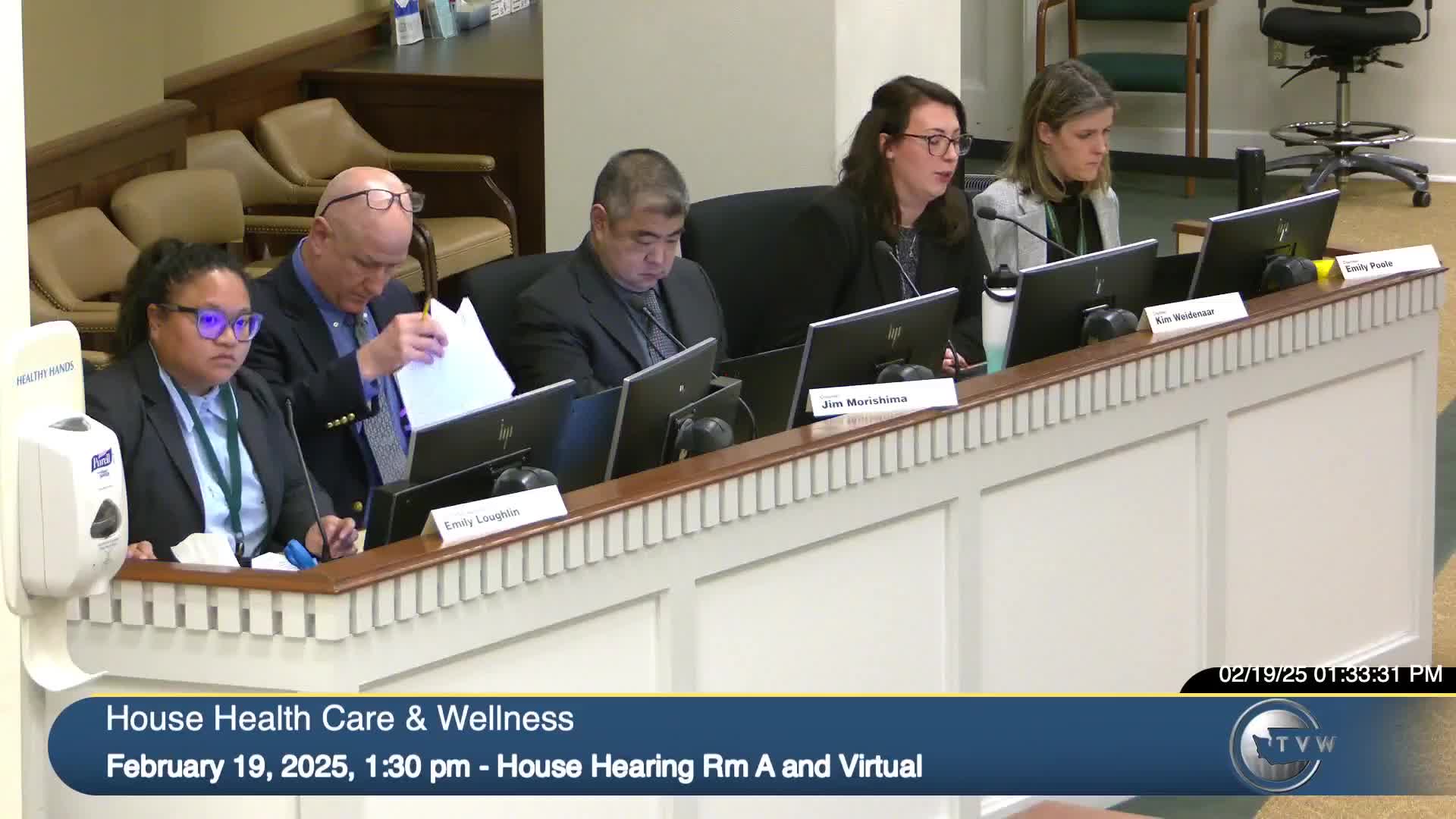
In an executive session Feb. 19, the House Health Care & Wellness Committee voted to report several health-care bills out of committee with due-pass recommendations, including measures on prior authorization, ambulance billing after motor vehicle collisions, co-responder definition and birthing-center inspections.
The House Health Care & Wellness Committee on Feb. 19 voted to report multiple health bills out of committee with due-pass recommendations, advancing measures addressing prior authorization processes, ambulance billing after motor-vehicle collisions, co-responder definitions and birthing-center inspection rules.
The committee voted to advance a package of prior-authorization reforms (House Bill 15 66, proposed substitute H1472.2) that changes notice, reporting and AI-use requirements for health plans and clarifies which third-party administrators the rules cover. Representative Ruhl, speaking for supporters, called H1472.2 “a big bill with a lot of parts” and said work remains on a few carrier concerns ahead of the floor. Representative Marshall, speaking as a provider, said some members would remain mixed but that the substitute “is better” than the underlying language.
The committee also advanced related prior-authorization technology and timing bills: House Bill 17 06 (proposed substitute H1474.1), which sets the state enforcement date for prior-authorization APIs to Jan. 1, 2027 regardless of future federal CMS rule timing; and provisions in the H1472.2 substitute that change reporting timelines, the scope of information carriers must provide with determinations, and definitions for artificial intelligence and generative AI used in prior-authorization systems.
On ambulance billing, the committee advanced substitute language for House Bill 11 87 (proposed substitute 1462.1) that removes a requirement that ambulance providers attempt to collect insurance information during transport or within 60 days after motor-vehicle-accident transports. Instead, the substitute prohibits ambulance services from selling or assigning medical debt for ambulance transports following motor-vehicle accidents for at least 120 days after the initial billing statement and authorizes the insurance commissioner to share information with the Department of Health if there is cause to believe the provider engaged in a pattern of unresolved violations. The mover argued the substitute would “offer some consumer protections” and help the state identify problematic patterns.
The committee approved changes to the scope of practice for certain radiologic technologists (House Bill 15 46, proposed substitute H1506.2), allowing specified technologists to perform intravenous contrast procedures under a clarified definition of “general supervision” that requires an appropriately trained licensed practitioner to be on site and available for consultation.
On behavioral health and workforce supports, the committee moved House Bill 17 18, which updates protections for physician well-being programs, adjusts the written/contracted requirements for programs, and expands the types of discussions covered by privilege. Representative Tai and others described the bill as addressing provider burnout and career fatigue.
Law-enforcement and crisis response policy also advanced. House Bill 18 11 was amended to remove a requirement that the University of Washington develop a statewide internal peer program and to narrow the statutory definition of co-response by removing follow-up activities such as case management and transportation from the definition. Supporters said the changes clarify the expected role of co-responders while preserving the program’s intent.
The committee adopted an amendment to House Bill 18 24 to align standards and timelines for inspection and accreditation of birthing centers with comparable facilities; the amendment extended the acceptable accreditation on-site survey window to 36 months and required the Department of Health to compare accrediting body standards to state rule and statute when making substantial equivalency determinations.
Votes at a glance
- Substitute House Bill 11 87 (ambulance billing after motor-vehicle accidents; proposed substitute 1462.1): reported out of committee with a due-pass recommendation; tally announced as 19 ayes, 0 nays. - Substitute House Bill 15 46 (radiologic technologists and IV contrast; proposed substitute H1506.2): reported out of committee with a due-pass recommendation; tally announced as 19 ayes, 0 nays. - Substitute House Bill 15 66 (prior authorization reforms; proposed substitute H1472.2): reported out of committee with a due-pass recommendation; roll-call tally announced as 17 ayes, 2 nays (members recorded individually during the roll call). - Substitute House Bill 17 06 (prior-authorization API timing; proposed substitute H1474.1): reported out of committee with a due-pass recommendation; tally announced as 19 ayes, 0 nays. - Substitute House Bill 17 18 (physician well-being program updates): reported out of committee with a due-pass recommendation; tally announced as 19 ayes, 0 nays. - Substitute House Bill 18 11 (co-responders; adopted amendments Blake 207 and Blake 211 rolled into substitute): reported out of committee with a due-pass recommendation; tally announced as 19 ayes, 0 nays. - Substitute House Bill 18 24 (birthing-center inspection and accreditation clarifications; pool 111 adopted): reported out of committee with a due-pass recommendation; tally announced as 19 ayes, 0 nays.
Why this matters
The prior-authorization measures change plan and vendor obligations for notifying providers and patients, how plans may use automated tools in approval or denial decisions, and the timeline for implementing technical APIs tied to federal rules — changes supporters said aim to reduce friction and inconsistent treatment approvals. The ambulance-billing substitute places a temporary restraint (120 days) on assigning medical debt for ambulance transports after motor-vehicle accidents and creates an information-sharing path between the insurance commissioner and Department of Health to identify patterns of noncompliance.
What the committee did not decide
The committee reported each bill out with a due-pass recommendation; the floor may see additional amendments, particularly on the large prior-authorization bill where carriers indicated there could be anticipated exceptions brought as floor amendments.
Who spoke and recurring concerns
Supporters stressed consumer protections and workforce implications (particularly for rural care access and provider burnout). Carriers and some provider representatives signaled outstanding concerns on prior-authorization implementation and oversight, and members noted further discussion may occur before floor action.
Next steps
All reported bills will proceed to the full House for further consideration; sponsors and stakeholders indicated several items may receive additional floor amendments before a final chamber vote.