Get Full Government Meeting Transcripts, Videos, & Alerts Forever!
Get email alerts on the Organics Food Waste topic
No spam. Unsubscribe anytime.
Substitute bill updates organics program: new bin colors, labeling, outreach and penalties for certain business noncompliance
Summary
Substitute House Bill 1497 would standardize colors and labeling for solid waste collection bins, fund contamination‑reduction outreach, require lists of businesses subject to organics requirements and add penalties for business noncompliance; Ecology and industry witnesses supported the bill with implementation caveats.
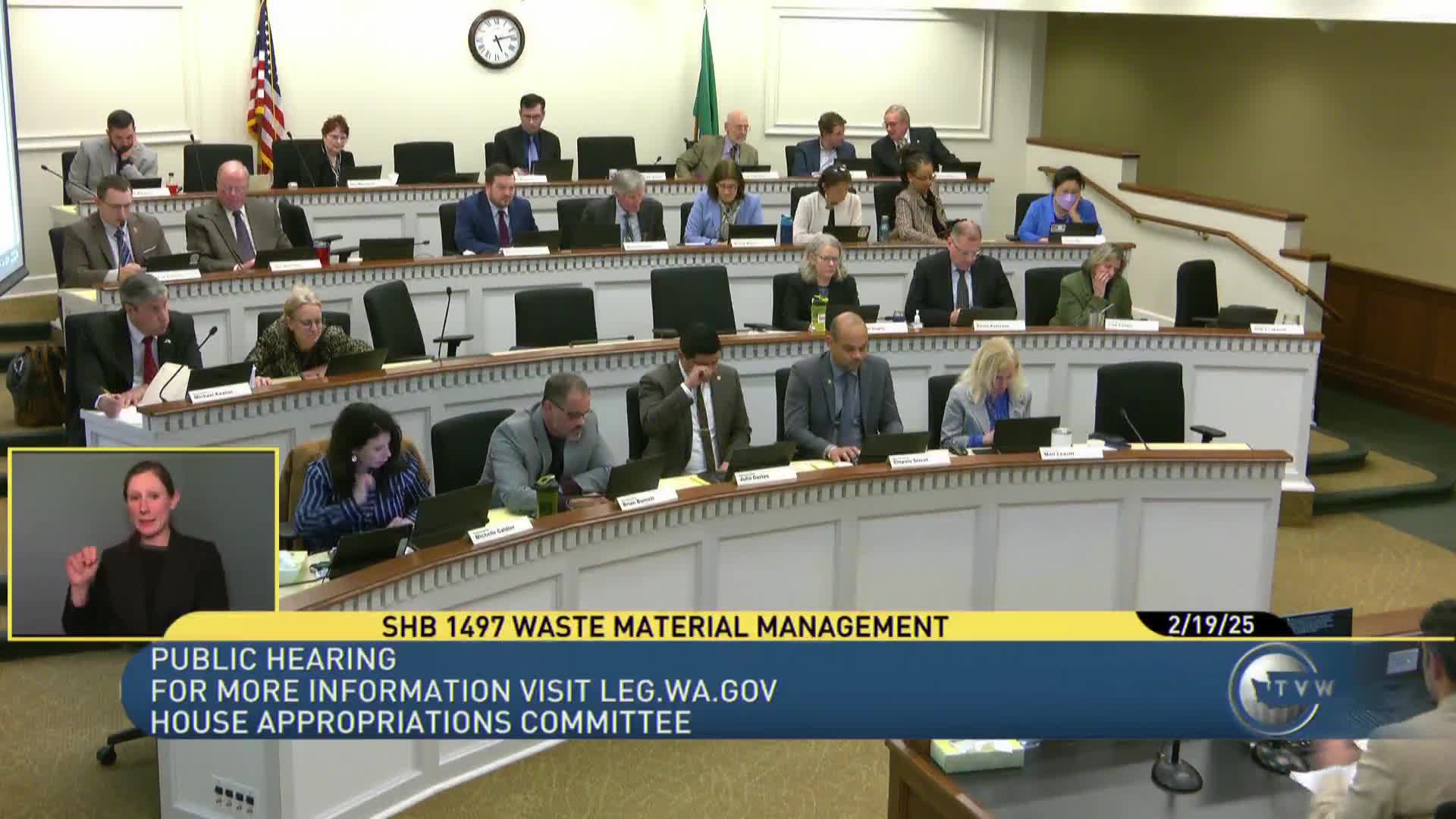
Substitute House Bill 1497 would implement several changes to Washington’s organic‑materials management framework. Jacob Lipson briefed committee members that the bill would require standardized coloring of new solid waste collection bins beginning in 2028 and labeling starting in 2027; entities not complying with the coloring rules would be ineligible for certain grants tied to organics implementation. The bill also would direct Ecology, subject to appropriation, to run a contamination‑reduction outreach program; publish lists of businesses expected to be subject to organics requirements; and establish penalties that jurisdictional health departments or local governments could impose for business noncompliance with previously established organic‑service requirements. The bill would phase in collection service requirements for multifamily residences as part of local solid‑waste planning and direct the State Building Code Council to adopt building code standards to facilitate separation of source‑separated organics.
Nut graf: Supporters said the bill builds on prior organics laws by clarifying implementation details, improving public education and addressing multifamily service gaps; service providers and recycling businesses urged attention to grant eligibility and outreach. Ecology’s fiscal estimate identified costs for outreach and program administration while the Environmental and Land Use Hearings Office estimated cost for appeals.
Public testimony: Kate White Tudor (NRDC), 0 Waste Washington, Waste Connections and DTG Recycle testified in support, stressing standardized containers, outreach and improved diversion. Supporters thanked the bill sponsor for implementation changes that address prior concerns. No significant opposing testimony was recorded in the provided excerpt.
Fiscal briefing: Dan Jones said Ecology estimates roughly $1.2 million next biennium and $1.6 million the following biennium from the toxics control operating account for outreach and related program costs; other costs include OSPI grants for food waste reduction (subject to appropriation), and an estimated $120,000 per fiscal year for the Environmental and Land Use Hearings Office to hear appeals of penalties.
Discussion and outcome: Committee members heard mostly supportive testimony from waste‑management and environmental groups. Staff noted grant eligibility incentives tied to bin compliance. The transcript contains no recorded committee vote.