Get Full Government Meeting Transcripts, Videos, & Alerts Forever!
Get email alerts on the Healthcare Policy topic
No spam. Unsubscribe anytime.
House approves broad health-care transparency, payment and anti-fraud package after extended debate
Summary
After several hours of debate, the House passed House Bill 1003, a 70-plus–section health-care omnibus that sponsors said expands price transparency, tightens prior authorization rules, and strengthens Medicaid fraud enforcement. The bill passed on a recorded vote.
House Bill 1003, a multi-topic health-care bill, passed the Indiana House after extended floor debate and discussion of several contested policy lines.
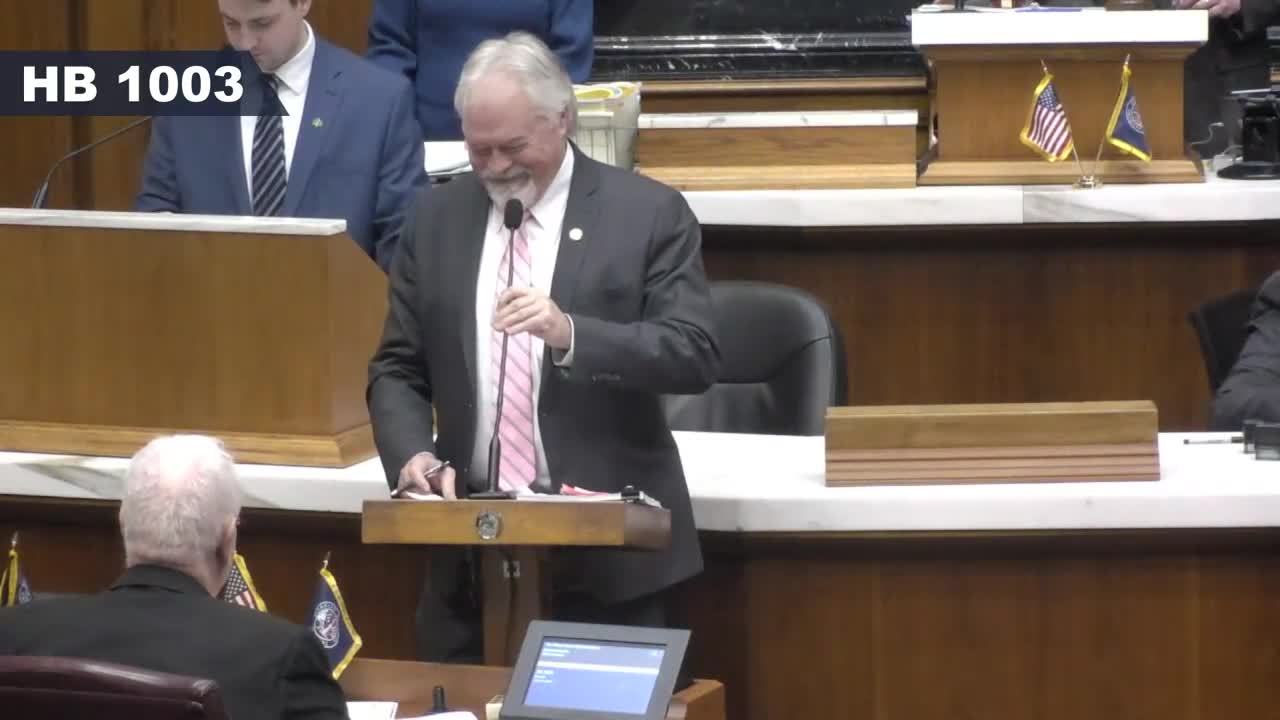
Representative Doctor Barrett presented the bill and described it as "a pretty significant piece of legislation" that had grown through multiple stakeholder conversations and several years of work. Barrett said the bill — about 73 pages and 70 sections — bundles changes on site-neutral payments, prior authorization, fraud control, patient access to medical information and pricing, and other transparency measures.
The measure includes provisions to expand transparency of laboratory and imaging prices, create a clearinghouse for prior authorization data at the Department of Insurance, authorize provisional credentialing for certain provider transitions and to revisit site-neutral payment rules that the sponsor said remain technically unresolved. Barrett told colleagues the bill also adds new tools for combating Medicaid fraud and would allow better patient access to all-payer claims data through consumer-facing tools.
Supporters said the bill contains useful patient protections and administrative reforms. Representative Manning highlighted prior-authorization changes and provisional credentialing as worth preserving. Representative Garcia Wilburn, speaking for local hospitals, said parts of the bill—particularly the expansion of site-of-service mandates and certain fraud-control provisions—risked imposing new administrative burdens on smaller hospitals and could strain rural providers.
Opponents also warned that changes to reimbursement or to the 340B program could have unintended effects on small providers. Several members said some policy lines needed additional technical work in committee or in conference with the Senate before they could be considered final.
Representative Barrett acknowledged outstanding technical issues on parts of the bill (he identified site-neutral payment and some surprise-billing details as still evolving) and asked members to keep the measure moving so negotiations could continue in the Senate.
The House recorded the final passage vote: 66 ayes, 31 nays. The clerk was instructed to inform the Senate of the bill's passage.
The bill's sponsor said he will continue work with the Senate and stakeholders to refine technical language and outstanding regulatory details before the measure becomes law.