Get Full Government Meeting Transcripts, Videos, & Alerts Forever!
Get email alerts on the Burrowing Shrimp Research topic
No spam. Unsubscribe anytime.
Growers urge funding for burrowing‑shrimp research as bill would create IPM program at Department of Agriculture
Summary
House Bill 1309 would establish a Burrowing Shrimp Research Program at the Department of Agriculture with a governing board and a non‑appropriated account; shellfish growers testified the program is needed to develop alternatives to imidacloprid and protect rural economies.
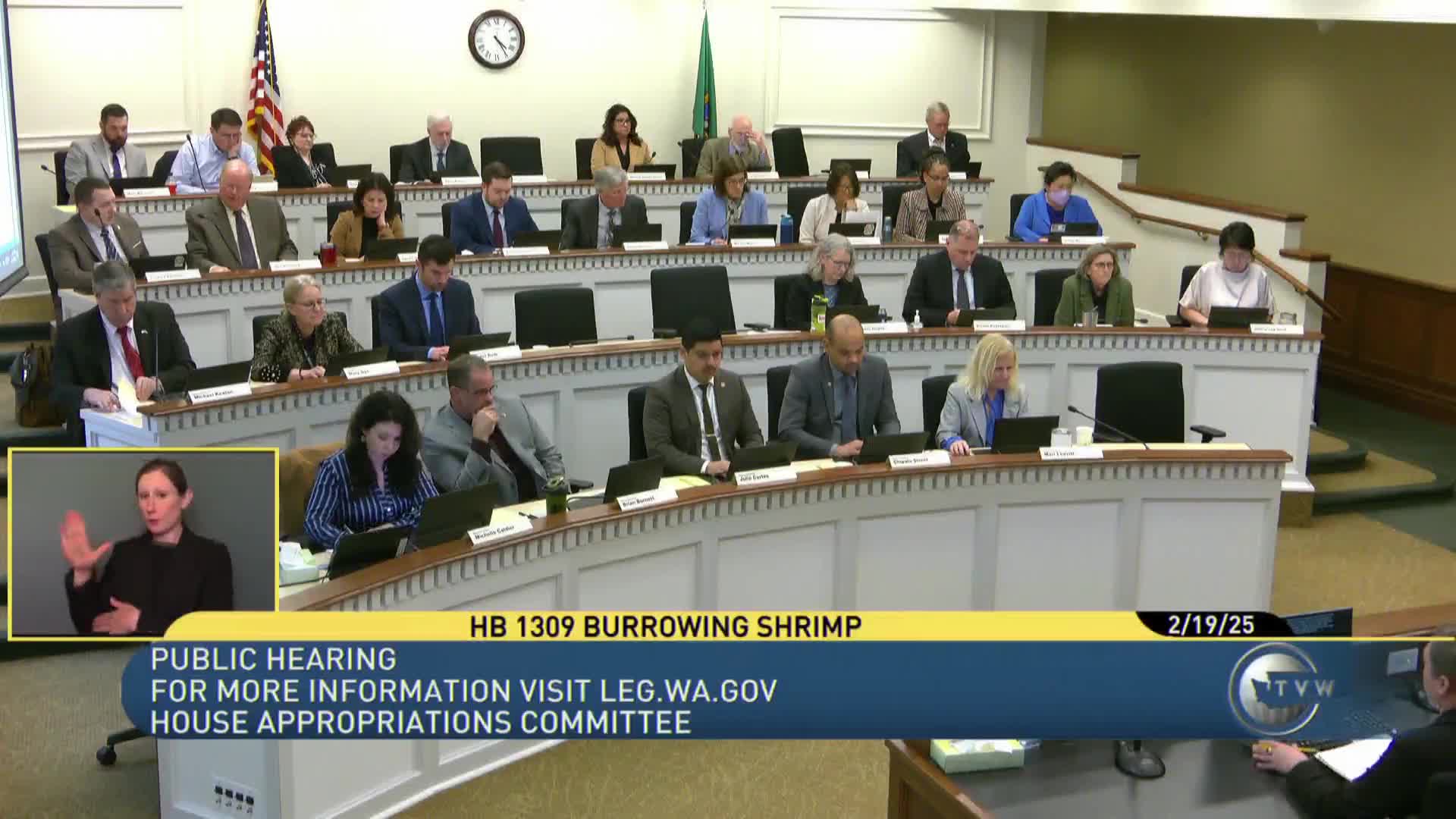
House Bill 1309 would create an Integrated Pest Management (IPM) research program at the Washington State Department of Agriculture to address burrowing shrimp impacts on bottom‑culture shellfish farming in Willapa Bay and Grays Harbor. Rebecca Lewis, staff to the Agriculture and Natural Resources Committee, briefed the Appropriations Committee on the bill’s governance and purpose, explaining the program would administer a Burrowing Shrimp Research account, solicit research projects, provide permitting assistance and require a governing board whose members must have expertise or vested interest in the shellfish industry. The program and account would expire on June 30, 2035.
Nut graf: Shellfish growers and industry witnesses said burrowing shrimp threaten the viability of multi‑generational shellfish farms and that recent legislative funding enabled an IPM working group to begin developing alternatives; they urged continued, targeted funding to translate research into practical controls that protect both livelihoods and environmental values.
Public testimony: Marilyn Sheldon and Kathleen Nisbett Monci, both representing Willapa Bay/Grays Harbor oyster growers, described shellfish farming as a cornerstone of rural economies and urged support for ongoing research and the IPM working group. Industry witnesses said funding directed to research could yield methods that protect farms and exports. Opponents and concerned witnesses included Darlene Champall, who argued the bill inappropriately prioritizes industry funding and risks habitat impacts; Marilyn Showalter, a former legislative counsel, testified concerns about potential regulatory capture and the program’s governing board composition.
Fiscal briefing: Dan Jones said the bill creates a non‑appropriated Burrowing Shrimp Research account with intent language to appropriate $2,000,000 per biennium from the toxics control operating account into the new account; agency costs for program administration were estimated at $260,000 in the example fiscal note, leaving up to $1.7 million for research projects if the $2 million appropriation were enacted.
Discussion and outcome: The transcript shows a contested public record with growers urging support and environmental advocates and former counsel raising governance and habitat concerns. No committee vote is recorded in the provided transcript.