Get Full Government Meeting Transcripts, Videos, & Alerts Forever!
Get email alerts on the Environmental Justice Sepa topic
No spam. Unsubscribe anytime.
Panel and stakeholders back adding environmental‑justice review to SEPA; industry and local governments warn of costs
Summary
Substitute House Bill 1303 would require the Department of Ecology to incorporate environmental‑justice analysis into the State Environmental Policy Act (SEPA) process and adopt mitigation standards. Supporters said it would address cumulative harms to overburdened communities; opponents said it could slow permitting and raise local costs.
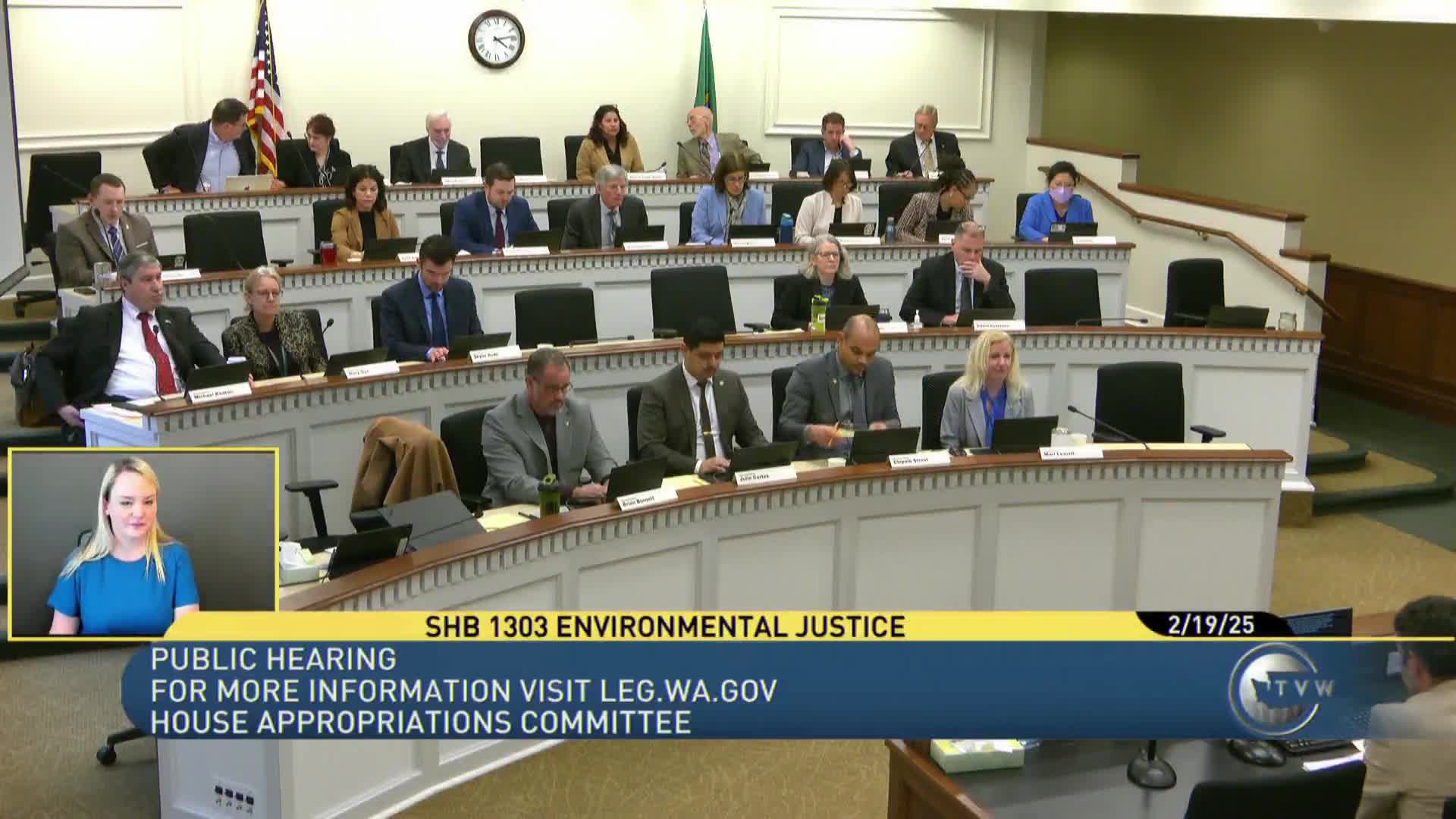
Substitute House Bill 1303 would add environmental‑justice (EJ) elements to the State Environmental Policy Act (SEPA) review and require the Department of Ecology to adopt rules and a checklist that includes EJ considerations prior to threshold determinations by lead agencies. Jacob Lipson, staff to the Environment and Energy Committee, told the Appropriations Committee that Ecology would be directed to adopt standardized mitigation for EJ impacts and could rely on assessments prepared under the 2021 HEAL Act where applicable.
Nut graf: Supporters — including community groups and faith organizations — argued the change would capture cumulative health and public‑health stressors borne disproportionately by overburdened communities; business and local‑government groups warned of increased permitting costs, longer timelines and uneven capacity among local lead agencies to carry out EJ assessments.
Public testimony: Guillermo Rogel of Front and Centered said the measure embeds EJ analysis into SEPA and advances protection of communities of color and low‑income populations. Jean Hill of the Washington Catholic Conference said the bill “takes into account the cumulative environmental public health stressors experienced by overburdened populations” and urged passage. Opponents included the Washington Aggregate and Concrete Association, the Building Industry Association of Washington, the Association of Washington Cities, the Association of Washington Business and the Washington State Association of Counties, which expressed concern about permitting delays, costs and local capacity; Corey Shaw of the concrete association asked members not to pass the bill as written, arguing members already include neighborhood impacts in SEPA checklists.
Fiscal briefing: Dan Jones summarized Ecology’s fiscal note estimating roughly $1.5 million in the first biennium and about $500,000 per biennium ongoing for staffing, rulemaking and assistance; additional indeterminate costs are expected across multiple lead agencies when they act under SEPA.
Discussion and outcome: The record shows a mix of community and industry testimony and no committee action recorded in the transcript.