Get Full Government Meeting Transcripts, Videos, & Alerts Forever!
Get email alerts on the Detention Facilities topic
No spam. Unsubscribe anytime.
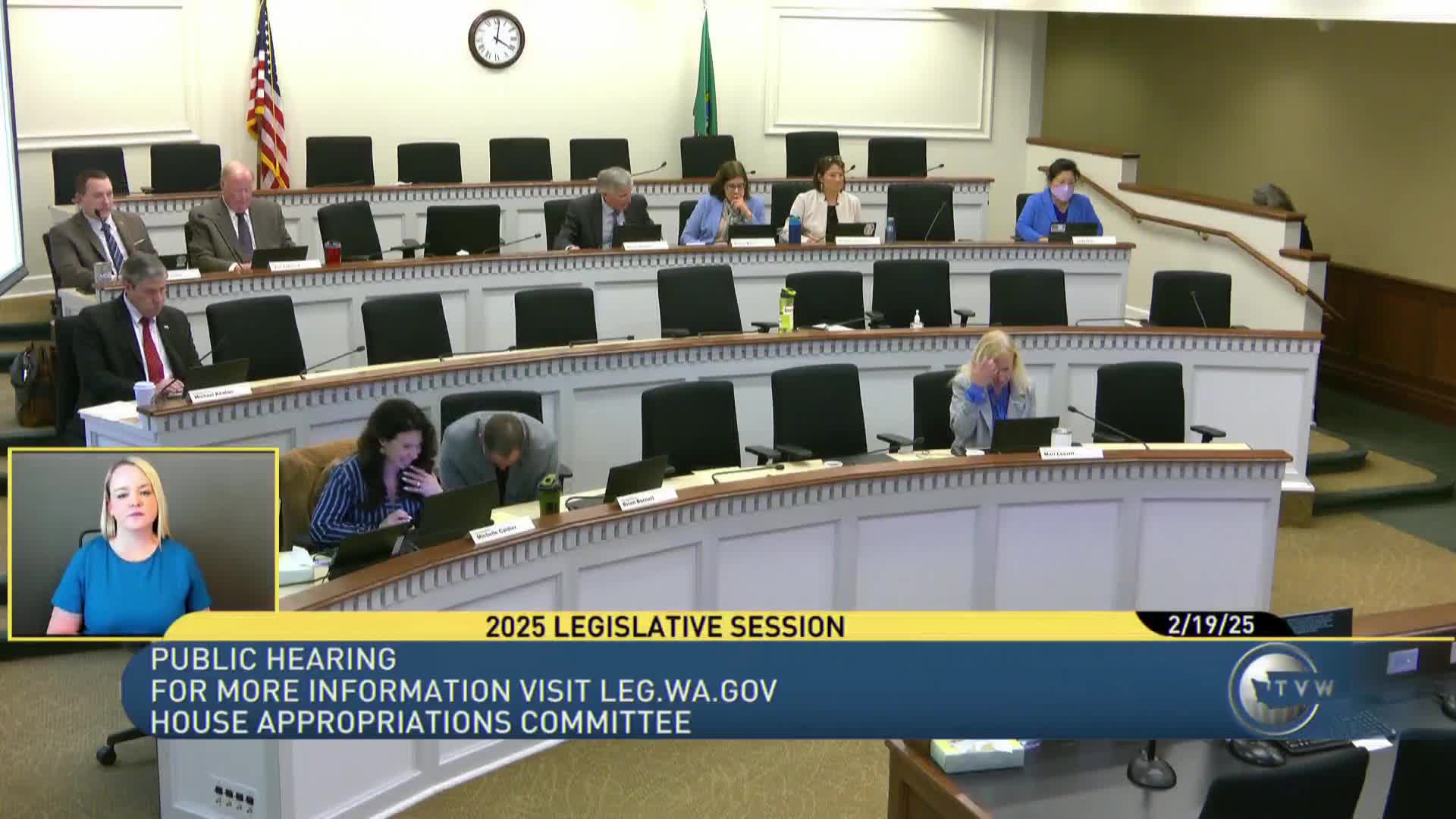
Committee hears testimony on bill to expand state oversight of private detention facilities
Summary
Substitute House Bill 1232 would broaden the state’s authority to regulate private detention facilities, require the Department of Health to adopt minimum operating standards and inspection powers, and authorize civil penalties and corrective actions for facilities found noncompliant.
Substitute House Bill 1232 would expand state oversight of privately operated detention facilities by amending the definition to include any detention facility operated by a non‑governmental entity under contract with a federal, state or local government, regardless of whether it is run for profit. Corey Patton, staff to the Community Safety Committee, told the House Appropriations Committee the bill modifies four categories of regulation: operational standards, inspections, civil penalties, and exemptions.
The bill would require the Department of Health (DOH) to adopt minimum standards for physical environment, services, equipment and policies at private detention facilities and to make specified inspection information available online. Patton said the bill also authorizes DOH to inspect facilities at any time “to determine whether they have failed or refused to comply with applicable state or federal law.” The bill expands civil‑penalty authority so DOH may impose conditions or assess fines of up to $10,000 per violation, not to exceed $1,000,000 in total, and requires DOH to adopt rules tying fines to the severity of noncompliance; proceeds are restricted to training or technical assistance for private detention facilities administered by the Department of Corrections.
Nut graf: Supporters described local concerns about conditions at the Northwest ICE Processing Center in Tacoma and urged the Legislature to give state agencies clear authority and resources to inspect and enforce standards when contracted facilities are not meeting legal or health obligations.
Advocates from Faith Action Network, the Washington State Catholic Conference and Tacoma city leadership spoke in favor. Kristen Eng, policy director for Faith Action Network, said the Northwest Detention Center has been “the site of serious human rights concerns, including inhumane living conditions, inadequate medical care, prolonged solitary confinement, and the barring of oversight agencies from entry,” and urged the committee to approve the bill to ensure “transparency, oversight, and fundamental human dignity.” Jean Hill of the Washington State Catholic Conference said the measure provides “guardrails on the use of private for profit entities” that care for detained people. Tacoma Council Member Christina Walker urged DOH enforcement authority, saying the city council lacks power to intervene at the privately run facility in Tacoma and called the fiscal cost “a small price to pay to ensure that Washington state remains a leader in safeguarding human rights.”
Staff fiscal briefing: Emily Stevens, committee staff, told members a fiscal note for the substitute had been requested but not yet available at the time of the hearing. Using DOH estimates, she said rulemaking to adopt sanitation and hygiene standards would require about 1.5 FTEs over two years at a total biannual cost of roughly $542,000, ongoing DOH inspection costs beginning in fiscal year 2028 of about $334,000 per year (1.5 FTEs to conduct two inspections annually of juvenile private detention facilities), and an estimate of about 500 complaints per year for the juvenile facilities that could require 1.5 FTEs and about $313,000 per year in ongoing costs; the Office of the Attorney General services were estimated at about $70,000. Stevens summarized the total cost to implement the substitute as approximately $542,000 in the 2025–27 biennium and about $1.3 million in the 2027–29 biennium, all general‑fund state dollars, per DOH estimates.
Discussion and outcome: Committee members asked no follow‑up questions during the recorded briefing and the hearing proceeded to public testimony. There was no formal committee action recorded in the transcript. The public record included multiple supporters who lobbied for passage; no opponents were recorded during the public testimony for this bill in the provided transcript.
Ending: The hearing record shows the committee received staff briefings and public comment; the transcript does not record a committee vote on the bill.