Get Full Government Meeting Transcripts, Videos, & Alerts Forever!
Get email alerts on the Charitable Gambling E Tabs topic
No spam. Unsubscribe anytime.
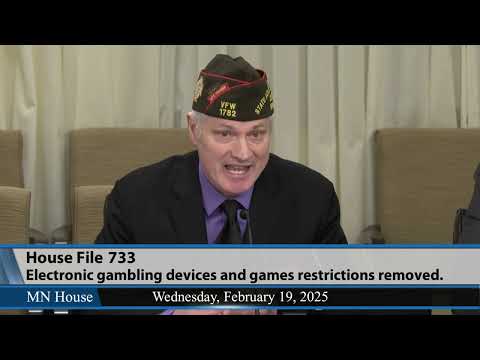
Committee advances House file 733 after contested hearing on e‑pull tab features and tribal concerns
Summary
After extensive testimony from charities, tribes and anti‑gambling advocates, the House Veterans and Military Division re‑referred House File 733 to the Commerce Committee by roll call. The bill would loosen restrictions on electronic pull‑tab features; opponents said it would mimic slot machines and harm tribal revenue and public welfare.
The House Veterans and Military Division voted 6–5 to re‑refer House File 733 to the Commerce, Finance and Policy Committee after a contested hearing that featured competing testimony from charitable gaming advocates, tribal representatives and opponents of gambling expansion.
Representative Olson, the bill’s sponsor, said HF 733 would undo regulatory changes adopted after a court challenge and restore certain electronic pull‑tab (e‑tab) features that supporters say charities rely on to fund veterans services and community programs. "We have constantly been sitting here saying you're hurting the charities," Olson said in testimony. He and several charitable‑sector witnesses said revenue declines after the 2023 restrictions have reduced donations to local programs.
Rachel Jenner, executive director of Allied Charities of Minnesota, told the committee that charities statewide reported revenue declines after January’s new rules, with some organizations reporting drops of 20 percent or more. Tim Engstrom of the American Legion described declines in some locations of 29 percent year‑over‑year and said e‑tab receipts were down 44 percent in his operation compared with the prior January. Engstrom and others said local charities fund youth sports, food shelves, scholarships and school programs.
Opponents urged the committee to reject the bill. Jack Meeks, chair of Citizens Against Gambling Expansion (CAGE), said the proposed electronic features would closely simulate slot machines and increase problem gambling in neighborhood restaurants and bars. "These machines, located in neighborhood restaurants and bars in all parts of our state, will encourage and promote increased problem gambling," Meeks said.
Andy Plato, executive director of the Minnesota Indian Gaming Association (MYGA), urged the committee to honor the 2012 law and the 2023 clarifications that followed court action. Plato said tribal gaming revenues fund essential tribal services and that regulators and the courts had previously ruled some electronic features were outside the law’s intent. He also said tax relief enacted in 2023 and a cap on manufacturers’ fees would return more dollars to charities than restoring slot‑like features would.
Laura Wade, executive director of the Minnesota Gambling Control Board, told the committee the court ruling and subsequent legislative action were focused on the "open all" feature; the board lost an appeal on that feature. Wade described the legal challenge as centered on whether the open‑all feature was permitted under the law and on the board’s rule‑making authority.
Committee members asked detailed questions about revenue data, impacts on tribal operations and whether children might be exposed to animated game features. Representative Feist and others suggested more direct appropriations to veterans programs as an alternative to restoring e‑tab features. Representative Hemmingson Yeager requested a roll call on a motion to delay the bill; that motion failed on a 5–6 vote. Later the committee approved re‑referral to Commerce by roll call.
Recorded roll call on re‑referral: Chair Bliss (yes), Vice Chair Olsen (yes), Rep. Bennett (yes), Rep. Clardy (no), Rep. Davis (yes), Rep. Duran (yes), Rep. Feist (no), Rep. Hemmingson Yeager (no), Rep. Hill (no), Rep. Ray Rauer (no), Rep. Repinski (yes). The committee clerk announced the count as 6 yes, 5 no and re‑referred HF 733 to Commerce.
The committee did not adopt substantive amendments or vote on the bill’s merits; the re‑referral sends HF 733 to Commerce for further work.