Get Full Government Meeting Transcripts, Videos, & Alerts Forever!
Get email alerts on the Equine Therapy First Responders topic
No spam. Unsubscribe anytime.
Committee lays over bill to expand equine therapy for first responders
Summary
A Minnesota House committee laid over House File 261, which would expand a pilot program providing equine-assisted clinical therapy to a broader group of first responders. Supporters cited a reported 98% retention rate among participants; the bill was discussed but not advanced to a vote.
A Minnesota House committee on Wednesday laid over House File 261, a bill to expand a pilot equine-assisted clinical therapy program for first responders.
The bill, introduced in committee by Representative Kosnick, would broaden eligibility beyond the earlier pilot to include active and retired police officers, full-time and volunteer firefighters, ambulance service personnel, 911 communicators and correctional officers. Representative Kosnick told the committee the program builds on a pilot funded by the legislature and reported a 98 percent retention rate for keeping first responders at work.
Supporters said the program, run by a nonprofit called Abijah's, provides clinical, horse-based therapy tailored to first responders' trauma. Sally Mixon, founder of Abijah's, told the committee she has worked with the population for more than a decade and described individual outcomes the program has produced. "You can always lie to us as therapists, but you can never lie to the horses," Mixon said as she explained why participants sometimes open up in that setting.
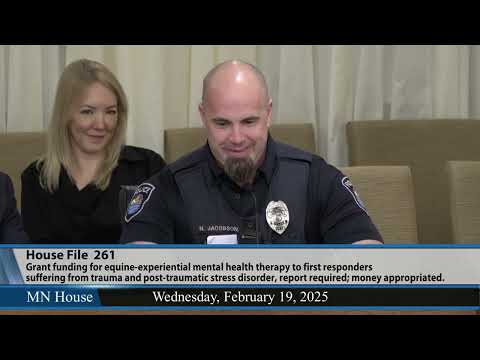
Officer Nick Jacobson, a Lakeville police officer and Marine Corps veteran, testified about his own experience with the program. "Ever since I started with Abijah's and with Sally, I've noticed an amazing transition in my life. Being more present as a father, a husband, and just a general police officer," Jacobson said, adding that his urge to return to combat has decreased.
Committee members asked about the program's relationship to other first-responder mental-health efforts and about funding and organizational structure. Committee members referenced Hometown Hero Outdoors, an outdoor therapy program that some members said could complement Abijah's work through cross-referrals. Mixon said Abijah's provides clinical sessions—weekly, biweekly or intensive multi-hour sessions tailored to a participant's needs—and works collaboratively with departmental peer-support teams and other therapists.
Danny Palmer, who described himself as a co-founder and business-development lead for Abijah's, told the committee the organization began as an LLC in 2021 at Canterbury Park, worked under a fiscal sponsor initially, and established its own 501(c)(3) in 2024; Palmer said Abijah's will file its first Form 990 in the coming months. Palmer also said the group has continued to serve participants through private fundraising while expanding statewide.
Committee members raised questions about clinical diagnoses and insurance. Mixon and other program staff said they try to reduce barriers to treatment because some first responders decline traditional care over concerns about diagnostic records affecting employment; Mixon said the organization has prioritized fundraising to allow services without insurance-based diagnostic billing. Representative Pete Johnson, a career firefighter, said the workforce needs clinicians trained to handle first-responder trauma and thanked presenters for addressing gaps in access to appropriate care.
Members heard specific program outcomes reported to the committee. Abijah's staff said the program has run for more than 10 years, moved to Canterbury Park in 2021 to focus on thoroughbreds, and—since the legislature funded the pilot in 2023—has treated 106 officers and firefighters; program staff said 102 of those participants remain on active duty and two retired for age-related reasons. Mixon and Palmer described at least one retired participant who later returned to active service after participating in the program.
Representative Kosnick said the bill would be another tool to address workforce shortages by supporting first responders' mental health and that local community groups in Lakeville have helped sustain the program. After questions and discussion, Chair Baker announced that House File 261 would be laid over for possible inclusion in future committee work rather than advanced that day.
The committee took no recorded roll-call vote on the bill at the hearing; the official next step noted by the chair was that the bill would be laid over for further consideration.