Get Full Government Meeting Transcripts, Videos, & Alerts Forever!
Get email alerts on the First Responder Mental Health topic
No spam. Unsubscribe anytime.
Committee hears bill to expand equine therapy program for first responders
Summary
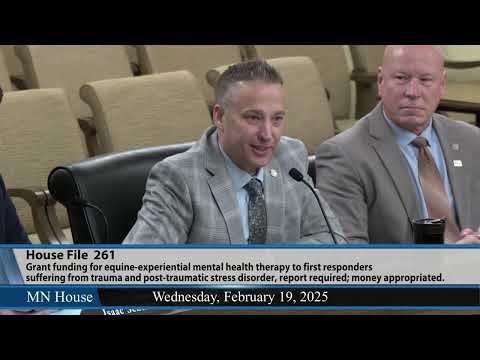
Lawmakers heard testimony on House File 261 to expand a pilot equine-assisted clinical therapy program to additional classes of first responders. Supporters cited high retention among participants and urged the committee to fund a wider rollout; the committee laid the bill over for possible further inclusion.
The House Workforce, Labor and Economic Development Finance and Policy Committee heard testimony on House File 261, a bill that would expand a pilot equine-assisted clinical therapy program for first responders to include active and retired police officers, full-time and volunteer firefighters, ambulance personnel, 911 communicators and correctional officers.
The program’s founder, Sally Mixon of Abijah’s, told the committee the model has a high retention rate and clinical focus. “Success rate in our eyes is first responders remaining in their job,” Mixon said, and she told members the group reports a 98 percent retention rate among participants who received services under the earlier pilot.
Rep. Kosnick, who sponsored the bill, said the expansion follows an initial two‑year pilot and that the therapy is tailored to the “unique traumas” first responders experience. Officer Nick Jacobson, a current Lakeville police officer who testified, described his experience after military deployments and said equine‑assisted therapy helped him “be more present as a father, a husband, and just a general police officer.”
Members asked for operational details about referrals, eligibility and prior state support. Committee members and testifiers described how Abijah’s built relationships with departments and peer support teams to recruit participants. Danny Palmer, identified as a co‑founder working on business development, said the organization registered as an LLC in 2021, operated under a fiscal sponsor at first, established a 501(c)(3) in 2024 and plans to file its first Form 990 in the coming months.
Representative Pete Johnson, a professional firefighter, pressed staff on whether the therapy could be covered by insurance. Mixon said many first responders avoid traditional therapy tied to diagnostic codes because a recorded diagnosis can follow them in their careers; Abijah’s has relied on fundraising to remove barriers and offer services without triggering employment‑linked diagnoses.
Committee members also discussed how the program might intersect with other first‑responder nature‑based programs such as Hometown Hero Outdoors; Mixon said the programs could be complementary, with each offering different referral paths and levels of clinical care.
House File 261 was not voted on; the committee laid the bill over for possible further inclusion.
Ending: The committee did not advance the bill today; members said they would weigh the testimony and fiscal options and may revisit the measure at a future hearing.