Get Full Government Meeting Transcripts, Videos, & Alerts Forever!
Get email alerts on the Pace Program Implementation topic
No spam. Unsubscribe anytime.
DHS outlines PACE option for Minnesota, highlights implementation, staffing and fiscal questions
Summary
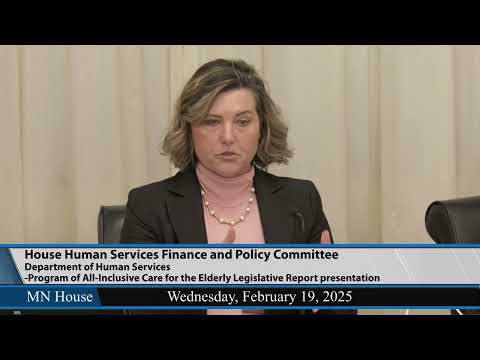
The House Human Services Finance and Policy Committee heard a presentation from the Minnesota Department of Human Services on the Program of All‑Inclusive Care for the Elderly (PACE), a federal Medicare‑Medicaid model the department said would offer a site‑based, fully integrated option for people age 55 and older.
The House Human Services Finance and Policy Committee heard a presentation from the Minnesota Department of Human Services on the Program of All‑Inclusive Care for the Elderly (PACE), a federal Medicare‑Medicaid model the department says would offer a site‑based, fully integrated option for people age 55 and older.
Assistant Commissioner Natasha Merz of DHS said PACE “is a model of delivering home and community based services for people age 55 and older” that combines Medicare, Medicaid and long‑term services and supports through a single capitation payment. She added, “PACE can’t result in more spending than Medicare or Medicaid would otherwise spend on that person were they not enrolled in PACE.”
The report submitted to the committee summarizes two analyses requested by the Legislature: an implementation analysis and an actuarial analysis. DHS contracted with a consulting firm (Barry Dunn) for implementation considerations and with Milliman for the actuarial work. Merz said the implementation analysis and actuarial report look at provider readiness, state‑level program criteria, readiness reviews required by the Centers for Medicare & Medicaid Services (CMS), and practical questions such as enrollment choice and involuntary disenrollment.
Why it matters
DHS told the committee PACE would create a new fully integrated option for people ages 55–64 that is not available now in Minnesota. The department emphasized the program is federally authorized and would require a state plan amendment, federal readiness reviews and state administrative resources to implement. Merz noted Minnesota already operates Minnesota Senior Health Options (MSHO), a fully integrated dual‑eligible product for people 65 and older, and said PACE’s principal distinction is its site‑based adult day center model and availability to people age 55 and older.
Key details presented
- Eligibility and services: PACE enrollment requires meeting a nursing facility level of care and being able to live safely in the community at the time of application. PACE programs include an adult day center that can provide primary care, therapy, meals, personal care and transportation, and they coordinate Medicare, Medicaid and long‑term services and supports.
- Financing: Merz said the PACE model is financed through a monthly capitation payment covering Medicare and Medicaid benefits. She told the committee the standard Medicaid match applies: “It’s the standard FMAP for Medicaid.” The federal requirement is that the PACE capitation payment must be less than the projected spending for the enrollee outside PACE.
- State context: Merz said there are about 180 PACE organizations operating nationally in 33 states and the District of Columbia serving roughly 80,000 people. By comparison, Minnesota has more than 25,000 people enrolled in MSHO. DHS noted that, because Minnesota already has MSHO, net state savings from PACE may be smaller than in states without an integrated product.
- Implementation and timeline: DHS described federal approvals and readiness reviews by CMS as prerequisites, and said states must draft a state plan amendment. Merz said implementation “is not flipping a switch” and will require federal coordination and readiness reviews. The department has issued a request for information (RFI) to gauge provider interest; the RFI was reported to close by the end of the month. Merz said the department will report RFI results to the committee when available.
- Department staffing: Rachel Shands, deputy director of Aging and Adult Services at DHS, told the committee the department will need additional staff to stand up and oversee PACE. When asked for a ballpark estimate, Shands said, “I would ballpark, 5 to 10, you know, somewhere in that range.” She also said the department will include staffing and systems costs in any fiscal note for legislation.
Questions and concerns from legislators
Committee members asked about provider interest, the 2011 procurement that drew no bids, the role of staffing shortages in Greater Minnesota, and how PACE would compare with nursing home costs. Merz said providers in 2011 felt the capitation rate then was too low. On staffing, DHS officials said workforce shortages are a systemwide challenge and that the PACE geographic, site‑based model may help assemble interdisciplinary teams, but they did not assert it would solve workforce constraints.
Several legislators pressed for more detailed fiscal analysis and for estimates comparing PACE costs with nursing home costs and with current integrated products. DHS reiterated that the actuarial report and a fiscal note for any bill would provide more precise numbers.
Votes at a glance
- Motion to adopt minutes for 02/18/2025: adopted by voice vote; individual member tallies were not recorded.
What’s next
DHS said it will share RFI summaries and two reports (implementation analysis and actuarial analysis) with the committee and will provide additional detail in a fiscal note if legislation is introduced. The department did not take a position on whether the Legislature should authorize or fund PACE; the presentation was framed as informational.