Get Full Government Meeting Transcripts, Videos, & Alerts Forever!
Get email alerts on the Childcare Licensing topic
No spam. Unsubscribe anytime.
DHS outlines licensing overhaul, enforcement steps and background‑check data after parent’s abuse testimony
Summary
A parent who says a teacher physically and emotionally handled his 3‑year‑old drew the committee’s attention to licensing and enforcement gaps before the Department of Human Services detailed plans to revise statewide childcare rules, inspections and background studies.
A parent who says a teacher physically and emotionally handled his 3‑year‑old drew the committee’s attention to licensing and enforcement gaps before the Department of Human Services detailed plans to revise statewide childcare rules, inspections and background studies.
Joshua Truax, who said a video of the incident at Little Explorer’s Plymouth Academy “went viral 13 days ago,” told the Children and Families Finance and Policy Committee he came to seek “stricter oversight, stronger protections, and real consequences for those who fail our children.”
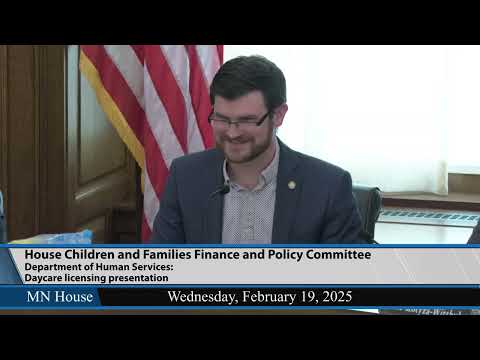
The Department of Human Services (DHS) presented an overview of licensing, enforcement and a modernization project the agency says is intended to better target high‑risk standards, shorten inspection time for long‑compliant providers and clarify family childcare rules. “The baseline of what we do in licensing is to ensure that programs can meet a minimum level of health and safety standards,” said Alyssa Dodson, deputy inspector general for DHS’s Licensing Division.
Why it matters: Committee members pressed DHS on how inspections, complaints and program‑integrity investigations intersect with payments from the Child Care Assistance Program (CCAP), how quickly background studies are completed and what changes the agency’s new risk‑weighted approach would mean for providers and families.
What DHS told the committee
Licensing scope and delegated system — DHS said it licenses or oversees a wide set of programs (childcare centers, family childcare, foster care, adult day services and other congregate settings). Family childcare licensing is delegated to counties; the state issues licenses and conducts inspections for larger center‑based programs. Dodson said that, as of February 2025, DHS records show 1,791 licensed centers and 5,756 licensed family childcare providers.
Inspection cadence and enforcement tools — DHS said the federal Child Care and Development Fund (CCDF) requires annual unannounced visits. DHS described a tiered set of enforcement tools: documented technical assistance (replacing the previous “fix‑it” tickets), correction orders, fines (including statutory fines tied to maltreatment), conditional licenses, temporary immediate suspensions and revocations. Dodson said licensors evaluate violations by “nature, severity, and chronicity” and that providers have reconsideration and appeal rights.
Modernization project — DHS outlined three linked elements of its modernization work: a weighted‑risk framework to prioritize rules that present the highest risk to children; abbreviated inspections for providers that meet predictive “key indicator” criteria; and revised licensing standards (a new draft for family childcare and centers). Dodson said DHS released a second draft of revised standards on Feb. 13 after more than 1,600 provider responses, 23 listening sessions and targeted interviews. DHS plans further engagement over the summer and expects a third draft after the department’s licensing staff transfer to the Department of Children, Youth and Families (DCYF) in June.
Background studies and disqualification rules — Dawn Davis, deputy inspector general for the Background Studies Division, briefed the panel on statewide checks. DHS said it processed roughly 538,000 background‑study applications in calendar year 2024, of which 73,556 (about 14%) were for childcare roles. DHS described enhanced child‑care background checks required under federal CCDBG/CCDF rules and cited Minnesota Statutes chapter 245C as the statutory list of disqualifying offenses (examples named in testimony included maltreatment, physical assault, murder and sexual conduct; some disqualifications are time‑limited, others permanent).
Program integrity and CCAP investigations — DHS said its CCAP investigators (a small team the agency described as four investigators) open fraud and compliance cases that are separate from routine licensing enforcement. Program integrity data presented to the committee included roughly 62 open investigations on the investigators’ caseload, about $2.4 million recovered since 2020, and that roughly 20% of referrals to program integrity lead to criminal investigations; the agency said administrative or compliance issues make up the majority of cases.
Questions from committee members and DHS responses
Payment holds and maltreatment: Committee members asked whether CCAP payments stop automatically when maltreatment is reported. Dodson said stop payments are not automatic for licensing violations; the integrity unit may withhold payments when its investigators find credible indications of CCAP fraud.
Verifying attendance and children’s identities: Committee members asked how non‑electronic attendance records are verified. DHS said licensors verify on‑site by reviewing attendance records and talking with children and staff, and will refer inconsistencies to the integrity unit for deeper review.
Data, capacity and alternative models: Members asked what DHS is exploring to maintain and rebuild provider capacity. Dodson cited a Wilder Research report DHS commissioned on alternate licensing models and pointed to “special family childcare” and umbrella or small‑center models as potential options to support smaller providers and resource sharing.
Transfer to DCYF: Dodson reiterated that certain DHS licensing staff supporting childcare will transfer to DCYF in June; she said county licensors will remain employed by counties and the delegated structure will continue.
Parent testimony and public information
Joshua Truax told the committee his son was “picked up, slammed ... aggressively pushed ... had his drumsticks ripped from his hands” in a classroom incident. He urged lawmakers to “demand stricter oversight, stronger protections, and real consequences for those who fail our children.” DHS told the committee that parents of alleged victims are contacted when investigators open a maltreatment investigation and that, if maltreatment is substantiated, DHS posts a public report and notifies parents as required; DHS also said public licensing reports must be on the state licensing lookup website and that new federal rules will require posting compliance items (both in‑compliance and out‑of‑compliance) under a timeline that currently has a waiver until August 2026.
What remains unresolved in committee testimony
Members pressed DHS for more detail about how program‑integrity investigators verify attendance in non‑electronic systems, timelines for investigations referred to law enforcement, and whether DHS can collect exit data from providers who close. DHS said it is exploring ways to collect provider exit information but did not produce a completed dataset at the hearing.
Votes at a glance
The committee approved the minutes of its Feb. 18 meeting by voice vote. Vice Chair Hanson moved approval; the motion passed (the transcript records the motion as adopted by ‘aye’ votes but does not specify a numeric roll call tally).
Ending
DHS told the committee it will continue stakeholder engagement on the revised standards through the summer and expects to publish an additional draft after the licensing staff move to DCYF; staff offered to follow up in writing to committee questions that could not be answered during the hearing.