Get Full Government Meeting Transcripts, Videos, & Alerts Forever!
Get email alerts on the Public Safety topic
No spam. Unsubscribe anytime.
Minn. committee approves amendment and refers bill raising penalties for fleeing a police officer by vehicle
Summary
A House committee adopted an A2 amendment to House File 340 that adds a four-year license revocation and deletes a tracking-device provision, then voted to refer the bill to the Transportation Finance and Policy Committee after testimony from law-enforcement representatives and lawmakers about rising vehicle pursuits and public-safety concerns.
Representative Steer renewed a motion to move House File 340 and recommend it be referred to the Transportation Finance and Policy Committee; the committee adopted an A2 amendment and approved referral by voice vote.
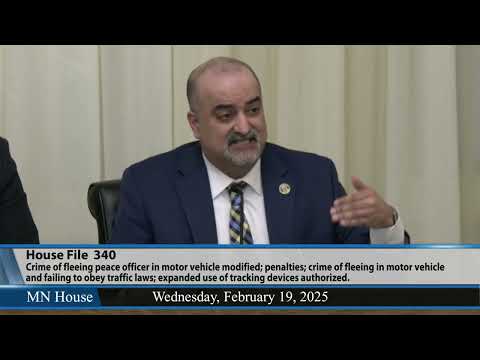
House File 340, as amended, would revise Minnesota statute provisions on fleeing a police officer in a motor vehicle. Representative Steer said A2 “adds the same 4 year license revocation for disobeying traffic laws while fleeing a police op as fleeing in a culpable negligent manner” and that the amendment deletes the section of the bill dealing with tracking devices, which he said will come up later on its own.
The bill drew testimony from law-enforcement representatives who described rising rates of vehicle thefts and pursuits and urged stronger penalties and public messaging. Shane Myrie, president of the Minnesota Police and Peace Officers Association, said pursuits and related crashes have become a “public safety crisis on our roadways,” citing media accounts of recent multi-jurisdictional chases. Imran Ali, general counsel for the Minnesota Police and Peace Officers Association, described fleeing as a “calculated risk” and argued prosecutors need additional tools to charge varying levels of fleeing conduct.
Lawmakers asked questions about the bill’s language and scope. Representative Moore and Representative Muller raised concerns about how some cross-referenced traffic code language (Minn. Stat. §169.18) might broaden the offense beyond the committee’s intent — for example, potentially capturing conduct such as passing or following rules that are not the specific dangerous behaviors lawmakers sought to target. Representative Steer and others said they are willing to refine statutory language and to work on public-safety messaging to ensure the public understands new penalties.
A staff member (Mr. Walz) notified the committee that an amended fiscal note had been requested to add rule-making costs; committee members said the updated fiscal note will accompany the bill when it returns to committee. The committee adopted the A2 amendment by voice vote and then approved referral of House File 340, as amended, to the Transportation Finance and Policy Committee by voice vote.
The bill’s substantive provisions cited in committee testimony include: adding felony-grade culpable-negligence fleeing with up to four years’ imprisonment (an increase from a three-year maximum), creating an offense tied to failing to obey signs or keeping on the proper side of the road with a stated potential sentence of up to five years, and imposing a four-year license revocation for certain fleeing-related traffic violations (all as described by Representative Steer and testifiers during the hearing). The transcript records that the A2 amendment removed a separate section on tracking devices; the committee did not consider that tracking provision in this session.
The committee action was a referral only; the transcript indicates Representative Steer and other members anticipated additional review of statutory cross-references, fiscal impacts, and a public-safety messaging plan before the bill moves further through the legislative process.