Get Full Government Meeting Transcripts, Videos, & Alerts Forever!
Get email alerts on the School Sports Gender Definition topic
No spam. Unsubscribe anytime.
House committee advances bill defining "female" for girls' sports after heated debate; referral to judiciary fails
Summary
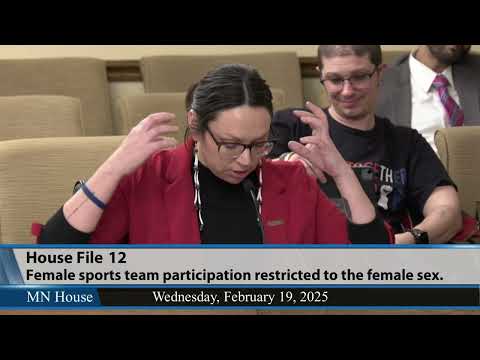
The House Education Policy Committee debated House File 12, which would add a definition of "female" to Chapter 121A to restrict participation on female sports teams. A motion to refer the bill to the Judiciary Committee failed 6-7; the committee then placed the bill on the General Register by voice roll call, 7-6.
House File 12, a bill that would add a definition of "female" to Minnesota's Chapter 121A and limit participation on female sports teams, was placed on the General Register by the House Education Policy Committee after a contentious debate and two roll-call votes.
The committee voted down a motion to re-refer the bill to the Judiciary Finance and Civil Law Committee, 6-7, after Representative Lee Jordan moved for referral, saying the bill interacts with the Minnesota Human Rights Act and raised data and civil-rights questions. After that failed motion, the committee voted 7-6 to place House File 12 as amended on the General Register.
Supporters, led by the bill's author Representative Scott, said the measure reiterates and clarifies existing education statute protecting opportunities for female athletes. "This bill is really not all that complicated. It's reiterating what current law is in Chapter 121A," Representative Scott said in closing remarks. Scott told the committee the change is intended to preserve girls' sports by adding an explicit definition of female to remove recent uncertainty.
Opponents warned the measure raises legal and practical problems, particularly around data, enforcement and impacts on children in elementary grades. Representative Keeler said the bill created "a lot of anxiety and worry" about how schools would identify and protect students' information and how challenges would be handled at the elementary level. Representative Keeler pressed the author on whether sports-physical records (which she said are commonly collected for grades 7–12) would be used for elementary students, and repeatedly asked how data would be stored and who would have access to it.
Representative Jordan said the Department of Education had testified the bill may conflict with the Minnesota Human Rights Act and urged referral to the Judiciary Committee so experts on human-rights and data issues could review it. "This bill will not become law in Minnesota. We will all be voting against it," Jordan said during remarks explaining why he sought referral and a roll call.
Medical and policy witnesses were also cited during the discussion. Dr. Simons, a physician who testified for the bill, described sex in reproductive terms: "So female sex is defined by our reproductive strategy. So female sex has a reproductive strategy for eggs," drawing a line between reproductive biology and the bill's definition. Miss Carlson, another proponent speaking to the committee, said physical exams are already used in youth athletics and cited public-opinion numbers: "70% of the population believes that males do not belong in female sports," she said. Committee members disputed and questioned the statistics and noted conflicting figures were cited during the hearing.
Several members, including Representative Bierman, urged the author to add more detail to the one-page bill to address implementation questions such as how challenges would be handled at elementary levels, where athletic directors (ADs) and formal processes may not exist. "A bill like this needs more details," Bierman said, describing wide variation in development and competitiveness among elementary-age players and pointing to likely parental pressure in younger leagues.
On procedure and costs, members asked whether a fiscal note had been requested and whether rulemaking would follow. Representative Jordan asked whether the bill had an associated fiscal note; Representative Scott said she had not requested a fiscal note and said any rulemaking ‘‘is probably something that the Department of Education or the State High School League could absorb.'' The author also maintained that the bill's principal reference is Chapter 121A and the Minnesota State High School League (chapter 128C), not the Human Rights Act or data statutes.
Votes at a glance
- Motion to amend and re-refer House File 12 as amended to the Committee on Judiciary, Finance and Civil Law (mover: Representative Lee Jordan): FAILED, 6 ayes, 7 nays. (Roll call recorded during the hearing.)
- Motion to place House File 12 as amended on the General Register (author/chair motion): PASSED, 7 ayes, 6 nays. Roll call recorded; the committee chair announced the outcome and placed the bill on the General Register.
The committee discussion included repeated statements that data about the number of affected student-athletes in Minnesota is not centrally collected; Representative Scott said she did not have statewide numbers and committee members said the data source was "not specified" in testimony.
The bill's author and supporters framed the measure as protecting girls' opportunities under Title IX–related state statute; opponents emphasized potential conflicts with the Minnesota Human Rights Act, unanswered data and privacy questions, and the risk of increased bullying or challenges to children based on appearance. The committee adjourned after the vote; members were told the next meeting will be Tuesday, Feb. 25.
Ending: House File 12 as amended will appear on the House General Register for further consideration. The committee record includes roll-call votes and statements from members and witnesses that will accompany the bill as it moves through the legislative process.