Get Full Government Meeting Transcripts, Videos, & Alerts Forever!
Get email alerts on the Ai Deepfakes Nonconsensual Images topic
No spam. Unsubscribe anytime.
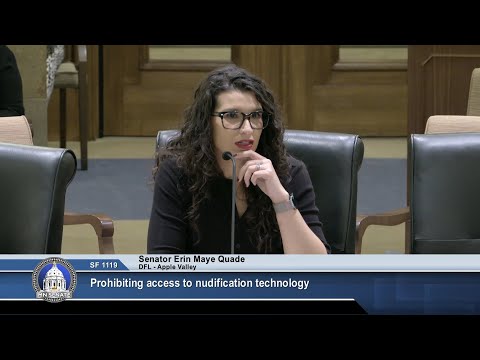
Senate committee hears testimony on bill to block AI 'nudify' notifications; amendment adopted and bill laid on table
Summary
The committee considered Senate File 1119, which would require apps, platforms and websites to disable functions that generate nonconsensual intimate images; survivors and advocates described harms and senators debated definitions, penalties and enforcement.
Senate File 1119, a bill requiring apps, platforms and websites to disable notification or generation functions that produce nonconsensual sexually explicit images and videos, drew testimony from survivors and advocacy groups and extended policy questions about enforcement, penalties and where recovered civil penalties should be directed.
Chief author Senator McQuaid told the committee the bill would require the notification functions on apps, platforms and websites be turned off in Minnesota to prevent "nudify" deepfakes — AI-generated images or videos that place a real person's likeness into sexually explicit content. ‘‘These functions should be turned off everywhere, in every state,’’ she said, arguing the harm begins at creation rather than dissemination.
Sandy Johnson, senior legislative policy counsel for RAINN (the national anti-sexual-violence organization), testified about the harms to victims and said the bill targets product design that enables nonconsensual image creation. "Once the images are created they can be posted anonymously, are rapidly and widely disseminated and become nearly impossible to remove," Johnson told the committee.
Megan Hurley, a Minnesota resident who testified as a victim, described extensive personal and financial harm after discovering convincing deepfake images and videos of herself online. "It is too easy for one person to use their phone or computer to create convincing hyper realistic non consensual nudes of you ..." she said, urging the committee to strengthen the bill.
Committee deliberations focused on definitions and scope: whether the statute should target generation or dissemination, how to define an "identifiable individual," how to handle consensual uses, and whether the civil penalty structure should prioritize deterrence or victim recovery. Counsel noted the bill as drafted could reach consensual AI uses as well as nonconsensual ones because the text does not require a showing of consent, and explained the phrase "mental anguish and suffering" used for damages already appears in the Human Rights Act.
An oral amendment (A3) replacing the word "reveal" with "depict" and clarifying references to an "identifiable individual" was adopted by voice vote after committee discussion and counsel's redrafting. Committee counsel also confirmed that, under current law as read in the hearing, proceeds from Attorney General 8.31 enforcement actions would be credited to the state's general fund unless the statute is amended to specify a different destination. Senators discussed amendments to direct some or all proceeds to crime victim services, but committee leaders agreed to continue word-smithing and jurisdictional checks before finalizing that change.
Outcome: The committee adopted the oral amendment by voice vote; later in the hearing the chair announced Senate File 1119 was laid on the table, with the committee intending to continue work on language and related jurisdiction questions in subsequent meetings.
Why it matters: Witnesses and senators said the technology is widely available, inexpensive in many cases, and produces images that can be indistinguishable from real photographs at a glance. Supporters argued the state can take narrowly tailored action to block a function that disproportionately harms women and children and to give the attorney general tools to hold platforms accountable. Opponents and some members raised First Amendment and technical concerns, as well as the interplay between civil damages and AG penalties.