Get Full Government Meeting Transcripts, Videos, & Alerts Forever!
Get email alerts on the High School Math Requirements topic
No spam. Unsubscribe anytime.
Senate committee hears debate on removing Algebra II graduation requirement
Summary
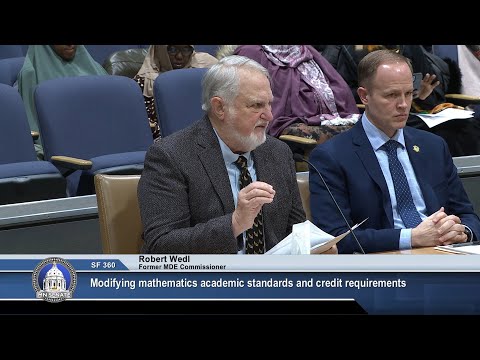
St. Paul — The Minnesota Senate Education Policy Committee on Feb. 19 heard more than an hour of testimony on Senate File 360, a bill from Sen. Andrew Farnsworth that would eliminate a statewide Algebra II requirement for high school graduation and allow districts to offer a locally designed third-year math course.
St. Paul — The Minnesota Senate Education Policy Committee on Feb. 19 heard more than an hour of testimony on Senate File 360, a bill from Sen. Andrew Farnsworth that would eliminate a statewide Algebra II requirement for high school graduation and allow districts to offer a locally designed third-year math course, including counting a personal finance course as a math credit if taught by a licensed math teacher.
Why it matters: Supporters told the committee that the change would let districts tailor math instruction to career and life needs and reduce barriers for students headed into trades or the workforce. Opponents said removing Algebra II as a requirement risks lowering academic expectations and could reduce college readiness and access to STEM fields.
Sen. Andrew Farnsworth, the bill author, said the measure grew from conversations with school counselors and local educators. "When I was first elected to the Minnesota Senate, the school counselors in the building that I work at asked me to try and eliminate the algebra 2 graduation requirement," Farnsworth said. He said the intent is not to reduce math instruction but to provide flexibility: "I'm not trying to get rid of math. I'm trying to make it more flexible."
Superintendent Scott Fedbrot of Browerville testified in support, arguing the Algebra II requirement is "one size fits all" and disadvantages many students. "Give us the opportunity to expand our curriculums and to ask for that personalized learning for our kids," Fedbrot said. Retired and current classroom teachers giving in-person and remote testimony — including Tony Harkonen, a former math teacher, and Chad Snyder, assistant principal at Hibbing High School — described examples of students better served by applied "math for trades" or consumer math and personal finance courses.
Critics cautioned about downstream effects. Kristen Hentgen, College and Career Readiness Policy Lead at the national nonprofit Ed Trust, told the committee that research shows students who complete higher-level math are more likely to enroll in and complete postsecondary credentials and warned that many college admissions offices (the University of Minnesota Twin Cities was cited) expect Algebra II as part of admissions preparation. Matt Shaver, senior policy director at MetAllies, said lowering the statewide requirement risks pushing more students into remedial college courses later, adding that "without a solid foundation in math, students can fall short when it comes to accessing career options in competitive STEM fields."
Committee members questioned practical impacts and equity. Sen. Duckworth asked whether the bill means students would stop learning math; Farnsworth replied that the bill still requires three years of math but would let districts tailor the third course. Farnsworth cited a Georgetown researcher to argue only a minority of jobs require Algebra II-level math, while opponents pointed to state and national assessments showing Algebra-related standards where students do not yet meet proficiency.
Outcome and next steps: After debate, the committee laid Senate File 360 over for possible inclusion in the omnibus education bill. The chair announced: "We'll be laying over Senate File 360 for possible inclusion in the omnibus education bill." No formal passage or rejection occurred at this session.
What was not decided: The bill’s final text, whether districts would need to notify colleges or align with college admissions, and the specific implementation timeline were not resolved in committee. The record shows competing views on whether removing a statewide Algebra II requirement expands opportunity or narrows students' future options.
Votes at hearing: The committee did not take a roll-call vote on the substance of the bill; the procedural action was to lay the bill over for possible omnibus inclusion.