Get Full Government Meeting Transcripts, Videos, & Alerts Forever!
Get email alerts on the Agriculture Pork topic
No spam. Unsubscribe anytime.
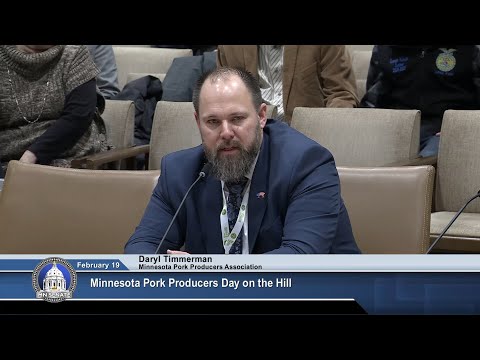
Minnesota Pork Producers describe financial losses, permitting and disease readiness to Senate panel
Summary
Darryl Timmerman of the Minnesota Pork Producers outlined 19 months of losses in the U.S. swine sector, urged streamlined permitting and continued support for the Board of Animal Health to prepare for threats such as African swine fever.
Darryl Timmerman, executive‑board member and recent past president of the Minnesota Pork Producers Association, told the Senate Committee on Agriculture, Veterans, Broadband, and Rural Development that Minnesota pig farmers endured a prolonged period of losses beginning in 2022 and that the sector faces continued pressures from feed costs, labor and permitting requirements.
Timmerman said an Iowa State model tracked a 19‑month stretch of industry losses and that, over the period, the model showed “$27 of losses on every single pig that went to market,” which he described as roughly “$4,700 of losses on every semi truck.” He said profitability began to return in April 2024 but that farmers are still repairing balance sheets.
The producer highlighted three state‑level strengths for Minnesota pork: a skilled, progressive farmer base; nearby processing and feed infrastructure; and the ability to use manure to build soil health. He said feed is the single largest cost for producers and that manure reduces fertilizer costs.
Testimony also stressed regulatory and workforce concerns. Timmerman asked for clearer, predictable permitting for barn replacement and remodeling, saying aging barns and lengthy permitting make capital investment difficult. He said state rules not grounded in science could disadvantage Minnesota producers. On labor, he cited childcare access and the need for a trained hands‑on workforce; he also flagged challenges for producers navigating new paid‑leave and related labor administration costs.
On animal‑disease readiness, committee members asked about African swine fever (ASF). Timmerman said industry collaboration with the Board of Animal Health and veterinarians has improved traceability and preparedness but urged continued investment in testing and response capacity because trade effects would be severe: “Trade’s a big deal for industry with 25% of our product, on a net basis being exported,” he said.
The committee did not take formal action on the testimony. Members thanked Timmerman and discussed follow‑up on permitting, labor and disease‑response supports.