Get Full Government Meeting Transcripts, Videos, & Alerts Forever!
Get email alerts on the Election Administration topic
No spam. Unsubscribe anytime.
Committee advances bill requiring photo ID to sign initiative petitions over broad opposition
Summary
Senate Bill 208, which would require a photo ID to sign an initiative petition, passed the House committee on a recorded vote. Sponsors said the measure helps verify identity; opponents argued it will suppress participation and add burdensome steps for grassroots campaigns.
The House State Agencies and Governmental Affairs Committee on Thursday advanced Senate Bill 208, a measure that would require a canvasser to verify a signer’s photo identification before obtaining a signature for an initiative petition.
Representative Ken Underwood, sponsor of the measure, said the requirement mirrors the state’s voter‑ID practice at the ballot box and would help “ensure those who are signing the petition are valid to sign the petition.” Underwood told the committee, “In Arkansas, we believe in voter ID.”
Secretary of State staff explained how petition verification currently works. Leslie Bellamy, director of elections, told the committee the Elections Division has 30 days to verify submitted petitions, and the office runs a verification program that catches many duplicates. Bellamy said the office hires temporary staff during heavy cycles — “we usually hire around 30 temps … this time we hired around 90” — and that large cycles can involve hundreds of thousands of signatures in a short window.
Opponents — including volunteer canvassers, civic groups and organizers — told the committee the ID requirement would add time and friction that will reduce turnout for petition signing and disadvantage grassroots groups. “If I don’t have my ID at the grocery store, I don’t get to sign a petition, which is my constitutional right,” said Melissa Fultz, who has sponsored and canvassed for ballot measures. Multiple witnesses warned the bill would add another “roadblock” and increase the cost and duration of signature drives.
Canvassers and young volunteers described practical problems in the field: many signers do not carry photo ID during errands or at community events, and requiring ID checks would increase the time needed to process each signature. Several witnesses stressed that organizers already use existing checks — such as checking the state voter file — to verify registration and that adding a physical-photo‑ID step would be redundant.
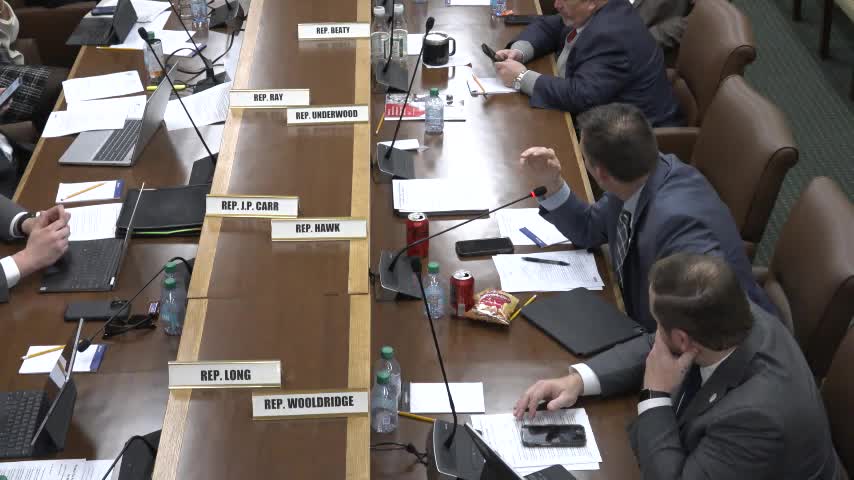
The sponsor moved the committee to advance SB 208. The committee recorded a roll‑call vote; the transcript records multiple members voting in favor and several opposed. The chair announced the bill passed the committee (recorded votes displayed in committee transcript). A roll-call in the transcript includes the following named votes (as recorded in the hearing): yes — Representative Meeks, Representative Berry, Representative Mayberry, Representative Ray, Representative Beatty, Representative Carr, Representative Underwood, Representative Long, Representative Hawk, Representative Rose, Representative Beck; no — Representative Innett, Representative McElroy, Representative Wooldridge. The committee chair announced the bill passed and said it would move forward for further House consideration.
Supporters said SB 208 provides a simple, one‑page verification step that deters fraudulent misrepresentation and protects the integrity of petition counts. Opponents said the same goals would be better achieved by stronger enforcement of existing laws, clearer petition forms and improved training for canvassers rather than adding a mandatory photo‑ID check for signers.
The committee approved SB 208 by recorded vote and the measure will be scheduled for further action in the House.