Get Full Government Meeting Transcripts, Videos, & Alerts Forever!
Get email alerts on the Inclusionary Housing topic
No spam. Unsubscribe anytime.
ARCH planner outlines inclusionary options and fee‑in‑lieu uses as Kenmore weighs middle‑housing rules
Summary
At a Feb. 18 Planning Commission meeting, ARCH planner Mike Stanger reviewed how cities can pair Washington’s HB 1110 middle‑housing requirements with inclusionary zoning, examples from Kirkland, Redmond and Sammamish, and how in‑lieu fees are collected and spent through the ARCH trust fund.
Kenmore City Planning Commission members heard a presentation Feb. 18 from Mike Stanger, a planner with ARCH (A Regional Coalition for Housing), on how cities can pair the state’s middle‑housing law with inclusionary housing approaches and fee‑in‑lieu programs.
Stanger framed the discussion around House Bill 1110’s middle‑housing provisions, reminding commissioners that the law allows up to four units per lot near major transit if a builder makes one unit affordable. “Cities can adopt other affordable housing programs, including inclusionary housing or incentives, to gain affordable housing through the new density that the middle housing bill requires,” Stanger said.
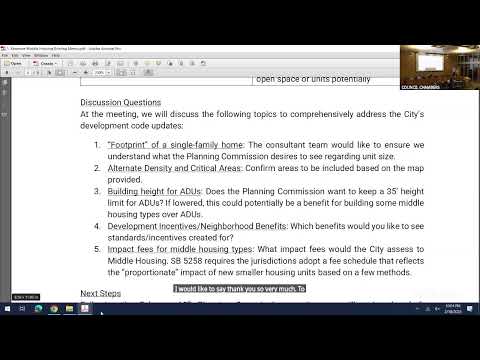
Why it matters: Commissioners are drafting local middle‑housing regulations to comply with state law while trying to retain tree canopy, limit impervious surface increases and preserve neighborhood character. How the city treats inclusionary requirements (onsite set‑aside versus a fee in lieu) affects whether affordable units appear in scattered new infill or are funded centrally and built elsewhere.
Stanger detailed how ARCH has approached feasibility and program design in East King County. ARCH’s study looked at prototypes ranging from duplexes to six‑plexes to estimate residual profit that could support affordable housing requirements without making projects infeasible. He said smaller projects often cannot absorb affordability requirements on‑site without becoming financially infeasible; in those cases, a fee in lieu is used.
He described typical uses and governance of in‑lieu fees: “In most cases, they go into the ARCH Trust Fund. That is the pool of funds that we manage for all cities and … our exec board, with help from a citizen’s advisory board, then recommends funding back to the City Councils,” Stanger said. He added that individual councils still approve spending, and that, at times, a city will hold fees briefly and pay a project directly when timing dictates.
Commissioners and Stanger discussed examples in nearby cities. Stanger said Kirkland’s program covers medium‑ and higher‑density zones and has produced roughly 53 ownership units and collected more than $5 million in fees in lieu; Redmond’s longstanding inclusionary requirement applies across the city (including single‑family zones), requires a 10% set‑aside at 80% of area median income (AMI) and has produced about 89 units. He added that Redmond set fee‑in‑lieu rates at about $30 per square foot for attached middle housing and $40 per square foot for detached types after an ARCH analysis.
Commissioners asked how in‑lieu funds are spent and whether they can be earmarked to fund projects within a contributing city. Stanger said funds are typically pooled in the ARCH trust fund but that spending decisions return to the contributing city’s council; he also said it is possible for a city to retain fees in its own affordable housing fund and direct them to local projects.
On enforcement and small projects, Stanger explained how jurisdictions treat fractional unit requirements: when a 10% requirement produces a fractional obligation (for example, 0.8 units for an 8‑unit project), codes typically allow fractions to be converted to a per‑unit or per‑square‑foot fee. Redmond uses simple rounding for small projects; other cities set a set fee rate to represent the fractional obligation.
Commissioners pressed on resale covenants and affordability duration. Stanger said homeownership units under the inclusionary approaches discussed are commonly subject to resale covenants of about 50 years, with each successive buyer signing the restriction.
Next steps: Commissioners signaled interest in further exploring both inclusionary set‑asides and fee‑in‑lieu options and asked staff and ARCH to return with concrete proposal options, cost estimates and mechanics for local administration and enforcement.
Ending: ARCH will provide written materials and follow‑up cost estimates for commissioners and staff; staff said they will post the presentation online for public review.