Get Full Government Meeting Transcripts, Videos, & Alerts Forever!
Get email alerts on the Agriculture Tax Policy topic
No spam. Unsubscribe anytime.
Committee advances credit to prioritize Arkansas rice in beer and sake ingredients
Summary
A House committee voted to advance House Bill 1491, which would give an excise-tax discount to brewers and sake producers that use Arkansas rice as a meaningful portion of their ingredient mix; bill sponsor disclosed ties to conservation group Delta Waterfowl and said industry groups back the measure.
House Bill 1491, a proposal to grant an excise-tax discount to beer and sake producers that use Arkansas-grown rice, was advanced by a House committee after a voice vote Tuesday.
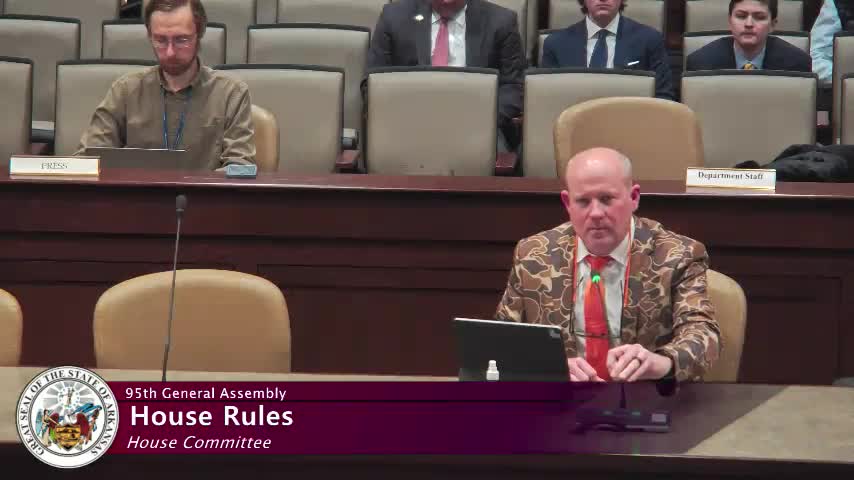
Representative Jeff Wardlaw (R-94) introduced the bill and said it is intended to “prioritize Arkansas rice” by offering a tax reduction to processors that use Arkansas rice above a specified ingredient threshold. Wardlaw disclosed he works for Delta Waterfowl and said rice provides habitat for wintering waterfowl and contributes revenue to the state.
Wardlaw said the bill would allow producers whose ingredient mix is more than 20% Arkansas rice to receive a 20% reduction in their excise tax; he also said the bill includes sake producers that use Arkansas rice. He described fiscal estimates by saying the “physical impact” came in “like 2 and a half million dollars” and that a separate figure was “less than $100,000.”
Supporters named during the presentation included Arkansas Rice, Riceland, the Arkansas Farm Bureau and Ducks Unlimited, Wardlaw said. Mark Lambert of the Arkansas Farm Bureau attended the committee and said he was present “for moral support.”
There were no public speakers for or against the bill on the committee sign-up sheet. Representative Wardlaw moved that the committee give the bill a “do pass” recommendation; the committee approved the motion by voice vote and the bill was reported out of committee.
The bill’s sponsor and supporters framed the proposal as an industry-targeted incentive; the committee did not render a roll-call tally in the transcript, and no formal fiscal estimate documents were included in the hearing record provided.