
Las Cruces council adopts 'Realize Las Cruces' zoning rewrite, sets 8‑month transition
Get AI-powered insights, summaries, and transcripts
Sign Up Free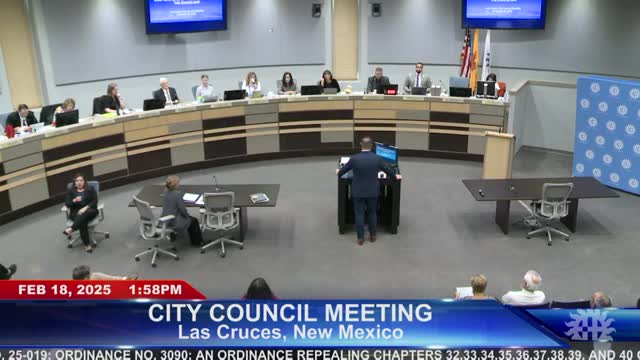
Summary
The Las Cruces City Council on Feb. 18 adopted Ordinance No. 3090 — the “Realize Las Cruces” development code update — by a 6–1 vote, aiming to increase housing options, streamline land‑use review, and move technical design standards into an amendable manual.
The Las Cruces City Council on Feb. 18 adopted Ordinance No. 3090 — the “Realize Las Cruces” development code update — by a 6–1 vote, aiming to increase housing options, streamline land‑use review, and move technical design standards into a separate manual.
City staff and the council said the code rewrite aligns the city's land‑use rules with the comprehensive plan, allow higher residential intensities in new neighborhoods, and aims to make permitting more predictable for builders and residents.
Realize revises zoning districts into three neighborhood types (NH‑1, NH‑2, NH‑3), reworks permitted uses and setbacks, and moves engineering‑level standards into a technical manual that staff can update more quickly. Community Development Director Chris Favor told the council the rewrite will “increase density allowances for residential development and that will allow greater flexibility for developers.”
Councilors and staff framed the changes as mainly affecting future development. Economic development staff said the ordinance allows small, low‑impact retail uses in some residential zones — for example, neighborhood groceries under 3,000 square feet or small cafes without drive‑throughs — and expands rights for accessory dwelling units where lot size and setbacks allow. Sarah Gonzalez, economic development staff, explained the package also creates a two‑step implementation during an eight‑month transition in which applicants may opt for the old code or the new code; after transition, the draft calls for existing structures to be brought into compliance within two years in specific situations.
Supporters said Realize is an attempt to address a local shortage of housing by allowing more types of housing — duplexes, townhomes, accessory units and limited mixed use — near services and transit. Dozens of residents and advocacy groups urged passage during a lengthy public comment period, saying the rewrite will create walkable neighborhoods and more affordable housing choices. The League of Women Voters of Southern New Mexico and several housing and social service speakers urged the council to pass the code.
Opponents, including many homeowners and neighborhood groups, argued the rewrite would change existing single‑family neighborhoods, reduce privacy and safety, and lower property values. Public commenters pressed for protections for existing homeowners such as a neighborhood petition threshold before a nonresidential use opens nearby. Council discussion repeatedly returned to those concerns. Councilmember Bill Matisse cast the lone no vote, saying he could not support changes that might allow commercial uses near existing single‑family homes.
Councilmembers and staff stressed safeguards: cannabis dispensaries are not permitted in NH‑1 and NH‑2 and would require a special use permit in NH‑3; gas stations must be on higher‑classification roads; parking, ponding and setback requirements remain in place and will continue to be enforced; and development review and public‑works review will consider traffic, pedestrian and bicycle safety. Staff also highlighted that new design standards will be placed in a technical manual so they can be updated more quickly than municipal code.
The ordinance passed on a roll call vote: McClure, Graham, Kran, Flores, Bencomo and Mayor Eric Enriquez voted yes; Matisse voted no.
The council established an eight‑month transition period during which applicants can choose to be processed under the old or new code; staff said they will return to council within the transition window to recommend any needed changes based on observed implementation issues.
Why it matters: City staff and supporters say the rewrite addresses a shortage of housing types and helps Las Cruces compete for state housing dollars tied to zoning and land‑use criteria. Opponents said the map‑ and use‑level changes risk altering long‑established neighborhoods and urged stronger grandfathering or petition requirements.
What happens next: With adoption, the council also approved the associated technical manual (separately adopted by resolution) that contains engineering and design standards. Staff said they will hold district meetings, post pamphlets, and run public outreach during the eight‑month transition so residents and design professionals can prepare.