Get Full Government Meeting Transcripts, Videos, & Alerts Forever!
Get email alerts on the Refugee Resettlement Workforce topic
No spam. Unsubscribe anytime.
Surge of Ukrainian arrivals reshaped Alaska resettlement; agencies urge credentialing, language and training supports
Summary
Catholic Social Services and Project Alaska told the House Judiciary Committee that recent Ukrainian humanitarian parolees and other arrivals sharply increased resettlement numbers, strained existing capacity, and highlighted opportunities to fill workforce gaps with targeted credentialing and training programs.
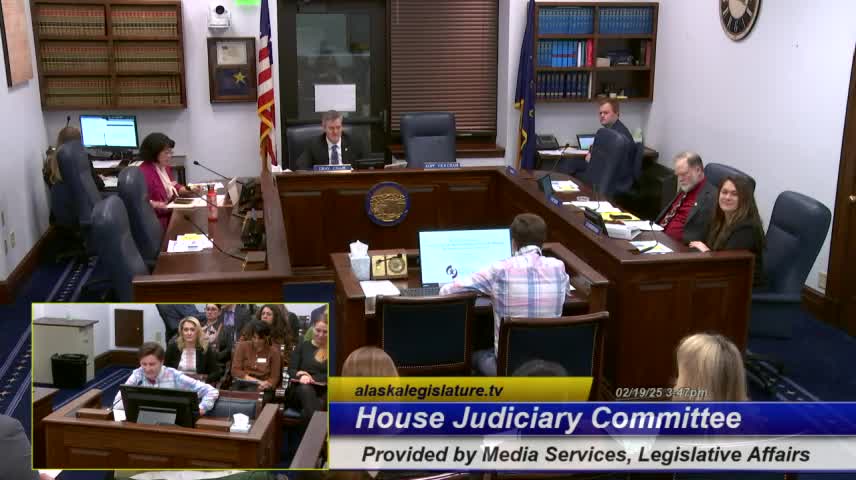
Isis Spatresano, Alaska state refugee coordinator for Catholic Social Services’ RAISE program, told the House Judiciary Committee on Feb. 19 that historical refugee resettlement to Alaska averaged roughly 150–180 people a year but spiked in federal fiscal year 2022 to 504 arrivals, 91% from Ukraine or Afghanistan. "As of 01/21/2025, the Alaska Office for Refugees is serving about 1,170 enrolled clients," Spatresano said, and she cautioned that the largest recent arrival group — Ukrainian humanitarian parolees — generally do not have a clear federal pathway to permanent status.
Tatiana Robbins, executive director of Project Alaska, described community efforts to bring family members to Alaska after the 2022 invasion of Ukraine, including a private fundraising airlift effort that raised nearly $1 million in seed donations and sponsorships though program rules ultimately shifted arrivals into the Uniting for Ukraine sponsorship pathway. Robbins described Project Alaska’s workforce and credentialing work: individualized job coaching, diploma evaluation partnerships, apprenticeship linkages and a diploma evaluation pilot with World Education Services to help professionals translate foreign credentials to U.S. standards.
Speakers and state partners highlighted job training pilots. Spatresano described a Mat‑Su VFW and school district pilot offering electrical and diesel mechanic certifications; 75 people attended the first workshop. Presenters pointed to Grow North Farm and Fresh International Gardens (FIG) as models that combine job training, income and community food production; Kirk Rose said farm vendors and participating food businesses have generated more than $500,000 in sales since 2019.
Several presenters and committee members flagged uncertainty about temporary statuses. Spatresano and Robbins said humanitarian parole and Temporary Protected Status (TPS) are discretionary federal designations that can be changed by the Administration; that uncertainty can affect work authorization, housing and long‑term planning for families. Representative Mina and others asked presenters about the legal threat to Ukrainian arrivals’ status and about what state actors could do to ease workforce transitions. Presenters urged expanded, flexible state and employer partnerships for language instruction, credential evaluation and targeted training tied to employer pipelines — for example, retooling certification requirements where safety and competency can be assured by supervised internships or bridging programs rather than full degree‑level repetition.
Deepika Ramesh Parimal, executive director of the Alaska Literacy Program, described language and workforce programs that support newcomers: advanced English classes, GED and citizenship test preparation, peer navigator programs and pre‑apprenticeship health‑care training. Ramesh Parimal said ALP now averages more than 600 students per quarter (up from about 350 per year in 2021) and partners with health care, education and workforce agencies to place students into jobs and further training.
Speakers asked the Legislature to consider programmatic investments, convening and implementation support rather than immediate statutory changes; they also asked the committee to follow up on implementation timelines for recently passed state bills that affect credentialing and licensing.