Get Full Government Meeting Transcripts, Videos, & Alerts Forever!
Get email alerts on the Immigration Services Trafficking topic
No spam. Unsubscribe anytime.
Nonprofit attorneys tell Judiciary Committee immigration status affects reporting of crimes; U and T visas, VAWA cited as relief paths
Summary
Alaska Institute for Justice explained to the House Judiciary Committee how immigration status shapes survivors' access to services and law enforcement, and reviewed visa-based relief (VAWA, U and T visas) and capacity constraints.
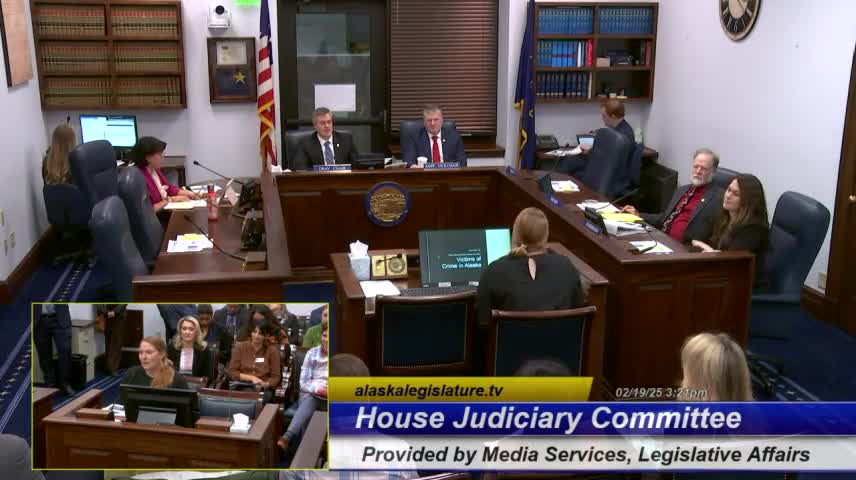
Anna Taylor, deputy director of the Alaska Institute for Justice, told the House Judiciary Committee on Feb. 19 that immigration status strongly affects whether a victim will seek help from law enforcement or service providers. "At the bottom, the most vulnerable people are people who are undocumented," Taylor said, adding that lack of status can mean no Social Security number, no work authorization and deep fear of deportation.
Taylor described legal avenues that can both protect survivors and encourage cooperation with law enforcement. She described the Violence Against Women Act (VAWA) self‑petition, U visas for crime victims who assist law enforcement, and T visas for human‑trafficking survivors. Taylor told the committee that U visas are capped at 10,000 per year nationwide and that the statutory cap has created a backlog; she said the Biden administration has allowed victims to obtain work permits while waiting on U‑visa adjudication.
Taylor also presented client service numbers used for federal grant reporting: she said that, in the most recent quarterly report (Oct. 1–Dec. 31, 2024), Alaska Institute for Justice and subgrantees served 40 survivors of human trafficking; of those 40 she said 32 were labor‑trafficking cases, 6 fell in another trafficking category, and 2 cases involved both categories. Taylor said other grant lines serve survivors of domestic violence and sexual assault and that demand for immigration legal services exceeds available nonprofit capacity in Alaska.
Taylor emphasized that certain immigration remedies are designed to reduce abusers’ power. “VAWA self petition … enables survivors of domestic violence to apply on their own without their abuser knowing about the application,” she said. Taylor asked legislators to recognize the complexity of federal immigration law and to support local services that help victims navigate federal applications and certifications required by law enforcement for U‑visa eligibility.
Committee members asked for follow‑up materials on trafficking and survivor services; Representative Vance asked for more information about the October–December trafficking statistics Taylor cited.