Get Full Government Meeting Transcripts, Videos, & Alerts Forever!
Get email alerts on the Department Of Agriculture Executive Order 136 topic
No spam. Unsubscribe anytime.
Senate Resources Committee sends resolution on governor's Department of Agriculture order to finance committee after public testimony
Summary
The committee voted 5-2 to move Special Senate Concurrent Resolution 1, which would disapprove Executive Order 136 establishing a Department of Agriculture, to the Finance Committee for further review after one public testimony and extended committee discussion about funding, staffing and timing.
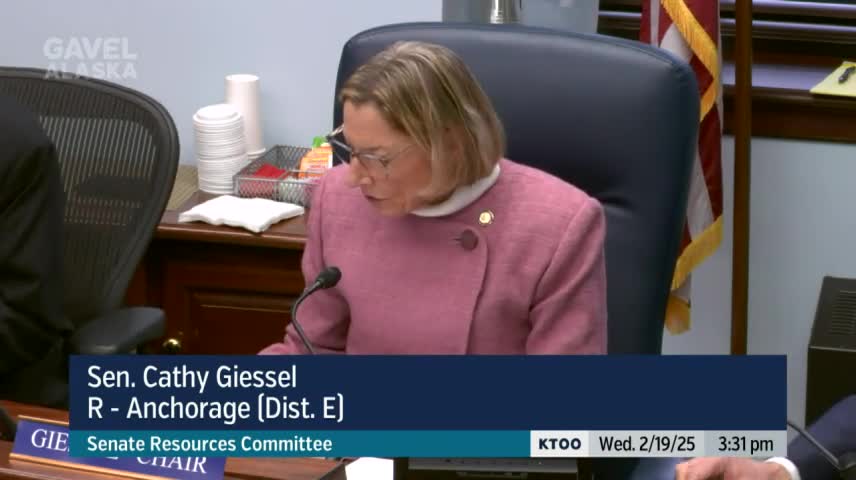
Senate Resources Committee Chair Senator Giesel on Feb. 19 moved Special Senate Concurrent Resolution 1, a disapproval resolution tied to Governor's Executive Order 136 proposing a standalone Department of Agriculture, to the Finance Committee following public testimony and committee debate.
The resolution would disapprove Executive Order 136, which the governor issued under Article 3, Section 23, of the Constitution of the State of Alaska and which would create a Department of Agriculture by transferring agriculture functions now in the Department of Natural Resources (DNR) to a new cabinet-level agency. Senator Giesel read the resolution aloud at the start of the hearing so the record would show the legislature had considered the matter and could convene a joint session to vote on the order.
Supporters told the committee a separate department could raise the profile of agriculture and direct more resources to producers, while opponents raised fiscal and implementation concerns.
Duncan Fields, president of the Kodiak Livestock Co-op, testified in favor of the governor's proposal. Fields said the co-op, which operates a Kodiak slaughter facility, had generally received good service from the division of agriculture but believed a standalone department would secure more consistent funding and attention to producers statewide. "We support the governor and ... we think it would be good for our industry and good for agriculture throughout Alaska to develop or establish a department of agriculture rather than keep the division of agriculture within the Department of Natural Resources," Fields said.
Members debated the merits and costs. Senator Hughes registered an objection to moving the matter out of the committee and urged not to reject the department's creation, calling it a "once in a multi-generational opportunity" and arguing a commissioner at the cabinet table would help shepherd recommendations from the Alaska Food Strategy Task Force (created by HB 298, 2022). Senator Wilikowski, who made the motion to refer the resolution to Finance, stressed that a yes vote to move the measure does not itself reject the executive order; it sends the question to a committee that can evaluate the fiscal and administrative details.
Committee members noted differences between the procedural resolution before them and the governor's underlying proposal. Chair Giesel clarified that the fiscal note attached to the legislative resolution is zero dollars but that the actual Department of Agriculture proposal carried a fiscal note of $2,700,000 to stand up the department. Senator Wilikowski also read aloud an administration summary that listed 13 new full-time positions the department proposal would initially create (including accountants, IT staff and administrative positions) and said additional funding requests could follow in subsequent years.
On a roll call requested by Chair Giesel, Senators Dunbar, Klayman, Wilikowski, Kawasaki and Giesel voted yes to move the resolution to Finance; Senators Myers and Hughes voted no. The committee recorded the motion as passing, 5 yeas to 2 nays. The committee will sign and transmit the referral paperwork and the matter will proceed to the Finance Committee for more detailed fiscal review and, if scheduled, later consideration in joint session.
What happens next: The resolution will be reviewed by the Finance Committee, which the Resources Committee identified as the next committee of referral. Committee members and supporters requested that Finance review the startup costs, the list of proposed positions, and the Alaska Food Strategy Task Force recommendations (the white paper passed to members during the hearing). Public testimony on the resolution at Resources consisted of one in-room speaker; Chair Giesel closed the public record after that testimony. The Resources Committee recessed its business and moved on to the first hearing on Senate Bill 92.