Division director outlines Alaska workers' compensation system, cites no-fault structure and focus on return to work
Loading...
Summary
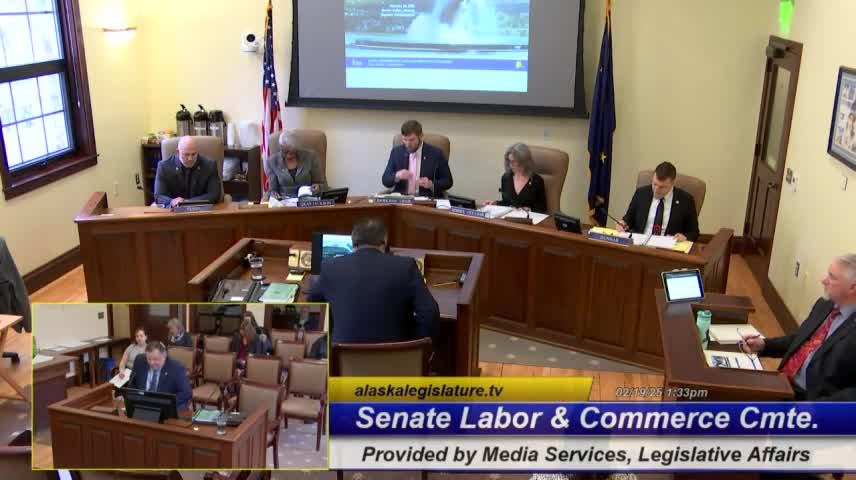
Charles Collins, director of the Division of Workers' Compensation, gave an overview of Alaska's workers' compensation system to the Senate Labor and Commerce Committee on Feb. 19, detailing the no-fault framework, claim handling, reemployment programs and caseload statistics.
Charles Collins, director of the Division of Workers' Compensation, told the Senate Labor and Commerce Committee on Feb. 19 in Juneau that Alaska’s workers’ compensation system is a state-run, no-fault framework designed to deliver “quick, efficient, fair and predictable” medical and indemnity benefits to injured workers.
Collins said the statutory definition of a work-related injury — ‘‘an illness or death that arises out of or in the course of employment’’ — drives the division’s approach to claims handling and mirrored the division’s internal motto. He described workers’ compensation as a social insurance system that places primary responsibility for payment on employers while aiming to get injured workers back to employment.
Alaska’s system, Collins said, pays medical benefits and wage-replacement benefits and includes reemployment services to help injured workers return to the workforce. He described key program elements: a toll of first reports of injury, an adjudication process that includes informal pre-hearing conferences and formal hearings before a three-member panel (a hearing officer and one labor and one industry panel member), a second independent medical evaluation process when medical evidence conflicts, investigator staff who pursue uninsured-employer and fraud referrals, a Fishermen’s Fund administered separately for commercial fishermen, and a benefit guarantee fund that covers claims where employers lack coverage.
Collins provided data from the division’s recent annual report: roughly 17,000 first reports of injury in the latest year cited, about 3,800 lost-time injuries, 5,000–6,000 contested matters that go beyond informal resolution, 123 formal hearings in 2023 and 68 mediations. He said the division retains claim records for 60 years and that some files remain open for medical benefits for decades.
Collins described changes enacted in recent years: statutory and program changes addressing permanent impairments and reemployment, the creation of a "stay-at-work/return-to-work" benefit implemented this year with a coordinator (named in testimony as Grace Morfield), and the Garrett benefit guarantee fund and other legislative updates. He also said the division has worked with a medical services review committee to reduce medical reimbursement rates; an Oregon study cited Alaska moving from the top five highest-cost states into the middle of the pack for workers’ compensation medical costs.
On procedural points, Collins summarized the typical claim path: medical care first, a first report of injury, payment of routine medical bills, and then a separate track where disputes lead to pre-hearing conferences, discovery and possibly mediation or formal hearing. He emphasized that settlements addressing future medical care receive board scrutiny and that attorneys are typically paid by the employer when the employee prevails, limiting direct attorney fees for claimants.
Committee members asked about specific practices. Collins said the division provides language assistance through contract interpreters and internal staff and that immigrant workers who are legally employed in Alaska are covered by workers' compensation. He clarified that cases remain in the division’s records for up to 60 years and, while a settled case is rarely reopened, it remains part of the database in case new evidence arises.
Collins described workload and staffing pressures: the division was operating with fewer hearing officers than ideal and said it can take time for new hearing officers to gain experience for complex claims. He closed by inviting committee members to meet the board and attend board meetings in Anchorage.
The committee paused the presentation at about 2:27 p.m.; Collins said he planned to return for additional briefing at a later meeting.