Get Full Government Meeting Transcripts, Videos, & Alerts Forever!
Get email alerts on the Vocational Training topic
No spam. Unsubscribe anytime.
AVTEC requests $888,600 to double industrial-electricity seats and $182,300 for an instructor
Summary
The Alaska Vocational Technical Center told a House finance subcommittee it needs $888,600 in FY2025 supplemental funds to buy and ship lab equipment and configure space to expand its industrial electricity program from 15 to 30 seats, and $182,300 in FY2026 to fund a second full-time instructor; no committee action was taken.
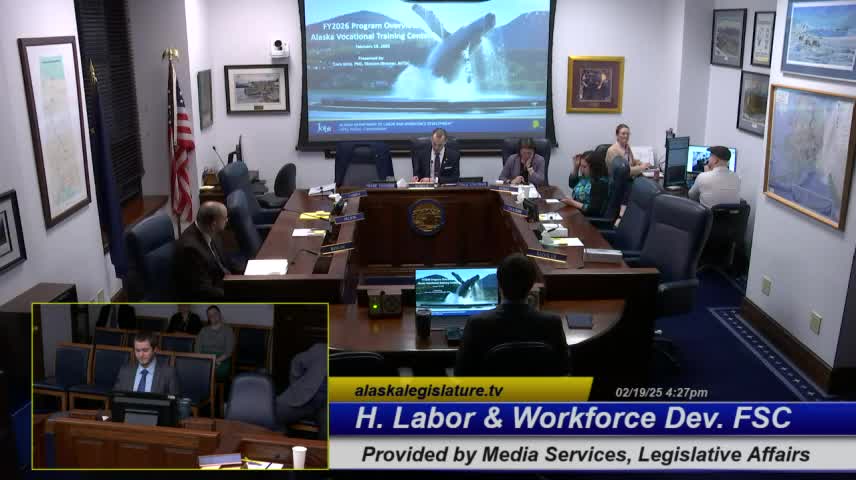
Dr. Corey Ortiz, division director of the Alaska Vocational Technical Center (AVTEC), told the House Finance Department of Labor and Workforce Development Subcommittee Feb. 19 that AVTEC is seeking an $888,600 FY2025 supplemental appropriation to buy and ship industrial-electricity lab equipment, configure the Seward lab space and fund targeted student recruitment, and a $182,300 FY2026 increment to cover salary and overhead for a second full-time instructor.
The request responds to what Ortiz described as immediate student demand: AVTEC received 40 applications for the industrial-electricity cohort; conditional acceptance letters went to the first 25 qualifiers and 15 students called in and paid half their tuition within about two and a half hours, filling the current class. Ortiz said the program currently trains 15 students and maintains a modest wait list and that doubling seats to 30 would make fall 2025 enrollment viable given procurement and shipping lead times.
The funding request would be used to purchase large, lab-oriented equipment — motors and programmable logic controllers arranged on training “blue boards” — and to hire an adjunct in FY2025 to oversee ordering, installation and curriculum preparation. Ortiz said a second full-time instructor would be needed once the expanded cohort begins; the $182,300 FY2026 request would cover that ongoing cost.
Why it matters: AVTEC is the Department of Labor and Workforce Development’s 24/7, residential technical training campus in Seward and supplies credentialed graduates for Alaska employers. Ortiz told the committee AVTEC has been accredited for about 25 years by the Council on Occupational Education and that many programs are at or above capacity; he said FY2025 long-term enrollments are among the highest in six years.
Committee members pressed AVTEC on program capacity, instructor availability and industry partnerships. Representative James Bynum asked whether industry pays some training costs and how AVTEC coordinates talent pipelines from high schools and apprenticeship sponsors. Ortiz said each program has an occupational advisory committee that meets annually to align curriculum with industry and that he is interested in exploring additional industry funding but did not describe existing industry payments for the industrial-electricity expansion.
Representative Josh Fields noted that the industrial-electric program often functions as a pre-apprenticeship for industry-funded NECA/IBEW apprenticeships and suggested long-term repayment models as a financing option. Ortiz said he would explore that idea.
AVTEC staff and committee members also discussed faculty recruitment and retention. Johnny Provost, AVTEC operations division manager, warned of the operational risk posed by a single-instructor model: “If that instructor were to decide to quit tomorrow, we would we would not be able to carry through with that program,” Provost said. Provost and Ortiz said instructor availability has affected enrollment historically when instructors left, and Ortiz noted AVTEC is currently bargaining with the faculty bargaining unit, limiting what he could say about pay adjustments during the hearing.
The committee asked for more detail on faculty compensation and long-term tracking of program completers. Ortiz said AVTEC tracks completion and initial placement as part of accreditation: AVTEC reported a FY2024 completion rate above 94 percent and a FY2023 placement rate of about 91 percent for program completers employed in their field of training. Ortiz said AVTEC does not systematically track graduates beyond initial placement and offered to follow up with more data.
Fiscal and prior supplemental funding questions received an administrative response. Dan DeBartolo, director of administrative services for the Department of Labor and Workforce Development, said a portion of last year’s UGF supplemental was one-time funding (about $329,000) used to cover a prior gap in tuition receipts as the department completed a regulatory package that raised tuition by 15 percent; he said about $250,000 went to base general operations and that staff would provide an accounting on request.
AVTEC described other facility and program needs raised to the committee. Ortiz said AVTEC’s campus includes roughly 43,000 square feet of lab space, 20 buildings including dorms, a cafeteria and a firefighting/maritime training field. He told members AVTEC faces deferred maintenance needs (the roof of the Industrial Electricity Training Building is slated for repair in the fiscal year) and recurring dormitory bandwidth constraints that cause periodic slowdowns. Ortiz said AVTEC is considering replacing aging wireless access points and buying more bandwidth from its partner GCI but has not completed a cost analysis.
Ortiz also described AVTEC’s maritime training center and contract-training partnerships with industry, citing Trident Seafoods and the Alaska Energy Authority as clients that send cohorts and fund specific related training. Carrie Anderson, AVTEC maritime department head, said AVTEC collaborates monthly with the University of Alaska Southeast–Ketchikan campus and the Alaska Marine Highway on training needs and has shared instructors or equipment when partners are short-staffed.
Ortiz closed by highlighting student outcomes and testimonials, quoting a graduate: “AVTECH will literally change your life. If you want a great job and skills that will make you highly employable, attend AVTECH,” which he presented as an example of graduate experience.
No formal committee action or vote took place on the funding requests during the Feb. 19 hearing. Committee members requested follow-up information on industry partnerships, faculty compensation and a detailed accounting of prior supplemental funds. Ortiz invited committee members to tour AVTEC’s Seward facilities.
The subcommittee adjourned without taking a vote on the requests.