Get Full Government Meeting Transcripts, Videos, & Alerts Forever!
Get email alerts on the Maritime Ports topic
No spam. Unsubscribe anytime.
Alaska longshore union warns carrier withdrawals and infrastructure gaps threaten ports and seafood exports
Summary
Leaders of the International Longshore and Warehouse Union(ILWU) Alaska Longshore Division told legislators in Juneau that carrier decisions, limited cold storage, and aging dock infrastructure are disrupting seafood exports and could cut work opportunities across key ports, while the union opposes automation that would replace local jobs.
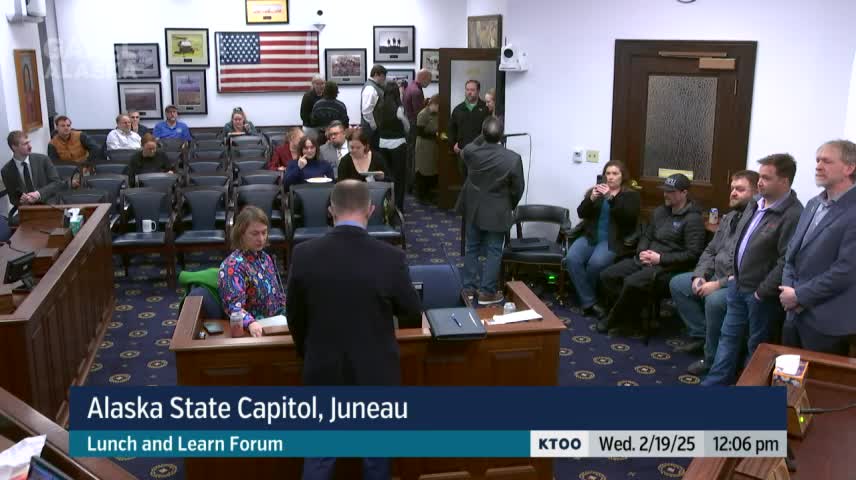
Senator Jesse Kiel hosted a Juneau "Lunch and Learn" where leaders of the International Longshore and Warehouse Union Alaska Longshore Division outlined workforce, infrastructure and shipping-carrier challenges facing Alaska ports and seafood exports.
The union's president, Dennis Young, said the ILWU represents coastal workers from Ketchikan to Dutch Harbor and noted the union's state membership and benefits reach: "We have approximately 235 registered members, 300 plus casuals, and 800 family members that are covered under our benefit plans all across the state of Alaska." He said the union is preparing for shore-power projects in Seward and Kodiak and other port investments to reduce emissions and improve operations.
Why it matters: Alaska's ports are central to the state's seafood, cruise and energy industries. Union leaders told legislators and attendees that decisions by ocean carriers and gaps in cold storage and dock maintenance are already reshaping which ports can export product efficiently — with direct consequences for local jobs and municipal revenues.
Dennis Young, president of the International Longshore and Warehouse Union Alaska Longshore Division, said a major immediate concern is the reduction in service by container carriers. Young said Maersk "pulled out of Alaska" for containerized seafood exports and that carrier consolidation and space-allocation practices are leaving Alaska out of regular calls unless customers guarantee container volumes. He warned that Matson and remaining carriers do not serve all of the same markets in Asia, which could reduce export opportunities for 2025.
Travis Swangle, a Southwest area representative, emphasized the sector—s reliance on seafood: "Alaska produces approximately 60% of the nation's seafood," he said, and described Dutch Harbor and Kodiak as export hubs handling billions of pounds of wild-caught product. Swangle and other presenters said limited cold storage capacity is constraining exporters when global gluts require product to be held while buyers decide.
Speakers from different regions described local challenges: - Darryl Veil, secretary-treasurer (Juneau), and other Southeast representatives stressed the economic importance of cruise tourism in Juneau, Ketchikan and Sitka and noted plans for dock expansions in downtown Juneau and the potential for more berths for cruise lines. - Travis Swangle noted travel costs and weather limit mobility for Southwest ports: he said one-way air fares to Dutch Harbor can be about $1,000 and that weather delays sometimes leave workers stranded for days. He urged expansion of cold storage and port maintenance. - Caleb Adleman, South Central representative, said Seward and Whittier together handle roughly a half-million passengers as turnaround ports and described Seward as the northernmost ice-free deepwater port in the United States.
On automation and national security, Young said the union opposes automation that would replace port jobs, arguing that "robots don't don't pay taxes. They don't buy homes. They don't put kids in schools." He also flagged an intelligence and procurement concern: he said many gantry cranes used in U.S. ports are manufactured overseas and that "there's actually been discussion back in D.C. ... they've basically found trackers on ... that nobody can explain."
Presenters also described opportunities: shore-power projects in Seward and Kodiak to cut vessel emissions, potential renewable-energy projects (including geothermal near Dutch Harbor) that could lower processing costs, and local training to expand the number of drivers with commercial licenses for cargo movements.
Questions from the audience addressed workforce structure (registered members versus casuals), carrier access, automation risks and the proportion of domestic versus export container flows. Young described the registered workforce as an on-call force that generally remains active year-round and noted that ports rely on a mix of registered members and trained casuals to meet demand.
No formal votes or policy actions were taken at the session; it was an informational presentation and Q&A. Presenters asked legislators and local planners to consider the effects of dock maintenance, cold-storage capacity and carrier service patterns when evaluating port investments.
The ILWU representatives said they plan to continue conversations with legislators and local ports on shoreline electrification, cold storage expansion and carrier access to protect export routes and local jobs.