Get Full Government Meeting Transcripts, Videos, & Alerts Forever!
Get email alerts on the Development Agreement Cordero topic
No spam. Unsubscribe anytime.
Planning commission delays decision on releasing parcel from Cordero agreement, citing infrastructure and contract concerns
Summary
Developer Caleb Levitt asked the Cedar City Planning Commission to release his parcel from the longstanding Cordero development agreement and accept a replacement development agreement. Commissioners and staff said key infrastructure modeling and agreement terms remain unresolved and voted to table the item to April 1.
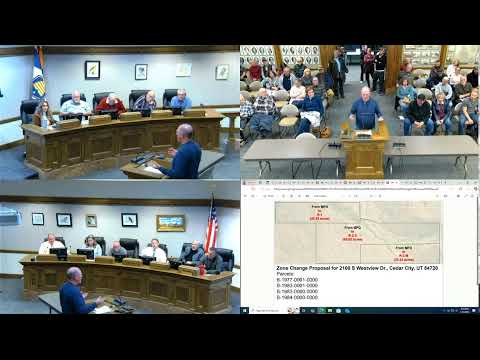
The Cedar City Planning Commission on Thursday deferred action on a request from developer Caleb Levitt to be released from the Cordero development agreement and to proceed under a replacement development agreement, citing incomplete infrastructure modeling and unresolved contractual obligations.
Levi tt sought formal release of roughly 60 acres of property from the original Cordero agreement and presented a draft replacement development agreement for the commission’s consideration. "This is an agreement that we have put together with the other successors of the property to basically exit our development from the old agreement and replace it," Levitt said.
Commissioners and city staff said the replacement agreement as submitted lacks the level of detail the city needs about how water, sewer and road systems will interconnect with the remainder of the Cordero area. City staff and the commission urged Levitt to work with other successor property owners — specifically the nearby 1,361‑acre property that is also pursuing development — and to have modelers produce combined engineering models showing how sewer flow, lift stations and water mains will work if buildout occurs in stages.
Why it matters: the original Cordero agreement tied multiple properties together and provided the city assurances (and developer concessions) that allowed annexation and planned infrastructure. Staff warned that carving only part of Cordero out without coordinated modeling could leave the city bearing upgrade or decommissioning costs or with incomplete infrastructure that does not connect across properties.
Staff and commissioners outlined several specific concerns: whether upsizing of water or sewer lines required for the broader Cordero buildout would be paid by the city or by developers; who would fund and later decommission temporary lift stations; whether the submitted development agreement includes enforceable obligations to locate modeled utility stubs at agreed property boundaries; and whether the draft would leave the city in a weak bargaining position if other successors later decline to participate.
City attorney Randall told the commission the original Cordero agreement was a 25‑year contract whose negotiated concessions were part of the city’s calculus to provide services at annexation. He noted a separate nine‑year practical window commissioners could use as leverage if a successor seeks piecemeal release. "Rescinding this agreement for a party would put the city in a worse position than we are right now," he said.
Several commissioners said the preferred path is a coordinated, broader plan: an RDO‑level or master plan prepared and modeled jointly with other successor owners that demonstrates how utilities and roads will ultimately connect. Commissioners said that if Levitt and at least the principal adjacent successor can produce shared modeling and a replacement agreement that preserves the city’s interests, the commission would be more likely to support a release.
Public commenters repeatedly raised water and density concerns. Residents near the proposed development said they want assurance about water availability, road impacts and a clearer transition between existing single‑family lots and any higher‑density zoning (R3M) proposed in the development agreement. The city planner and staff responded that zoning changes and density are part of the land‑use review but that the commission will expect clear “feathering” and buffering where higher densities abut existing homes.
Formal action: after extended discussion and public comment, the commission voted to table the item and return it to a future meeting with more detailed modeling and negotiated language between the developer and city staff. The commission set April 1 as a date certain for the applicant to return with additional information.
What’s next: commissioners and staff recommended that Levitt coordinate model runs with the city’s engineering modelers and with adjacent successor owners (including the party identified as the 1,361‑acre property) and that the replacement development agreement include explicit obligations about utility upsizing, lift station responsibilities and decommissioning language. Levitt said he would continue to pursue those negotiations and modeling.
Ending: the commission emphasized that its reluctance to approve a piecemeal release reflects contractual and infrastructure risk to the city, not opposition to development in general. Commissioners repeatedly encouraged Levitt to pursue joint modeling with adjacent owners and to work with city legal staff before bringing a revised replacement agreement back to the commission on the April 1 docket.