Get Full Government Meeting Transcripts, Videos, & Alerts Forever!
Get email alerts on the Lead Service Line Replacement topic
No spam. Unsubscribe anytime.
Superior council rejects resolution to let private utility access federal lead‑line grants
Summary
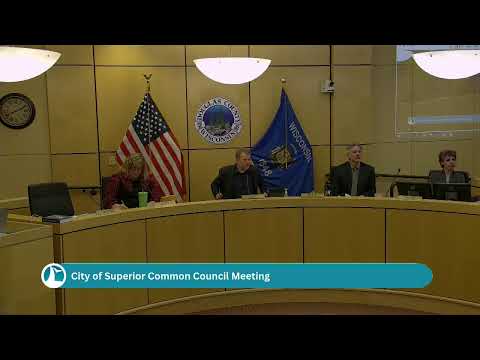
After more than two hours of public comment and council debate, the Superior Common Council voted 6–4 to reject a resolution asking the Wisconsin Legislature to allow Superior Water, Light and Power to receive federal capitalization‑grant funds for lead service line replacement.
The Superior Common Council on Feb. 19 rejected a resolution asking the Wisconsin Legislature to change state law so that Superior Water, Light and Power — a privately owned utility — could receive federal capitalization grants for lead service line replacement.
The resolution, introduced by Councilor Katie Fennessy and seconded by Councilor [first name not specified in transcript] Johnson, drew extended public comment and debate before the council voted 4–6 against the measure. Councilors who voted yes were Councilor Katie Fennessy, Councilor Elm, Councilor Herrick and Councilor Johnson; Councilors Grama, LaDeen, Van Sickle, Moffett, Sweeney and Ludwig voted no.
Supporters told the council the change would help secure state and federal funds to speed replacements. “I got that letter in the mail. Knowing full well, my 1889 home is full of lead,” said Shannon Johnson, who identified herself as a South End homeowner and business owner, appealing for help to avoid leaving replacement costs entirely with homeowners. Kyle Bukovich, president of Northern Wisconsin Building Trades, said the trades support the resolution for worker safety and to allow the utility to access grants to replace lines.
Opponents, including multiple councilors, focused on the legal and financial risks of allowing a private, investor‑owned utility to receive grant funds. Councilor Moffett called the proposal “a bad bill,” arguing private ownership shifts grant benefits to an owner that may not use all funds for customer‑side work and could raise long‑term costs for ratepayers. Several councilors said the city can pursue its own replacement program and loans.
Jocelyn Skandell, manager of regulatory compliance for Superior Water, Light and Power, answered technical questions from councilors about state programs and said the Wisconsin Department of Natural Resources program reimburses construction costs and may reimburse engineering costs; she stated, “No admin costs are recoverable through that program.” Skandell also said the DNR awards funding by a pointing system that prioritizes homeowner replacements first and then utilities if funds remain.
Council debate touched on multiple technical and policy points: whether the DNR program allows administrative costs; which side (homeowner or utility) is prioritized for reimbursement; how many lines need replacement; per‑line cost estimates; and whether public funding directed to a private utility could increase the utility’s asset value, and therefore the purchase price if the city later sought to acquire the system.
Key factual figures discussed at the meeting included councilors’ and staff estimates that roughly 8% of homeowner service lines in the city are lead on the homeowner side and that about 38% of utility‑owned service lines appear in the utility inventory as lead service lines connected to active accounts. The utility cited prior averages of about 285 utility‑side replacements per year and an application estimate of about $7,000 per utility‑owned service line; Superior Water, Light and Power also provided a homeowner‑side average cost estimate in the $8,000–$12,000 range (the utility used $10,000 as a middle estimate). One councilor cited a rough system‑wide replacement cost of about $44,000,000 based on per‑unit figures and counts discussed at the meeting.
Councilors and utility staff also discussed timing: Skandell said a June 30 deadline applies for submitting an application for 2026 DNR funding, which is why proponents sought a council signal before that date. Opponents said the resolution as written was a blanket endorsement without conditions, oversight language, or guarantees that funds would be used to replace homeowner‑side service lines.
The measure failed on a roll call, 4 in favor and 6 opposed. Several councilors said that regardless of the vote tonight the city will continue work on city‑led replacement and financing options, and staff indicated the city plans to pursue replacement on streets scheduled for construction this year and to develop loan or grant programs to reduce homeowner out‑of‑pocket costs.
The council’s detailed public record of the debate includes questions to and answers from the Wisconsin DNR and the Public Service Commission of Wisconsin on program structure, pointing/prioritization, and reimbursement mechanics.