Get Full Government Meeting Transcripts, Videos, & Alerts Forever!
School board reviews FY26 proposed budget as enrollment and revenue fall; administration proposes cuts and targeted investments
Summary
District staff presented a FY26 proposed budget that assumes a roughly $16 million shortfall driven by lower enrollment and declining state revenue. The plan pairs staffing reductions and school consolidations with targeted investments and asks the borough for a higher local contribution; board members requested alternate scenarios and more data.
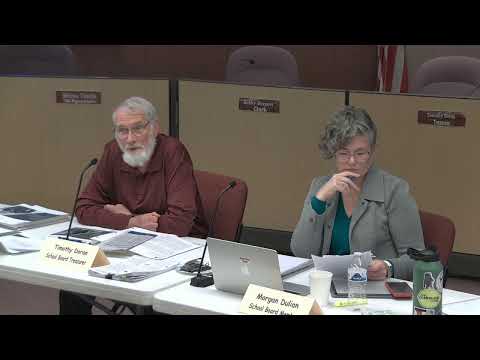
Fairbanks North Star Borough School District board members spent a Feb. work session reviewing an FY26 proposed budget that administration says is built around a roughly $16 million shortfall driven by lower student enrollment and declining state revenue.
District staff presented the proposal and described its assumptions and trade-offs. Mr. DeGraw, district budget presenter, told the board the district is projecting 11,626 students for FY26 and that ‘‘actuals [have been] coming in lower, sometimes significantly lower than what we have projected,’’ a trend he said has put continual pressure on fund balances. He said the current-year deficit is principally a $10.3 million increase in expenditures and a roughly $5.7 million drop in revenue, producing the shortfall.
The proposed budget pairs reductions — including increases in pupil‑teacher ratios (PTR) that remove roughly 33–34 FTE classroom positions and a plan to contract custodial services — with a set of smaller investments such as reinstating two swim‑aid positions, additional curriculum materials and technology, and a $2 million transfer from the general fund to the transportation fund to stabilize bus service.
Why it matters: the district’s audited FY24 general‑fund calculation sits at about $11.2 million, which administrators and several board members called an insurance policy that could be quickly consumed if revenue falls further. Board members repeatedly pressed administration for more conservative enrollment scenarios and for detailed, alternate “balancing act” scenarios that show the budget’s sensitivity to higher declines, lower borough support or smaller increases from the state.
What administration assumed and asked for
Mr. DeGraw said the proposed budget uses three main revenue assumptions: a base student allocation (BSA) of 5,960 (the governor’s number at the time), an assumed BSA increase equivalent of 6.80 (the proposal the district built into its numbers), and a projected enrollment decline of 179 students compared with the current year. Mr. DeGraw said administrators purposely used conservative revenue estimates to avoid over‑allocating funds.
Dr. Minor, district co‑presenter, reiterated that the 6.80 assumption is not a…
Already have an account? Log in
Subscribe to keep reading
Unlock the rest of this article — and every article on Citizen Portal.
- Unlimited articles
- AI-powered breakdowns of topics, speakers, decisions, and budgets
- Instant alerts when your location has a new meeting
- Follow topics and more locations
- 1,000 AI Insights / month, plus AI Chat