Get Full Government Meeting Transcripts, Videos, & Alerts Forever!
Get email alerts on the School Budget topic
No spam. Unsubscribe anytime.
School board reviews FY26 proposed budget as enrollment and revenue fall; administration proposes cuts and targeted investments
Summary
District staff presented a FY26 proposed budget that assumes a roughly $16 million shortfall driven by lower enrollment and declining state revenue. The plan pairs staffing reductions and school consolidations with targeted investments and asks the borough for a higher local contribution; board members requested alternate scenarios and more data.
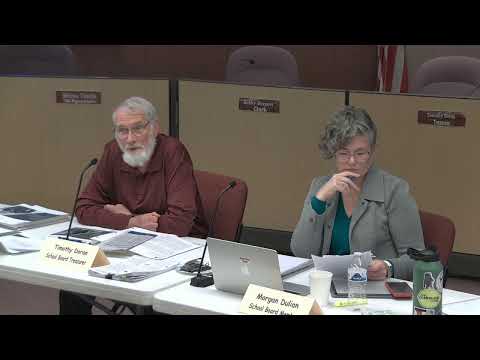
Fairbanks North Star Borough School District board members spent a Feb. work session reviewing an FY26 proposed budget that administration says is built around a roughly $16 million shortfall driven by lower student enrollment and declining state revenue.
District staff presented the proposal and described its assumptions and trade-offs. Mr. DeGraw, district budget presenter, told the board the district is projecting 11,626 students for FY26 and that ‘‘actuals [have been] coming in lower, sometimes significantly lower than what we have projected,’’ a trend he said has put continual pressure on fund balances. He said the current-year deficit is principally a $10.3 million increase in expenditures and a roughly $5.7 million drop in revenue, producing the shortfall.
The proposed budget pairs reductions — including increases in pupil‑teacher ratios (PTR) that remove roughly 33–34 FTE classroom positions and a plan to contract custodial services — with a set of smaller investments such as reinstating two swim‑aid positions, additional curriculum materials and technology, and a $2 million transfer from the general fund to the transportation fund to stabilize bus service.
Why it matters: the district’s audited FY24 general‑fund calculation sits at about $11.2 million, which administrators and several board members called an insurance policy that could be quickly consumed if revenue falls further. Board members repeatedly pressed administration for more conservative enrollment scenarios and for detailed, alternate “balancing act” scenarios that show the budget’s sensitivity to higher declines, lower borough support or smaller increases from the state.
What administration assumed and asked for
Mr. DeGraw said the proposed budget uses three main revenue assumptions: a base student allocation (BSA) of 5,960 (the governor’s number at the time), an assumed BSA increase equivalent of 6.80 (the proposal the district built into its numbers), and a projected enrollment decline of 179 students compared with the current year. Mr. DeGraw said administrators purposely used conservative revenue estimates to avoid over‑allocating funds.
Dr. Minor, district co‑presenter, reiterated that the 6.80 assumption is not a certainty and framed the district’s fund‑balance as an ‘‘insurance policy’’ should that increase not materialize. Board member Ms. Julian asked directly whether it was prudent to include the 6.80 assumption; Ms. Julian said that uncertainty made her reluctant to rely on one‑time or uncertain revenue in the baseline.
Fund balance, state vs. borough calculations
Administrators explained two ways of measuring available fund balance. Mr. DeGraw said the state calculation allows subtraction of encumbrances (committed purchase orders) and produces a lower effective cap the district tracks (about 10% of expenditures under state rules, which equated to roughly $11.2 million in audited FY24 figures). The borough uses a different method across five tracked funds and does not permit subtracting encumbrances, a distinction that produces different reported balances. Board members asked for a clearer breakout of both calculations, recent audited figures and more up‑to‑date projections for the end of FY25.
Staff reductions, closures and service changes
The proposed FY26 budget contains a mix of system‑wide reductions and a handful of targeted restorations. Key elements presented by Mr. DeGraw include:
- Increasing elementary PTR in grades K–5 from 25 to 27.5 and similar PTR increases at middle and high school levels, which administration estimates will remove about 18 FTE elementary and about 15 FTE secondary classroom teachers. Overall general‑fund FTE drops in the proposed budget from about 1,470 to about 1,306 (a decrease of roughly 164 FTE), including PTR adjustments and the effects of school consolidations. - Contracting custodial services (estimated savings about $3 million). - Projected savings from previously discussed school consolidations and a reduced‑staffing model for Salcha Elementary (numbers presented during the session: closure‑related savings and a reduced staffing model estimated at several hundred thousand to millions depending on scenario). - A 1.0 FTE reduction at the CEC program and 2.5 FTE fewer counselors spread across Lathrop, West Valley and North Pole High (after reductions, some large high schools would have about three counselors each).
Administrators said much of the FTE reduction can be absorbed through attrition, but they would not guarantee that no layoffs would be required.
Targeted investments and program restorations
The administration proposed several investments it characterized as high‑impact and relatively low‑cost: reinstating two swim‑aid positions (one at North Pole and one at Ryan Middle) after community requests, increasing curriculum materials funding by about $300,000, investing roughly $600,000 in educator laptops, and the $2 million subsidy to transportation. District staff said the borough’s willingness to waive pool rental fees for student use changed the net cost of the swim program and made reinstatement more feasible.
Transportation and impact aid interactions
Board members and staff spent significant time on transportation. Administrators said the district currently runs roughly 90 routes and that a large share are special‑education routes; special‑education transportation is legally required. Mr. DeGraw said the proposed $2 million transfer to the transportation fund is meant to offset rising costs and declining state transportation revenue, and he noted the governor’s budget proposal for a 20% transportation increase would materially reduce, but probably not eliminate, the subsidy needed.
Board members also pressed staff on federal Impact Aid. Ms. Hardy described calculations showing that if the borough increased the local contribution closer to the cap, the district would retain a larger share of Impact Aid dollars (she presented illustrative figures showing sizable changes depending on the borough contribution). Mr. DeGraw confirmed the relationship: a higher local contribution can reduce the percentage of Impact Aid that is deducted from state funding and thus effectively increase net dollars for the district.
Charter funding, one‑time dollars and pass‑throughs
Administrators proposed passing on half (not all) of the one‑time 6.80 equivalent funding to charter schools in the proposed budget; the presentation noted the district is not strictly required by statute to pass one‑time funds to charters. Ms. Julian and others urged that if the state places recurring increases in the BSA, routing those increases to the BSA would be the clearest way to fund both neighborhood and charter schools equitably.
Board requests and next steps
Board members repeatedly asked administration for more scenarios and data. Formal requests included: alternate enrollment projections (more conservative declines such as 3% scenarios), updated FY25 fund‑balance projections, a clean breakout of reductions by dollar and FTE (including a 3‑year comparison of expenditures by function), precise estimates of how a higher borough contribution would change Impact Aid kept by the district, and the projected budgetary effect if the governor’s transportation increase holds.
Several board members also asked staff to provide more detailed cost estimates for possible alternatives — for example, a reduced‑staffing model for 2 Rivers or Salcha (to inform possible community or charter alternatives), and a clear mapping from proposed administrative reductions to specific positions or functions.
Quotable
Mr. DeGraw, district budget presenter, on the enrollment trend and fund pressure: "The reason why we show this is there's been a pretty consistent trend ... of actuals coming in lower, sometimes significantly lower than what we have projected." Mr. DeGraw, on the current‑year deficit makeup: "Increased expenditures a little bit over $10,000,000 and a loss in total revenue of approximately $5,700,000. So that's what makes up that deficit." Ms. Julian, board member, on relying on the governor’s proposed increase: "Is this prudent of us to include this 6.80 BSA increase?" Ms. Hardy, board member, on fund balance as insurance: "I appreciate that you're including that 6.80. I think it's a reasonable risk to take but also pointing out for us in the public that if our insurance policy is 11,200,000.0 our insurance policy is not big enough."
Ending
Administration said it will update the slide deck and supply the board with requested breakout tables and scenario runs in advance of future work sessions and the regular meeting that will move the proposed budget toward a recommended budget in March. The district’s deadline to submit a recommended budget to the borough is April 1; the board’s final adopted budget is typically approved in June but may shift if state revenue figures arrive late.