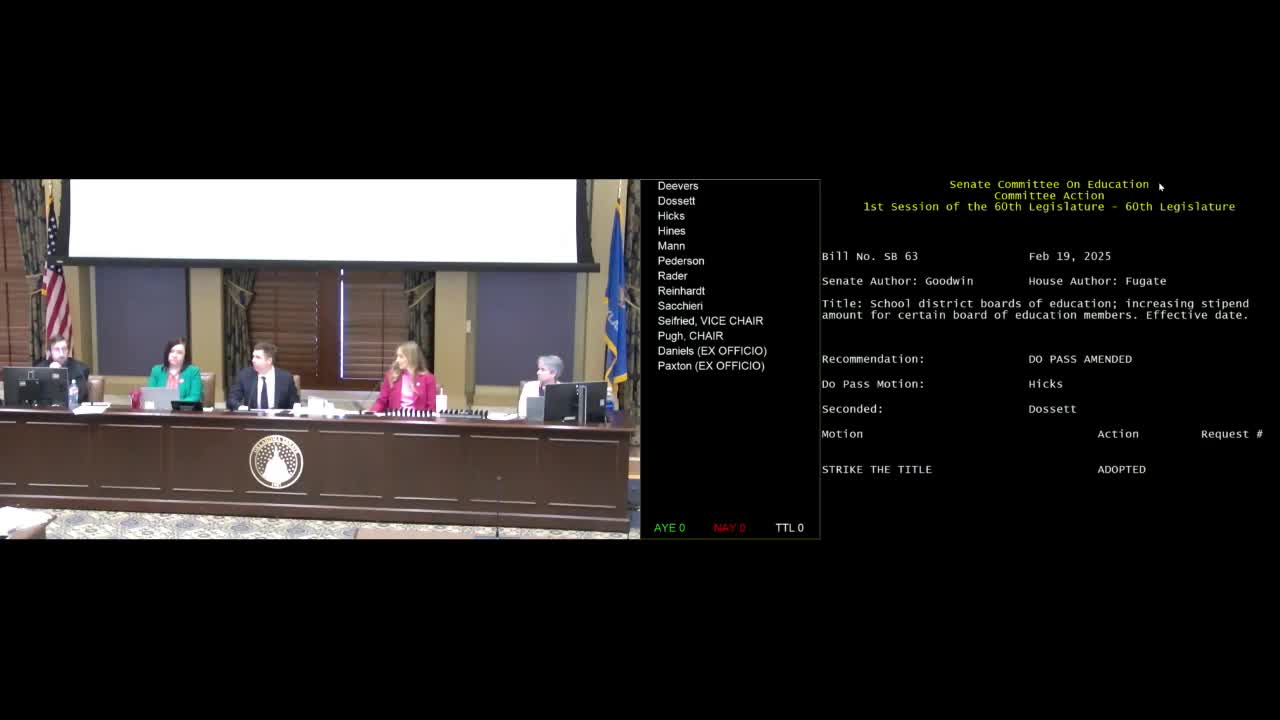
Committee removes public‑school‑enrollment requirement for Lindsay Nicole Henry scholarship, passes bill 9‑3
Loading...
Summary
The Senate Education Committee approved changes to the Lindsay Nicole Henry scholarship, eliminating a one‑year public‑school enrollment requirement and excising language that said scholarship acceptance revoked consent to public school services; the bill passed committee 9‑3 after extended debate on IEPs, definitions and fiscal impact.
The Senate Education Committee on a 9‑3 vote approved revisions to the Lindsay Nicole Henry scholarship statute that remove a requirement that families keep a child in public school for one year before accessing the scholarship and delete a provision that stated acceptance of the scholarship revoked consent to public school services.
Leader Daniels, the author, told the committee the changes are housekeeping and corrective: the original one‑year requirement dated to a period when districts were allowed to count students after they left, a practice the committee said no longer applies. Daniels said the earlier language had produced confusion for parents and school districts and conflicted with federal law on consent.
Why it matters: The scholarship provides publicly funded tuition support for students with qualifying disabilities to attend nonpublic schools that can meet their needs. Committee discussion focused on federal Individuals with Disabilities Education Act (IDEA) requirements, who prepares individualized education programs (IEPs) and how state rules will protect both parental choice and federally guaranteed services.
What the bill does and committee discussion
- Substantive change: removes the requirement that a student attend public school for one year before being eligible for the scholarship and deletes language that said scholarship acceptance revoked consent to public school services.
- Fiscal and scale context: Leader Daniels said the program served 1,557 students in FY23‑24 with total scholarship spending of about $12,000,000; last year’s average scholarship cited in committee testimony was $7,866 and SDE estimated scholarship costs can range from about $4,196 to $22,236 depending on the student and services. SDE retains 2.5% of scholarship funds for administration, the author said.
- Federal compliance and screening: Committee members pressed the author on whether the change broadens eligibility and how states and districts will ensure applicants meet IDEA thresholds. Senator Hicks asked whether private schools receiving scholarship students would be required to provide IEPs and how initial evaluations and child‑find responsibilities would be met. Leader Daniels repeatedly noted that federal law (IDEA) governs eligibility and that child‑find and associated screening responsibilities remain with the public school system under federal law.
- Definition questions: Senators asked why the bill uses the term “special need” instead of “disability,” and the author said she would clarify language and that eligibility criteria in the statute remain tied to the IDEA categories and criteria.
- Concerns raised: Committee members asked about the potential fiscal growth of the program if access is broadened, whether families bear the cost of initial testing (some comments noted private diagnostic testing can be costly), and whether the bill requires periodic reevaluation of students who remain on scholarship.
Representative testimony and clarifications
Leader Daniels: “This isn't allowed under federal law. You cannot revoke consent.” (referring to removing language that suggested parents could waive services.)
Senator Mann (former school board member): “I didn't run for the school board to make money, but I can tell you the $25 per meeting stipend did not cover my gas or my time.” (debating a different bill in same hearing but echoed committee concern for compensation and supports).
SDE and process notes: SDE officials on the record said it is difficult to predict enrollment growth but confirmed the program is small relative to statewide enrollment and that administrative fees and scholarship averages were based on FY figures.
Outcome and next steps: The committee voted 9 ayes and 3 nays to pass the bill. Authors said they would work with committee members and SDE to clarify language about “special need,” IEP procedures and whether a reevaluation protocol should be explicit in statute or left to administrative rulemaking. The bill proceeds to the Senate floor for further consideration.
Provenance: topicintro excerpt from Leader Daniels introducing the bill (transcript at 2435.865–2463.51). Top finish: committee roll call declaring the bill passed (transcript at 4191.445–4210.005).