Get Full Government Meeting Transcripts, Videos, & Alerts Forever!
Get email alerts on the Sentencing Eluding topic
No spam. Unsubscribe anytime.
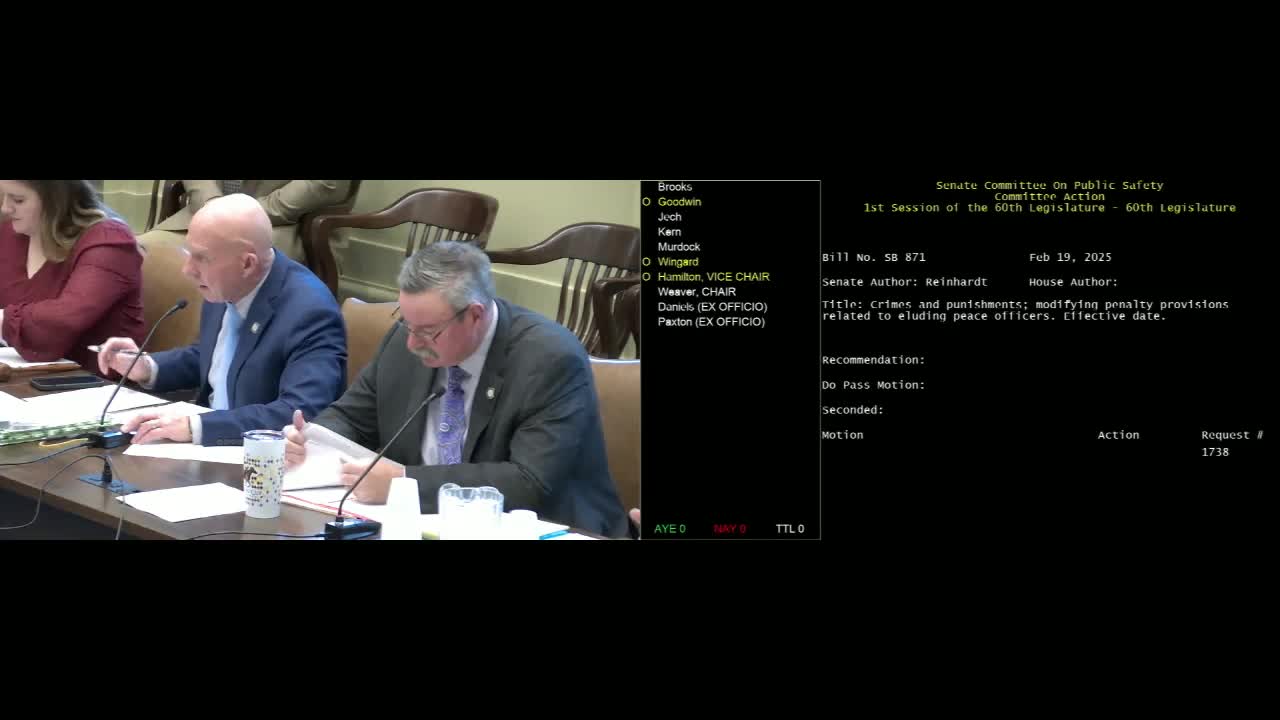
Committee advances bill to require 85% time‑served when eluding causes great bodily injury
Summary
Senate Bill 871 would add an 85% time-served mandate to eluding a police officer that causes great bodily injury; supporters said it responds to rising pursuits, while opponents warned it removes judicial discretion.
Senate Bill 871, a committee substitute introduced by Senator Reinhart, advanced out of the Oklahoma Senate Public Safety Committee after contested debate over sentencing policy and judicial discretion.
The lede: The measure would add an 85% time‑served requirement to the sentencing guidelines when a motorist eluding a police officer causes great bodily injury, moving that offense into the category that requires serving 85% of the imposed term.
Why it matters: Supporters told the committee the change answers a rise in police pursuits that have endangered officers and the public. Opponents said the mandatory threshold would reduce judicial discretion and questioned whether longer mandatory service deters crime.
What the bill would do: Senator Reinhart said the substitute amends existing statute to apply the 85% provision when eluding causes “great bodily injury,” a statutory definition that the author said covers injuries that create a substantial risk of death, permanent disfigurement or protracted loss or impairment of function.
What supporters said: "We worked with our law enforcement agencies, our county sheriffs, our district attorneys — pursuits are on the rise," Senator Reinhart said, adding the change is intended to "add some teeth" to sentencing guidelines to protect officers and civilians.
What opponents said: Senator Yek (recorded in debate) said, "Anytime we're going to add another 85% crime to the list of crimes, that's always something that's going to be of concern to me," and warned that the change could tie judges' hands and inhibit individualized sentencing. Senator Brooks questioned whether stacking existing sentences would already produce long terms and asked about prevention strategies, including more officers and training.
Committee action: The committee voted to advance the bill on a recorded roll call: 4 ayes, 2 nays.
Ending: The bill now moves to the full Senate for further consideration. Committee debate centered on competing goals: increasing penalties for severe harm in pursuits versus preserving judicial discretion and focusing on prevention strategies.