Get Full Government Meeting Transcripts, Videos, & Alerts Forever!
Get email alerts on the Committee Votes topic
No spam. Unsubscribe anytime.
Public Safety Committee advances a slate of bills; several contentious measures advance, one fails
Summary
The Oklahoma Senate Public Safety Committee voted on more than 20 bills; most advanced to the floor after committee votes, one notable pilot program failed and several measures drew extended debate over sentencing, firearms and immigration information sharing.
The Oklahoma Senate Public Safety Committee took final action on more than 20 bills at a meeting called to order amid weather delays, advancing the bulk of measures to the Senate floor while sending one high-profile pilot program to a committee defeat.
Why it matters: The committee moved bills with direct effects on criminal sentencing, firearm policy, reentry services, and state-federal information sharing — areas that carry policy and budget implications for public safety and corrections in Oklahoma.
Most consequential outcomes
- Senate Bill 444 (disposition of decedents' controlled substances): advanced, 6 ayes, 0 nays. The measure, presented by Senator Rader, allows family members, hospice and hospitals improved mechanisms to dispose of a decedent’s controlled substances.
- Senate Bill 39 (firearm licensing and medical marijuana): advanced, 6 ayes, 0 nays. Senator Daniels said the bill prevents medical marijuana registration alone from being the sole basis to deny firearm licensing; it preserves prohibition on firearm use while under the influence.
- Senate Bill 768 (first responder carry): advanced, 4 ayes, 1 nay. The bill defines “first responder” in statute and authorizes certain first responders to carry; committee discussion clarified the statutory definition includes firefighters and emergency medical personnel.
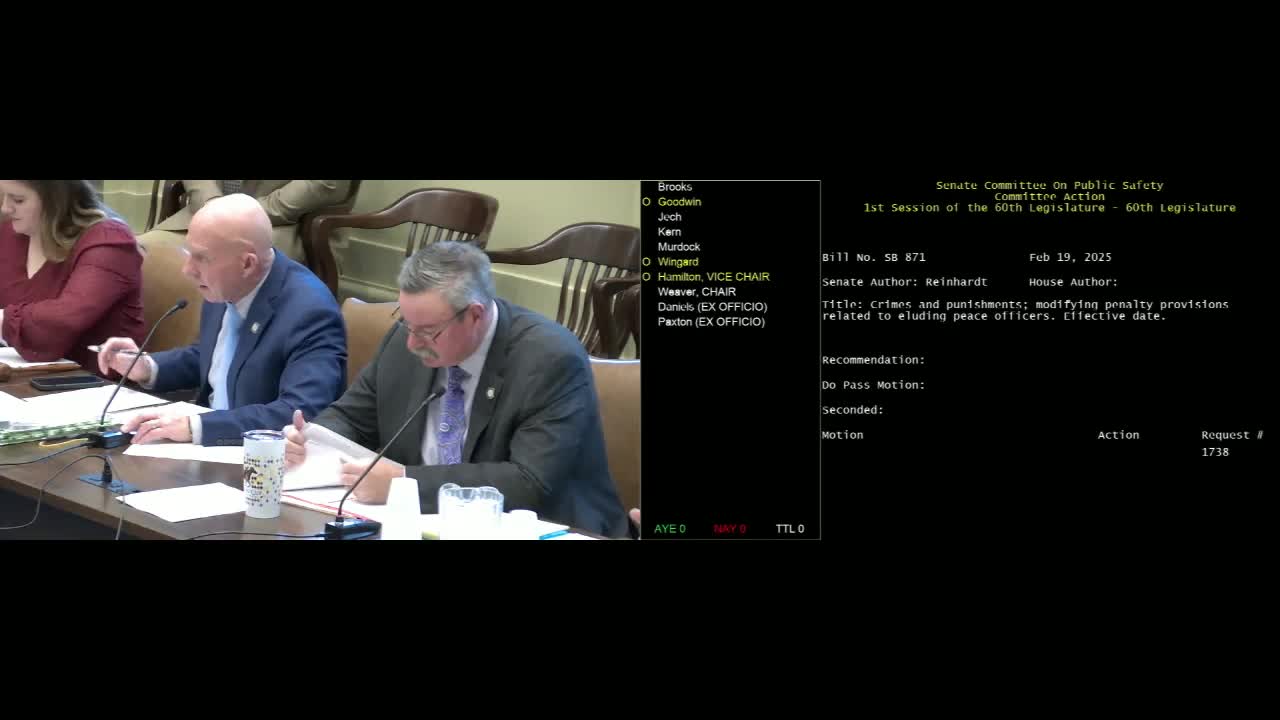
- Senate Bill 871 (eluding with great bodily injury — sentencing change): advanced, 4 ayes, 2 nays. The committee substitute would add an 85% time-served requirement when eluding a police officer causes great bodily injury. Supporters said it “adds teeth” to sentencing; opponents warned it reduces judicial discretion.
- Senate Bill 742 (appellate judges and carry rights): advanced, 6 ayes, 0 nays. The request bill clarifies carry allowances for various judges after approval by the chief justice.
- Senate Bill 216 (driver’s licenses for people released from prison): advanced, 6 ayes, 0 nays. The committee substitute extends and streamlines provisional and post-release license processes and directs Service Oklahoma and DOC to coordinate documentation and notices.
- Senate Bill 513 (places of worship during states of emergency): advanced, 5 ayes, 2 nays. The bill would prohibit government entities from forcing the closure of places of worship during a state of emergency; committee debate recalled COVID-era decisions and local choices.
- Senate Bill 124 (home-manufactured firearm suppressors / state preemption): advanced, 4 ayes, 3 nays. The bill would attempt to exempt certain in-state-manufactured firearm suppressors from federal regulation under a Tenth Amendment argument; committee discussion focused on federal supremacy and ATF enforcement.
- Senate Bill 636 (prohibiting taxpayer dollars for anti–Second Amendment advocacy): advanced, 5 ayes, 2 nays.
- Senate Bill 887 (Department of Corrections pre-release reintegration pilot): failed, 3 ayes, 4 nays. The measure, intended as a pilot to reintegrate select nonviolent inmates (including some Oklahoma citizens adjudicated in Texas) into community custody, drew extended questions about interstate compact authority, fiscal impacts and whether the proposal improperly favored one case.
- Senate Bill 628 (municipal buildings carry opt-in): advanced, 5 ayes, 2 nays. Local city councils could approve firearm carry for employees and elected officials inside municipal buildings.
- Senate Bill 945 (animal neglect and cruelty definitions/penalties): advanced, 5 ayes, 3 nays. The bill clarifies and adds penalties for knowingly depriving animals of necessary resources; debate centered on livestock exceptions and prosecutorial discretion.
- Senate Bill 84 (vehicle firearm storage on school property): advanced, 5 ayes, 2 nays. The committee adopted a technical amendment to clarify locked, out-of-view storage and to broaden coverage for constitutional carry holders.
- Senate Bill 500 (preventing corporate discrimination against firearm-related businesses in state contracting): advanced, 5 ayes, 2 nays.
- Senate Bill 865 (secure interagency platform for immigration/corrections data sharing): advanced, 5 ayes, 2 nays. The bill would establish an integrated platform to speed sharing of biometric and booking data between Oklahoma law enforcement/DOC and federal immigration authorities; committee debate questioned whether current phone- and fingerprint-based processes already provide sufficient access and raised constitutional concerns about asking federal agencies to “prioritize cooperation.”
- Senate Bill 634 (Impaired Driving Prevention Advisory Committee updates): advanced, 8 ayes, 0 nays.
- Senate Bill 544 (cleanup on Service Oklahoma and undercover IDs): advanced, 8 ayes, 0 nays.
- Senate Bill 462 (agency authorization to gift weapons to retiring officers): advanced, 7 ayes, 1 nay.
- Senate Bill 524 (concealed carry at polling places): advanced, 6 ayes, 2 nays.
- Senate Bill 861 (gang definition alignment): advanced, 6 ayes, 2 nays.
What failed
- Senate Bill 887, the DOC pre-release reintegration pilot, failed 3–4 after extensive debate about the pilot’s scope, interstate compact limitations with Texas, fiscal responsibilities, and whether it was effectively a single-case remedy packaged as broader policy.
Context and next steps
Most bills that passed the committee move to the full Senate calendar for consideration. Several measures that drew extended debate — notably the sentencing change in SB 871, the suppressor preemption language in SB 124, and the deportation-platform measure SB 865 — are likely to receive further scrutiny and potential floor amendments. The committee also adopted several technical amendments and committee substitutes during the meeting.
Votes at a glance is intended as a factual summary of the committee’s actions based on recorded motions, questions and roll calls recorded in the meeting transcript.