Get Full Government Meeting Transcripts, Videos, & Alerts Forever!
Get email alerts on the Ethics Investigation topic
No spam. Unsubscribe anytime.
Wausau ethics board finds complaint about mayor and absentee ballot drop box sufficient, votes to investigate
Summary
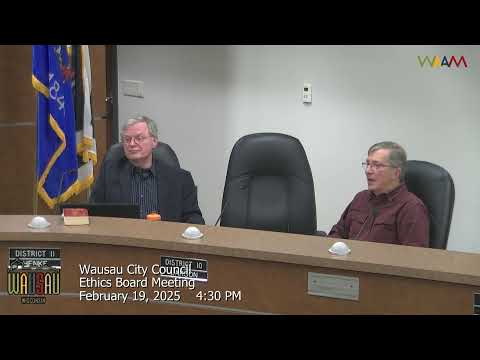
The Wausau City Ethics Board unanimously determined on Feb. 19 that a citizen complaint alleging the mayor prevented the city clerk from installing an absentee ballot drop box alleges facts sufficient to warrant an investigation.
The Wausau City Ethics Board unanimously determined on Feb. 19 that a citizen complaint alleging the mayor prevented the city clerk from installing an absentee ballot drop box alleges facts that, if true, are sufficient to violate the city's ethics code, and the board voted to authorize a formal investigation.
The ruling triggers a multi-part investigation order the board approved at the meeting in which the board asked for documentary and written statement evidence from the respondent (the mayor), the City Attorney and the City Clerk. The board set a seven-day deadline for the respondent to file a written response from the date the board's order is delivered and set a 14-day deadline for other documents and statements to be filed with the city clerk.
The ethics board's outside counsel, municipal attorney Eric Larson, guided the panel through the board's narrow role under the Wausau municipal code — that the initial step is to decide only whether the complaint, on its face, alleges facts sufficient to state a possible violation. "The board shall review a third party complaint at a duly called meeting and determine whether it alleges facts sufficient to constitute a violation of this chapter," Larson said while reading the ordinance language the board relied on.
Board members said the complaint asserts that during the week of Sept. 23, 2024, the mayor prevented the city clerk from installing an absentee ballot drop box, that the mayor had prior notice from the city attorney about legal limits on that action, and that the complaint alleges possible violations of federal and state laws prohibiting interference with voting. "We have a unanimous vote determining that the complaint is sufficient," Chair Calvin Dexter said after the board voted to find the complaint sufficient. The board's finding is limited to sufficiency; a later probable-cause determination or hearing would address disputed facts and final adjudication.
After the sufficiency vote the board considered next steps permitted under Wausau Municipal Ordinance 2.03.060 paragraphs c and d: referral to the district attorney, authorize an investigation, or proceed directly to order a hearing. The board voted unanimously to adopt a resolution authorizing an investigation prior to any decision to order a hearing.
As part of implementing that investigation the board approved specific documentary and statement requests. The orders (as revised and approved) include: requesting that the respondent file a written response admitting or denying each allegation and that any factual allegation not denied be deemed admitted; asking the respondent to submit that response within seven days after service of the board's order; requesting a copy of a letter the respondent's counsel provided to the common council (identified in the meeting as a Jan. 27, 2025, letter from attorney Joseph Bugney); and directing production of communications among the respondent, the City Attorney and the City Clerk from calendar year 2024 up to the present that discuss absentee ballot drop boxes.
The board also invited (but did not order) the City Clerk, the respondent and the City Attorney to provide statements identifying, to the extent of their personal knowledge: dates and circumstances of initial placement, removal and return of any absentee ballot drop box outside Wausau City Hall; locations and dates the box was kept if moved; whether the box was locked or contained ballots at particular times; and the basis for the declarant's knowledge of each material fact. The board removed language that would have required sworn statements for all declarants after outside counsel advised the board that inviting non-sworn statements at this stage is more appropriate given ongoing criminal inquiries.
Board members discussed logistics and service. Attorney Larson agreed to draft an order the chair could sign; the deputy clerk would handle delivery and mailing. The board discussed service by mail plus hand delivery and recorded that service is complete on mailing for related resolutions; the board directed documents and statements be filed with the city clerk by the 14-day deadline unless otherwise stated in the order.
Several board members expressed caution about coordination with the state attorney general's or other criminal investigations. Larson and multiple board members emphasized the ethics board's separate role: the board is deciding only whether the complaint alleges a possible ethics code violation and will proceed on its independent timetable and with its own investigatory steps.
The meeting also covered housekeeping matters: the board elected Calvin Dexter chair and Doug Hossler vice chair at the start of the meeting; board member Kaye Palmer recused herself from the complaint proceeding because of her public advocacy as a League of Women Voters member and Jesse Kearns, the alternate, stepped in to serve. The board tabled a separate packet of recommended ordinance changes until after the complaint process is complete.
The board did not hear evidence or witnesses at the Feb. 19 meeting; members said the investigation is intended to gather material to support a later probable-cause determination and, if necessary, a hearing. The board repeatedly affirmed that this stage is not a determination of guilt or wrongdoing but a threshold sufficiency and investigatory authorization under Wausau's ethics ordinance.
The board asked attorney Larson to prepare written orders incorporating the approved items and to return the drafted order for signature and service. The board then discussed scheduling a follow-up meeting for late March or April after requested materials are returned and after consulting attorney Larson's availability.
Ending note: the ethics board's actions on Feb. 19 move the complaint into a formal investigatory phase; the board's next public steps will depend on materials it receives and any further procedural votes (probable-cause determination, referral or hearing) the board takes at a later meeting.