Get Full Government Meeting Transcripts, Videos, & Alerts Forever!
Get email alerts on the K 12 Education topic
No spam. Unsubscribe anytime.
House Common Education Committee advances range of K-12 bills, approves teacher, safety and telehealth measures
Summary
At a meeting of the House Common Education Committee, members advanced multiple bills affecting teacher certification, school staffing and student services; several measures passed unanimously and others drew debate over parental consent, funding and data collection.
The House Common Education Committee met to consider a large set of bills affecting K-12 schools, advancing several measures to the next stage and debating others that drew sustained member questions on parental consent, funding and data quality.
Committee action covered teacher certification and testing rules, limits on certain non-year-long employment contracts, a bill named the Emerson Kate Cole Act requiring annual anaphylaxis/epipen training for school staff, a pilot telehealth mental-health program for rural schools, changes to how the state counts high-school cohorts and chronic absenteeism, and other administrative cleanups. Some bills passed unanimously; others drew close or split votes.
Why this matters: the package touches classroom staffing, student safety and how schools receive and use personal and performance data. Changes to certification or contract timing affect teacher recruitment and retention; telehealth and school-based mental-health options affect rural students’ access to services; and proposed changes to accountability metrics affect how schools are evaluated.
Most consequential votes and debate
- Teacher education coursework waiver (House Bill 2893). The committee accepted a working draft and voted to advance the bill to oversight by a voice-labeled vote announced as “11 aye, 0 nay.” The measure would remove an additional 12 semester-hour professional-education coursework requirement for educators who already hold an education degree but are on emergency/alternative certification or paraprofessional tracks. Sponsor comments emphasized reducing time and cost barriers during a teacher shortage. The formal vote was announced at the meeting and recorded as 11–0.
- Aligning open-enrollment insurance window (House Bill 1769). A proposed committee substitute (PCS) was adopted as the working draft; the committee approved the PCS and the clerk announced the vote as 11 ayes, 0 nay. The PCS aligns school-district open-enrollment with private-sector insurance enrollment timing between Nov. 1 and Dec. 15.
- Allowing superintendents to hire adjunct teachers for all grades (House Bill 2125). Members adopted an amendment and a PCS; discussion included concerns about guardrails for adjuncts and professional training. The recorded vote was announced as 8 aye, 3 nay. Members who raised concerns asked about training requirements and protections for early-childhood investments in phonics and literacy.
- One-year contract notice for teachers (House Bill 1946). The bill that would prohibit districts from entering certain non-yearlong permanent contracts for teachers failed in committee. The chair announced the tally as 5 yays, 6 nays; the motion failed and the measure remained with the committee.
- Affidavit in lieu of board minutes (House Bill 1958). A PCS was accepted that would allow school districts to send a one-page affidavit to the department of education instead of full minutes. The vote was announced as 10 ayes, 1 nay; the bill will move to oversight committee.
- Emerson Kate Cole Act — staff training on anaphylaxis (House Bill 2047). The committee approved a measure requiring annual training for teachers to recognize anaphylactic reactions and use an epinephrine autoinjector; the vote was announced as 11 aye, 0 nay and the bill will advance to oversight.
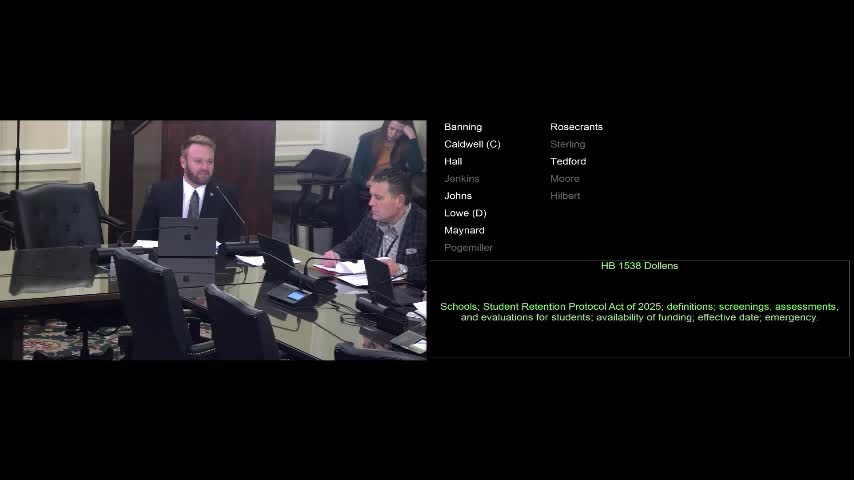
- Preventing retention without intervention (House Bill 1538). Committee members debated requiring a set of assessments (vision, hearing, occupational therapy, psychiatric evaluation and a family assessment) before retaining a student. Members raised questions about funding (unfunded mandate), parental consent, data privacy (HIPAA/FERPA) and how remediation would be implemented. The PCS changed some language from mandatory to permissive in places; parental consent language was discussed as required for some evaluations, while routine vision/hearing screening was described as already statutorily mandated. A documented final floor vote in committee is not recorded in the transcript excerpt; the item remains in committee discussion and will proceed with oversight-level review per the sponsor.
- Pilot school telehealth program (House Bill 1553/15 53 PCS). The PCS establishes an optional pilot telehealth mental-health program for schools that choose to apply, prioritizing rural districts with limited access to in-person providers. The program requires availability of funds and a private match; parent consent is required before services are provided to a child. Committee discussion focused on privacy and HIPAA/FERPA protections, limits of telehealth for crisis situations, whether AI would be permitted (sponsor agreed to consider language prohibiting AI-driven telehealth), and cultural-competency language for providers. The committee recorded a voice tally (transcribed as a multi-digit announcement that was not fully legible in the excerpt); the sponsor indicated willingness to refine privacy and AI language before oversight.
- OEQA / national board and other cleanups (House Bill 1955 and others). Committee members adopted PCS/cleanup language for a request from OEQA regarding national board certification (vote announced 11 ayes, 0 nay), and several technical bills and policy updates were approved unanimously or with clear majorities, including an open-records clarification requiring districts to provide parents records about their child without excessive fees (vote announced 12 ayes, 0 nay).
- Changes to cohort and accountability measures, climate survey pilot (House Bill 1412 / related). A bill proposing removal of transfers and chronic absenteeism from the adjusted four-year cohort calculation and adding a school-level climate survey as an accountability component passed committee by recorded voice vote announced as 7 aye, 3 nay. Committee members repeatedly said the climate-survey language is a work in progress and noted any change to federal reporting must be coordinated with federal requirements; sponsor and OEQA will continue to refine metrics and methodology during oversight.
Other procedural notes
- Several bills that passed were sent to the oversight committee for further review. Where the transcript recorded vote tallies, those totals are cited above. When the transcript did not record a final numerical tally for a given item, the article notes discussion points and the sponsor’s stated next steps rather than asserting a final outcome.
What to watch next
Bills moving to oversight that drew the most follow-up questions include the student-assessment/retention proposal (funding, parental consent, HIPAA/FERPA), the telehealth pilot (privacy, crisis protocols, and explicit AI restrictions), and the cohort/accountability changes tied to climate surveys (measurement design and federal compatibility). Committee sponsors signaled willingness to refine statutory language before oversight consideration.
Votes at a glance (selected items; tally is the announcement recorded in committee)
- HB 2893 — waive extra coursework for those with education degree: 11 aye, 0 nay — advances to oversight. - HB 1769 (PCS) — align enrollment window with insurance: 11 ayes, 0 nay — advances to oversight. - HB 2125 (PCS + amendment) — allow adjunct hiring across grades (superintendent authority in certain cases): 8 aye, 3 nay — advances to oversight. - HB 1946 — prohibit certain non-yearlong teacher contracts: 5 yays, 6 nays — motion failed; stays with committee. - HB 1958 (PCS) — allow affidavit in lieu of minutes to Dept. of Education: 10 ayes, 1 nay — advances to oversight. - HB 2047 Emerson Kate Cole Act — annual anaphylaxis/epipen training: 11 aye, 0 nay — advances to oversight. - HB 1538 — require assessments before student retention: discussion recorded; final committee vote not specified in transcript excerpt; sponsor indicated PCS changes and further review in oversight. - HB 1553 / 15 53 (PCS) — optional school telehealth pilot (parent consent required; private match; subject to funds): recorded voice tally in transcript excerpt not fully legible; sponsor to refine privacy/AI language before oversight. - HB 2696 (open-records/parent access to child records) — 12 ayes, 0 nay — advances to oversight. - HB 1394 (testing requirement change for university-trained teachers) — voice-voted; transcript recorded an announced tally (text excerpted as “Aye, 2 nay”) and the sponsor reported the bill will advance to oversight; committee minutes will record final numeric detail. - HB 1523 / 15 23 (cohort/absenteeism/climate-survey changes) — 7 aye, 3 nay — advances to oversight. - HB 1484 (fentanyl awareness / Raines Law) — 9 aye, 0 nay — advances to oversight. - HB 1304 / 13 04 (computer science requirement for graduates) — 8 ayes, 0 nay — reported out as do pass.
This summary is based on the committee’s publicly recorded remarks and roll-call announcements as provided in the meeting transcript. Where the transcript announced a numeric tally, that announcement is reported verbatim. Where the transcript did not include a final numeric tally for a bill, the article reports discussion points and the sponsor’s stated next steps rather than asserting a vote outcome.
Ending note: Sponsors and committee leadership signaled they will continue to refine statutory language on parental consent, privacy, funding and metric design as these measures move to oversight review.