Get Full Government Meeting Transcripts, Videos, & Alerts Forever!
Get email alerts on the Consent Decree Competency Restoration topic
No spam. Unsubscribe anytime.
House adopts resolution approving consent decree on competency restoration
Summary
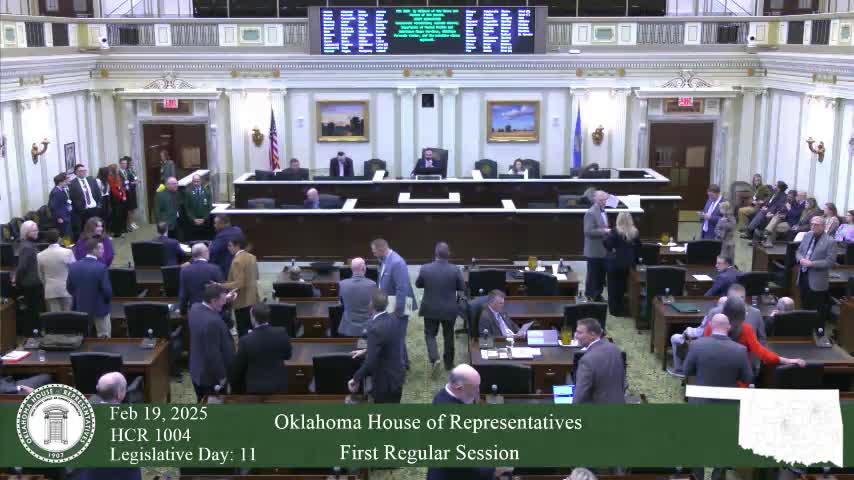
The Oklahoma House on Feb. 17 adopted House Concurrent Resolution 1004, approving a consent decree related to competency restoration for defendants found incompetent to stand trial. The measure passed 91-0; lawmakers asked questions about local options and cost but received no detailed price estimate on the floor.
The Oklahoma House of Representatives on Feb. 17 adopted House Concurrent Resolution 1004, a resolution approving a consent decree between the Department of Mental Health and Substance Abuse Services, the attorney general's office, the governor's office and the plaintiffs in a federal lawsuit, the chamber's clerk said. The measure passed by roll call, 91-0.
The resolution, introduced in the House by Representative Hilbert and in the Senate by Senator Paxton, was presented on the floor by Representative Sensen. Representative Sensen told members the consent decree is the product of negotiations among the parties and that members had several opportunities to review the agreement before the vote.
Why it matters: The consent decree addresses how the state will provide competency restoration services for defendants found incompetent to stand trial—services that determine whether defendants can proceed through the criminal-justice process. Supporters said approving the decree avoids further litigation that could otherwise impose large judgments and delays on the state.
On the floor, Representative Fugate praised those involved in negotiating the agreement, saying, "I applaud all of those who've been involved in this process. I think it's gonna be a much better outcome than if we wound up in the courts having to fight this thing out in a class action." Fugate asked whether the decree preserves local options for restoration services for people who are incompetent and waiting trial.
Representative Sensen responded that the settlement "does allow for an in-jail based competency restoration program," and said that implementation details would be left to the Department of Mental Health and Substance Abuse Services. When asked about earlier cost estimates—cited during prior discussions as around $100 million—and how the current agreement reduced that figure, Sensen said he did not have specifics on what changed. He said the current decree resulted from negotiations and a subsequent settlement agreement among the parties.
Sensen further said counsel for the department warned legislators that rejecting the resolution would likely return the matter to litigation. He referenced the state of Washington as an example in which prolonged litigation led to substantial court judgments and long implementation timelines, saying lawmakers were seeking to avoid repeating that outcome.
The clerk identified the measure as "House Concurrent Resolution 1004 by Hilbert of the house and Paxton of the senate, a resolution relating to consent decree." After roll call, the clerk announced "91 aye, 0 nay," and the presiding officer declared the resolution adopted. The resolution directs that a notice of the speaker's action be printed in the journal and places responsibility for implementation with the agencies named in the decree.
No cost breakdown or implementation timetable was provided on the floor during the Feb. 17 session; representatives on the floor directed remaining implementation details and policy development to the Department of Mental Health and Substance Abuse Services.