Get Full Government Meeting Transcripts, Videos, & Alerts Forever!
Get email alerts on the Education Committee Concepts topic
No spam. Unsubscribe anytime.
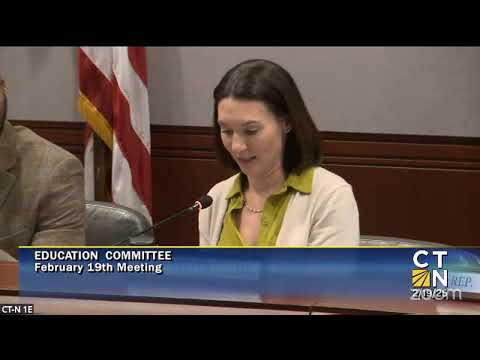
Education committee raises six legislative concepts, agrees to public hearings; mixed responses on ‘free tuition’ idea
Summary
The Connecticut General Assembly Education Committee on Feb. 6 voted to raise six high-level legislative concepts for public hearing, including proposals to reengage disconnected youth, protect students’ 504 accommodations, publish multilingual-learner data on EdSight, explore tuition support for aspiring teachers, review state school-district takeovers, and study project-based learning tied to cultural resources.
The Connecticut General Assembly Education Committee on Feb. 6 voted to raise six high-level legislative concepts for public hearing, including proposals to reengage disconnected youth, protect students’ 504 accommodations, publish multilingual-learner data on EdSight, explore tuition support for aspiring teachers, review state school-district takeovers, and study project-based learning tied to cultural resources.
Senator McCrory, who introduced several of the concepts, told the committee that “these are just high level concepts open for, continued discussion about things that I think are, deeply impacting our children and students in schools in the state.” He said the state estimates “we have a 19,000 students across the state who are disconnected from school or employment,” and framed the first concept as an opportunity to pursue reengagement and prevention strategies.
The committee approved the concepts largely by voice vote. Several items (including the concept on tuition support for aspiring educators and the school-district takeover concept) were decided by roll call; the clerk recorded individual member responses in the hearing transcript.
Why it matters: The committee’s actions open formal public hearings and staff work on several items that, if advanced, could change reporting requirements, state supports for schools, and workforce pipelines for educators. The proposals range from data transparency (multilingual learners) to potential statutory or administrative reforms (school-district takeovers) and programmatic studies (project-based learning tied to cultural resources).
Key details from each concept
Disconnected youth: The committee agreed to raise “an act concerning disconnected youth” to allow public review of proposals intended to reengage students not currently in school or employment. McCrory cited the statewide estimate of 19,000 disconnected students and said municipalities, state agencies and communities have worked on reengagement approaches.
504 accommodations: Members raised an act “protecting 504 plans and accommodations for certain students” after committee staff noted that a federal court case has raised questions about the status of some 504 accommodations. The committee approved sending the concept to public hearing to consider statutory or clarifying language to preserve access to those accommodations in Connecticut schools.
Multilingual learners transparency: Senators McCrory and Kushner moved a concept asking the state Department of Education to publish additional multilingual-learner data on EdSight, the department’s data portal. McCrory said the Department already collects much of this information but does not publish it in the requested format; the concept would require certain reports to be posted so policymakers can better see performance and program participation.
Tuition support for aspiring educators: The committee debated a concept to explore free or subsidized tuition for aspiring educators and educator-preparation programs at Connecticut State Colleges and Universities, generally tied to a service commitment (for example, several years of teaching in-state). Several members said the word “free” was problematic and asked for clearer definitions of cost, repayment or service obligations. Representative Cepkus asked which pathways the proposal would cover; commenters noted some alternative-pathway programs already exist but that traditional-route support is limited. The committee approved raising the concept for a public hearing; a roll call on this item is recorded in the transcript.
School-district takeovers: Lawmakers moved to raise an act concerning school-district takeovers to examine supports, staffing and measurable outcomes when the State Board of Education intervenes. Sponsors said past takeovers have not always produced lasting improvements and that the concept would look at parameters, qualified personnel and a clearer plan of action and accountability if the state intervenes. This concept passed and was placed for public hearing by roll call.
Project-based learning and cultural resources study: The committee agreed to study how Connecticut’s cultural institutions and resources could support project-based and experiential learning (field trips, local partnerships, curricular materials). Sponsors described the item as a study to identify ways to facilitate those learning opportunities statewide; the committee approved the study by voice vote.
Votes at a glance
- Raise an act concerning disconnected youth — Motion moved by Representative Brown, seconded by Representative Arzano; outcome: raised for public hearing (voice vote). - Raise an act protecting 504 plans and accommodations — Moved by Representative Brown, seconded by Representative Comey; outcome: raised for public hearing (voice vote); committee discussion referenced a federal court case affecting 504 accommodations. - Raise an act concerning transparency of multilingual learners — Moved by Senator McCrory, seconded by Senator Kushner; outcome: raised for public hearing (voice vote). - Raise an act concerning tuition support for aspiring educators and educator-preparation programs at Connecticut State Colleges and Universities — Moved by Senator McCrory, seconded by Representative Sanchez; outcome: raised for public hearing (roll call; individual member votes recorded in the hearing transcript; several members said they would vote no on the concept as written because of the term “free” and unclear funding/repayment obligations). - Raise an act concerning school-district takeovers — Moved by Representative Gucker, seconded by Representative Brown; outcome: raised for public hearing (roll call; members expressed support for “teeth” and clearer accountability for any takeover). - Study concerning project-based learning and Connecticut’s cultural resources — Moved by Representative Menapace, seconded by Senator McCrory; outcome: raised for study (voice vote).
What’s next: Each concept as raised will be eligible for formal public hearings and staff analysis. Committee members asked for follow-up details on funding sources, service obligations (for tuition-support concepts), and precise data fields to be published for multilingual learners. Sponsors and ranking members signaled willingness to refine language before drafting bill text.
Speakers quoted in this article are drawn from the committee hearing transcript and identified by role in the transcript: Senator McCrory (sponsor), Representative Brown (mover on several motions), Representative Arzano (seconder), Representative Comey (seconder), Representative Gucker (mover on takeovers), Representative Menapace (mover on project-based learning study), and several other committee members who registered votes or offered comments during discussion.