Get Full Government Meeting Transcripts, Videos, & Alerts Forever!
Get email alerts on the Deputy Registrar Fee Sharing topic
No spam. Unsubscribe anytime.
Committee considers fee‑sharing and reimbursements to support deputy registrars
Summary
Lawmakers and deputy registrar owners argued Feb. 19 that online transactions have stripped revenue from local deputy registrar offices; committee considered bills (SF 1164, SF 1165) to share filing fees and reimburse no‑fee transactions. DVS said some online work is done entirely by state employees and warned about revenue impacts.
ST. PAUL, Minn. — Owners and managers of deputy registrar offices told the Senate Transportation Committee on Feb. 19 that an increasing share of routine vehicle and driver transactions done online has eroded the revenue base that supports local offices, and they supported two bills to redirect some fees back to those offices.
Senate File 1164, amended with an A.1 author's amendment that the committee approved, would create a deputy registrar fee‑sharing account and a driver's license agent fee‑sharing account. For some mail‑ or online‑completed vehicle transactions, the bill would deposit half of the statutory filing fee into the fee‑sharing account and split the remainder between Driver and Vehicle Services operating and technology accounts; a new $5 surcharge on mail renewals would be split between DVS and the fee‑sharing account. The amendment sets an effective date of Oct. 1, 2025.
Senate File 1165 would reimburse deputy registrars for certain transactions that currently carry no fee, using a quarterly distribution based on the number and types of transactions. The bill specifies reimbursement calculations for renewals and "other" vehicle transactions (examples: $9 for renewals and $13 for other transactions under the bill's language) and would appropriate funds from the DVS operating account for those disbursements.
Why it matters: many deputy registrar offices — public and private — rely on small filing fees to cover rent, staffing and scanning/processing costs. Testimony from owners and managers said the shift of simple renewals and other routine work to state online services has left local offices to handle more time‑consuming transactions without commensurate compensation.
Owners and managers speak
Mike Hintz, who owns three deputy registrar offices, said the business model has changed: where staff once collected paper and mailed it to the state, clerks now enter data, scan records and manage more complex transactions. "A renewal used to be quick; now a title transfer can take 15 minutes and we do the data entry the state used to do," Hintz said. He told the committee many offices are "on the brink of closure" without fee sharing.
Amanda Coppin, manager at the South St. Paul deputy registrar office, told senators the trend is widespread and urged action so offices can keep providing in‑person service for customers who cannot or prefer not to use online options.
Agency concerns and fiscal questions
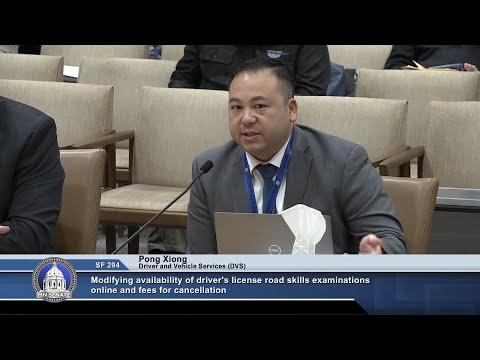
Peng Zhang, director of the Driver and Vehicle Services Division, said DVS recognizes the role of deputy registrars but cautioned that the online and mail transactions that would generate fee‑sharing revenue are completed in the state's systems by state employees. "This bill, though, would compensate them for work that's done entirely by state employees," Zhang said, and added that a surcharge on mail renewals could create customer confusion.
The committee adopted the A.1 author's amendment to SF 1164 by voice vote; Senator Grant Jasinski offered the amendment. Members also discussed a fiscal note and the governor's related budget proposals, which include other approaches to supporting deputy registrars. Testimony cited a recent independent review (the King report and a Barry Dunn financial sustainability assessment) recommending fee sharing and reimbursements.
Committee action and next steps
The committee laid Senate File 1164 as amended on the table and then considered Senate File 1165; both bills were laid on the table for further work and fiscal analysis. Advocates asked the committee to ensure reimbursements and fee sharing adequately cover staff time and fixed costs, and the agency asked to see fiscal detail showing impacts to its operating and technology accounts.
Ending
Supporters said they will continue to pursue legislation to stabilize deputy registrar offices across the state; the committee asked DVS and fiscal staff for cost estimates and the expected impact to agency accounts before advancing either bill.