Get Full Government Meeting Transcripts, Videos, & Alerts Forever!
Get email alerts on the Driver Test Appointments topic
No spam. Unsubscribe anytime.
Committee hears bills to expand driver-test scheduling and raise no‑show fees
Summary
ST. PAUL, Minn. — The Minnesota Senate Transportation Committee on Wednesday considered two bills aimed at easing the backlog for on‑road driving tests by changing how appointments are released and increasing penalties for missed appointments.
ST. PAUL, Minn. — The Minnesota Senate Transportation Committee on Wednesday considered two bills aimed at easing the backlog for on‑road driving tests by changing how appointments are released and increasing penalties for missed appointments.
Senate File 294, carried by Senator Grant Jasinski, would require the commissioner to make a portion of projected road‑test appointments available farther in advance: at least 50% available three months out, 75% two months out and 100% one month out. The bill also would restructure the fee for failing to appear: a $50 fee for cancellations or no‑shows within 24 hours and a $20 fee for cancellations between 24 and 72 hours. The bill would keep the current $20 fee for a third‑time retake of a failed road test.
The measures aim to let Minnesotans — particularly teenage applicants — plan ahead and reduce the scramble to find appointments. "We've got some funding for it, but it continues to be an issue," said Senator Grant Jasinski, who told the committee many families log on or travel long distances to secure road‑test slots.
Why it matters: long waits for Class D road tests have pushed some applicants to travel to other counties to find openings, fueling complaints from residents and requests to the Legislature. Committee testimony stressed that timely access to tests is a frequent constituent complaint and that improving scheduling would help families and reduce unsafe queuing at exam sites.
Division concerns and data
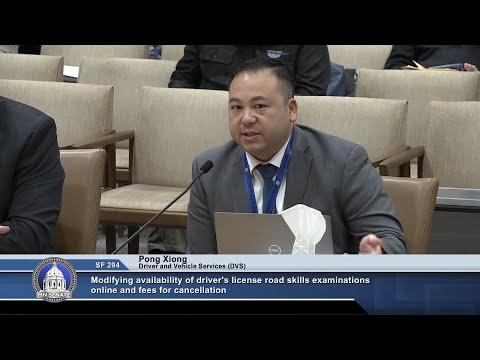
Peng Zhang, director of the Driver and Vehicle Services Division (DVS), told the panel the agency understands the bill's intent but warned that releasing appointments farther out could increase cancellations and hold slots unused. "We pulled up last year's—last calendar year's cancellations, and 48% of all cancellations and no shows are within the last 24 hours," Zhang said, adding that longer lead times encourage customers to book earlier but also to cancel closer to the appointment date.
Zhang said DVS saw improved attendance after instituting a smaller no‑show fee and that the division is implementing more robust reminder and confirmation functionality. "We have a robust reminder system, and we are actually looking at more creative ways to be even more robust in our notifications and reminders," Zhang said.
Union and staffing perspective
Pat Benner, a legislative representative for AFSCME Council 5, supported raising the fee but urged flexibility. "We're not necessarily wed to $50 being the final number," Benner said, adding that any change should be evaluated and could include a sunset or report to test effectiveness.
Zhang told senators that DVS has hired 30 new examiner positions this fiscal year and expects all 30 to be trained and operating by spring. The director also said the agency had expanded weekend testing in the metro area and has converted an office in Plymouth to focus on Class D tests; at the time of the hearing, Zhang said there were about 7,000 appointments available across the system.
Local‑priority proposal and technical risk
Senate File 1181, also introduced by Jasinski, would stagger booking windows to give local residents longer lead time (60 or 90 days) to reserve slots at nearby exam stations while opening remaining slots to nonlocal residents as time shortens. DVS cautioned that implementing a geography‑based priority would require customization of the MnDRIVE system and additional GIS functionality, which the agency said would be a technical and contractual lift with FAST (the vendor) and carries operational risk.
Committee action and next steps
Committee members agreed to hold the bills for further work and fiscal analysis. Several senators urged DVS to explore improvements to reminder and cancellation workflows that would allow automatic cancellations via simple confirmations. The committee laid both bills on the table for further consideration pending fiscal notes and implementation details.
Votes at the hearing: the committee adopted no roll‑call votes on these bills; both Senate File 294 and Senate File 1181 were laid on the table at the hearing for later action.
Ending
Committee members said they expect additional data from DVS and a fiscal note on system changes before deciding whether to advance the bills. Supporters said they will continue to refine proposals to balance appointment access with realistic customer behavior and system capacity.